periodical issue
The Indian Libertarian
An Independent Journal of Economic and Public Affairs
By MA Venkata Rao, M. N. Tholal
The Indian Libertarian, Arya Bhuvan, Sandhurst Road, Bombay 4 · Bombay · 1962
24 pages
The Indian Libertarian
Summary
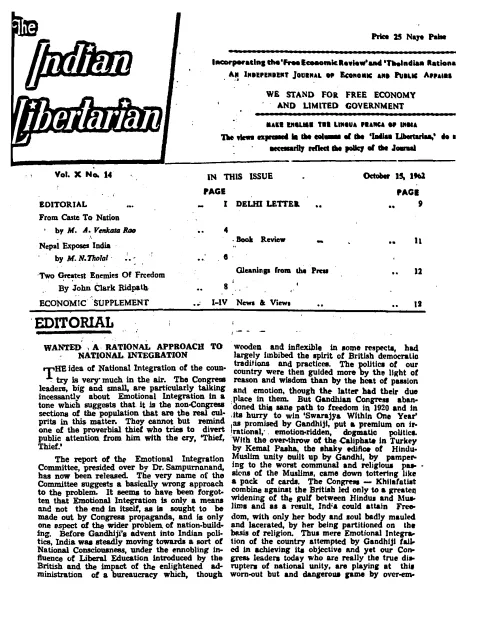
This October 15, 1962 issue of The Indian Libertarian (Vol. X No. 14), the Bombay fortnightly edited by D. M. Kulkarni, leads with an editorial on national integration and carries signed essays on caste and nationhood, Indo-Nepal relations, and the perils of over-organisation. In the rendered pages the editorial ‘Wanted: A Rational Approach to National Integration’ critiques the Emotional Integration Committee report chaired by Dr. Sampurnanand and argues that integration is a means, not an end; M. A. Venkata Rao’s ‘From Caste To Nation’ takes recent events around caste-based reservation in colleges as occasion to revisit nation-making; M. N. Tholal’s ‘Nepal Exposes India’ reads the reshuffle of Nepal’s cabinet and King Mahendra’s moves as embarrassing for Indian foreign policy; and a reprinted piece by the nineteenth-century American author John Clark Ridpath, ‘Two Greatest Enemies Of Freedom,’ attacks over-organisation. The issue’s classical-liberal, limited-government stance frames each topic against the dangers of statism and centralised control.
Key points
-
This 15 October 1962 issue, Vol. X No. 14, edited by D. M. Kulkarni, leads with the editorial Wanted: A Rational Approach to National Integration, critiquing the Emotional Integration Committee report chaired by Dr. Sampurnanand.
-
The editorial argues emotional integration is only a means and not an end, tracing India’s National Consciousness to Liberal Education and enlightened British administration before its later degeneration into dogmatic politics.
-
M. A. Venkata Rao’s From Caste To Nation engages caste-based reservation in medical and engineering colleges, citing quotas for scheduled castes, scheduled tribes and backward classes as an obstacle to nation-building.
-
M. N. Tholal’s Nepal Exposes India reads King Mahendra’s cabinet reshuffle, restoring the foreign portfolio to Dr. Tulsi Giri and dropping Rishikesh Shah, as exposing the weakness of Indian policy toward Nepal.
-
Tholal cites a communique claiming that India’s attitude to Nepal had not changed even after Shah’s Delhi talks, despite charges that anti-national elements have been receiving all sorts of aid.
-
A reprinted essay by nineteenth-century American author John Clark Ridpath, Two Greatest Enemies Of Freedom, names over-organisation as a force that has extinguished the life and soul within social and political institutions.
Essays
Editorial
The editorial ‘Wanted: A Rational Approach to National Integration’ observes that National Integration is much in the air, with Congress leaders incessantly talking about Emotional Integration in a tone suggesting the non-Congress sections of the population are the real culprits. In the rendered pages it notes the release of the report of the Emotional Integration Committee presided over by Dr. Sampurnanand, argues the Committee’s name reflects a basically wrong approach because emotional integration is only a means and not an end, and recalls how Gandhiji’s advent into Indian politics gave the country a sort of National Consciousness rooted in Liberal Education and enlightened British administration before later degenerating into emotion-ridden, dogmatic politics.
- Notes Congress leaders’ incessant talk of Emotional Integration, casting non-Congress sections as culprits.
- Marks the release of the Emotional Integration Committee report under Dr. Sampurnanand.
- Argues the Committee’s very name shows a basically wrong approach.
- Holds that emotional integration is only a means, not an end, and one aspect of nation-building.
- Traces National Consciousness to Liberal Education and British administration, later degenerating into dogmatic politics.
From Caste To Nation
By MA Venkata Rao
M. A. Venkata Rao’s ‘From Caste To Nation’ returns to the problem of nation-making, prompted by recent events. In the rendered pages it engages caste-based reservation in medical and engineering colleges — citing percentages set aside for scheduled castes, scheduled tribes, and backward classes — and treats the persistence of caste as a central obstacle to forging a nation.
- Revisits the problem of nation-making in light of recent events.
- Discusses reservation of seats in medical and engineering colleges.
- Cites quotas for scheduled castes, scheduled tribes, and backward classes.
- Treats caste as a central obstacle to building a nation.
Nepal Exposes India
By M. N. Tholal
M. N. Tholal’s ‘Nepal Exposes India’ reads the restoration of Nepal’s foreign portfolio to Dr. Tulsi Giri, Vice-Chairman of the Cabinet, and the dropping of Foreign Minister Rishikesh Shah in King Mahendra’s recent reshuffle as disturbing for India. In the rendered pages Tholal notes a communique stating India’s attitude to Nepal had not changed even after Shah’s Delhi talks and that ‘anti-national elements have been receiving all sorts of aid,’ arguing the episode exposes the weakness of Indian policy toward Nepal.
- Reads King Mahendra’s cabinet reshuffle as disturbing for India.
- Notes the foreign portfolio restored to Dr. Tulsi Giri, Vice-Chairman of the Cabinet.
- Notes Foreign Minister Rishikesh Shah dropped from the Cabinet.
- Cites a communique that India’s attitude to Nepal had not changed after Shah’s Delhi talks.
- Quotes the charge that ‘anti-national elements have been receiving all sorts of aid’.
Two Greatest Enemies Of Freedom
By John Clark Ridpath
A reprinted essay by the nineteenth-century American author John Clark Ridpath, titled in the table of contents ‘Two Greatest Enemies Of Freedom’ (and headed on the page as ‘Two Greater Enemies Of Freedom’), argues that one of the greatest enemies of freedom — and therefore of human progress and happiness — is over-organisation. In the rendered page Ridpath contends that the social, political, and ecclesiastical forms instituted to serve mankind have become so hard, cold, and obdurate that the life, emotion, and soul within have been all but extinguished, and that such institutions become natural enemies of their own peace.
- Names over-organisation as one of the greatest enemies of freedom.
- Argues mankind has been ‘organised to death’.
- Holds that social, political, and ecclesiastical forms have grown hard, cold, and obdurate.
- Claims these institutions extinguish the life, emotion, and soul within.
- Treats such institutions as natural enemies and destroyers of their own peace.
Generated by the v1.5 extraction pipeline. Awaiting editorial review.
Metadata and summary are AI-extracted from the source PDF and reviewed for editorial accuracy. The original work is available via the Read PDF tab above (where present); paragraph-level citation inside the PDF is deferred to a future engagement.