periodical issue
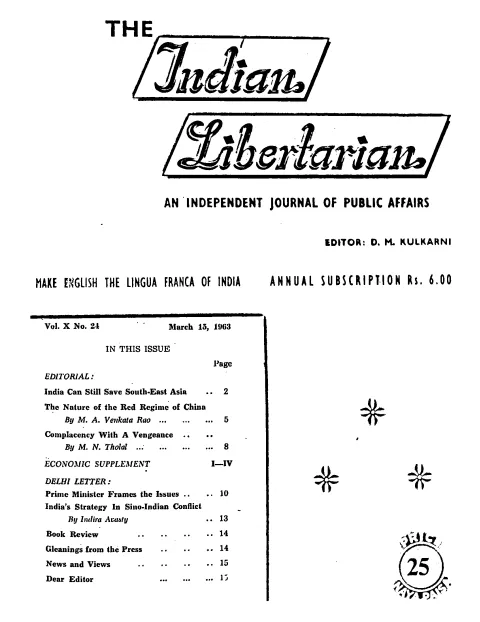
The Indian Libertarian
An Independent Journal of Public Affairs
By MA Venkata Rao, M. N. Tholal
The Indian Libertarian, Arya Bhuvan, Sandhurst Road, Bombay 4 · Bombay · 1963
24 pages
The Indian Libertarian
Summary
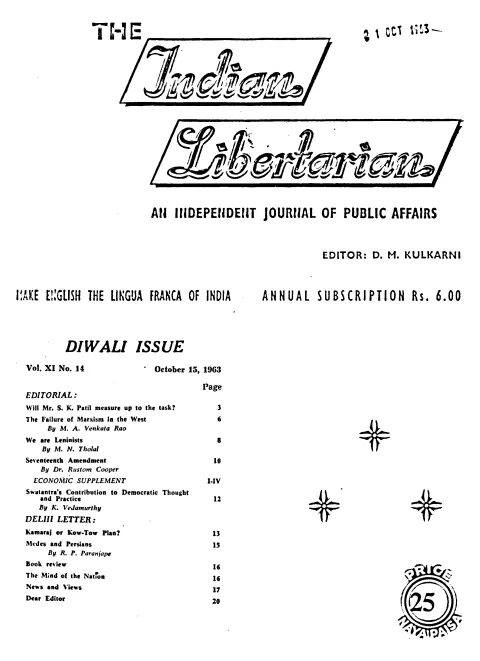
This Diwali Issue of The Indian Libertarian (Vol. XI No. 14, October 15, 1963), the Bombay fortnightly edited by D. M. Kulkarni and now styled ‘An Independent Journal of Public Affairs,’ opens with an editorial on Congress leadership and follows with signed essays attacking Marxism and Leninism, analysing a constitutional amendment, and defending the Swatantra Party. In the rendered pages the editorial asks whether Mr. S. K. Patil will measure up to his task and reflects on the leader’s position between party and people; M. A. Venkata Rao argues in ‘The Failure of Marxism in the West’ that the Marxian prophecy of proletarian revolution has been falsified in America and Western Europe since 1945; M. N. Tholal in ‘We are Leninists’ reads India’s non-alignment as objectively serving Russia’s Leninist foreign policy; Dr. Rustom C. Cooper examines the Seventeenth Amendment’s effect on the Indian farmer and citizen through compensation and land-acquisition law; and K. Vedamurthy assesses ‘Swatantra’s Contribution to Democratic Thought and Practice.’ The issue’s classical-liberal, anti-communist stance frames each topic against the threat of socialist and statist orthodoxy.
Key points
-
The editorial Will Mr. S. K. Patil measure up to the task? weighs Patil’s standing within the Congress Cabinet and party amid corruption and factional pressures on leadership.
-
M. A. Venkata Rao’s The Failure of Marxism in the West argues Marx’s prophecy of proletarian revolution has been falsified in America and Western Europe since 1945.
-
Venkata Rao observes that the American worker enjoys the benefits of socialism without socialisation, and pleads for a thorough, country-wide examination of Marxism in India.
-
M. N. Tholal’s We are Leninists takes Lenin’s line that the way to London lies through Peking and Calcutta to argue Russia’s foreign policy depends on India’s non-alignment.
-
Tholal claims the end of Indian non-alignment would simultaneously end China’s expansionist dream and hand Russia its greatest political defeat in Asia.
-
Dr. Rustom C. Cooper’s essay on the Seventeenth Amendment Bill, introduced 6 May 1963, notes compensation under the Kerala Act can run as low as one per cent of the Land Acquisition Act value.
-
Cooper frames the amendment, which extends Article 31A’s definition of estate to ryotwari land, as eroding the property protections of the farmer and citizen.
-
K. Vedamurthy’s Swatantra’s Contribution to Democratic Thought and Practice situates the party’s classical-liberal position against the prevailing planned-economy consensus of the period.
Essays
Editorial: Will Mr. S. K. Patil measure up to the task?
The editorial ‘Will Mr. S. K. Patil measure up to the task?’ considers the standing of S. K. Patil within the Congress Cabinet and party and weighs whether he can meet the demands of his office. In the rendered pages it broadens into a reflection on the leader’s position between the party and the people, the corruption and factional pressures within the Congress, and the qualities required of national leadership.
- Asks whether Mr. S. K. Patil will measure up to the task before him.
- Situates Patil within the Congress Cabinet and party leadership.
- Reflects on the leader’s position between the party and the people.
- Touches on corruption and factional pressures within the Congress.
- Weighs the qualities national leadership demands.
The Failure of Marxism in the West
By MA Venkata Rao
M. A. Venkata Rao’s ‘The Failure of Marxism in the West’ argues that Marx’s theory of the industrial proletariat as the destined bearer of revolution has been falsified in America and in many European countries, particularly in the post-war period since 1945. In the rendered pages he observes that the American worker is enjoying the benefits of socialism without socialisation, and pleads for subjecting Marxism to thorough examination and country-wide discussion in India, since it has become the stuff of the country’s destiny.
- Holds that Marx’s prophecy of proletarian revolution has been falsified in the West.
- Points to America and many European countries in the post-war period since 1945.
- Argues the American worker enjoys ‘the benefits of socialism without socialisation’.
- Pleads for a thorough examination and country-wide discussion of Marxism in India.
- Treats Marxism as having become the stuff of India’s destiny.
We are Leninists
By M. N. Tholal
M. N. Tholal’s ‘We are Leninists’ takes Lenin’s saying that ‘The Way to London lies through Peking and Calcutta’ as a summary of Russia’s present foreign policy, which Tholal argues cannot be fulfilled without India’s Nonalignment policy and its emotional bias in favour of Russia. In the rendered pages he contends that the day Indian non-alignment ends will also mark the end of China’s dream of expansion at the cost of India and Russia’s greatest political defeat, opening from a reader’s letter affectionately calling him ‘uncle.’
- Quotes Lenin: ‘The Way to London lies through Peking and Calcutta.’
- Argues Russia’s foreign policy depends on India’s non-alignment.
- Reads Indian non-alignment as carrying an emotional bias in favour of Russia.
- Claims the end of non-alignment would end China’s expansionist dream and defeat Russia.
- Frames India’s professed neutrality as objectively Leninist.
Seventeenth Amendment
By Dr. Rustom Cooper
Dr. Rustom C. Cooper’s ‘Seventeenth Amendment To The Constitution: Its Effect On The Indian Farmer And The Citizen’ examines the Constitution (Seventeenth Amendment) Bill, 1963, introduced in Parliament on 6th May 1963, which seeks to amend Article 31A and the definition of ‘estate’ to include land held under ryotwari settlements. In the rendered pages Cooper analyses the compensation regime for farmers whose land is acquired, noting that under the Kerala Act and other land-ceiling enactments the quantum of compensation is sometimes as low as 1% of the prescribed Land Acquisition Act value, and frames the amendment as eroding the property protections of the cultivator.
- Examines the Constitution (Seventeenth Amendment) Bill, 1963, introduced 6 May 1963.
- Notes the Bill amends Article 31A and the definition of ‘estate’ to cover ryotwari land.
- Analyses the compensation due to farmers whose land is acquired.
- Observes compensation under the Kerala Act can be as low as 1% of the Land Acquisition Act value.
- Frames the amendment as weakening the farmer’s and citizen’s property protections.
Swatantra’s Contribution to Democratic Thought and Practice
By K. Vedamurthy
K. Vedamurthy’s ‘Swatantra’s Contribution to Democratic Thought and Practice’ assesses the role of the Swatantra Party in Indian democratic life. In the rendered pages the discussion engages questions of population, consumption, and economic policy, situating the party’s classical-liberal contribution against the prevailing planned-economy consensus.
- Assesses the Swatantra Party’s contribution to democratic thought and practice.
- Engages questions of population and consumption in the rendered pages.
- Situates the party’s classical-liberal position against the planned-economy consensus.
Generated by the v1.5 extraction pipeline. Awaiting editorial review.
Metadata and summary are AI-extracted from the source PDF and reviewed for editorial accuracy. The original work is available via the Read PDF tab above (where present); paragraph-level citation inside the PDF is deferred to a future engagement.