periodical issue
The Indian Libertarian
An Independent Journal of Economic and Public Affairs
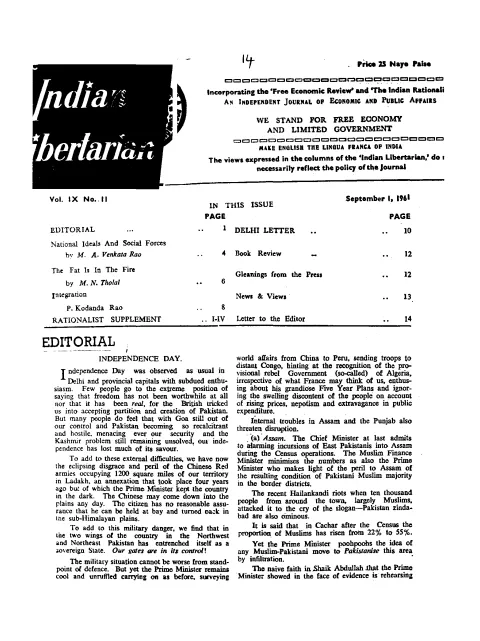
The Indian Libertarian, Independent Journal of Free Economy and Public Affairs · Bombay · 1959
28 pages
The Indian Libertarian
Summary
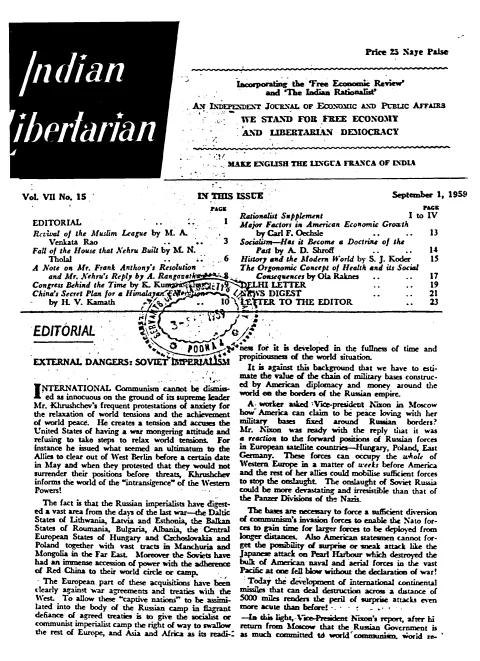
This 1 September 1959 issue of The Indian Libertarian (Vol. VII No. 15), a Bombay fortnightly ‘Independent Journal of Free Economy and Public Affairs,’ leads in the rendered pages with editorials on ‘External Dangers: Soviet Imperialism’ and ‘Chinese Designs on India,’ framing the journal’s Cold War liberal anti-totalitarian stance. The bylined articles in the rendered pages argue against communal and statist drift in Indian politics: M. A. Venkata Rao examines the revival of the Muslim League and Muslim political ideology, M. N. Thölal attacks the Congress ‘house that Nehru built,’ A. Ranganathan parses Frank Anthony’s language resolution and Nehru’s reply, K. Kumara Sekhar charges that the Congress is ‘behind the times,’ and H. V. Kamath warns of a Chinese ‘secret plan for a Himalayan Federation’ encircling India. The issue also carries a bound ‘Rationalist Supplement’ whose lead piece, ‘The Revival’ by S. Ramanathan, celebrates the relaunch of the rationalist/freethought movement in India.
Key points
-
The 1 September 1959 issue of The Indian Libertarian, Vol. VII No. 15, leads with editorials on “External Dangers: Soviet Imperialism” and “Chinese Designs on India,” framing the journal’s Cold War anti-totalitarian stance.
-
M. A. Venkata Rao traces the revival of the Muslim League in Kerala coalition politics against the Communist ministry, reading it as a resurgence of Muslim “two-nation” political ideology.
-
A. Ranganathan’s response to Frank Anthony’s language resolution and Nehru’s reply defends English as a vital “additional” link language and instrument of national integration rather than a colonial relic.
-
K. Kumara Sekhar’s “Congress Behind the Times” argues the party has grown out of the national movement but failed to modernise, using its record in Kerala as a case study of statist, centralising drift.
-
H. V. Kamath’s “China’s Secret Plan for a Himalayan Federation” warns that Chinese cartographic claims, road-building and border encroachments in Ladakh and NEFA point toward absorbing Tibet, Nepal, Sikkim and Bhutan.
-
The bound “Rationalist Supplement” leads with S. Ramanathan’s “The Revival,” celebrating the relaunch of the rationalist and freethought movement in India under the patronage of the Indian Rationalist.
-
Ramanathan argues rationalism, by abolishing the fear of death and the apparatus of priestcraft, would redirect human energy toward worldly human betterment, while conceding the difficulty of reaching the masses.
Essays
Revival of The Muslim League
By MA Venkata Rao
M. A. Venkata Rao traces the revival of the Muslim League in Kerala and reads it as a symptom of a deeper revival of Muslim political ideology in India. In the rendered pages he argues that the League’s re-entry into coalition politics (notably alongside the anti-Communist front in Kerala) exposes the unresolved problem of religious community as a basis for political organisation, and he treats Muslim ‘two-nation’ ideology as a continuing challenge to a secular, liberal Indian order.
- The Muslim League’s revival is tied to Kerala coalition politics against the Communist ministry.
- Venkata Rao reads the revival as a resurgence of Muslim political ideology, not a local accident.
- He frames religious community as an unstable and dangerous basis for political organisation.
- The piece situates the problem within India’s secular-state debate.
A Note on Mr. Frank Anthony’s Resolution
By A Ranganathan
A. Ranganathan responds to Mr. Frank Anthony’s resolution on the status of English and to Nehru’s reply. In the rendered pages he defends English as a vital ‘additional’ language for India and as a practical instrument of national integration and access to world knowledge, taking issue with both the resolution’s framing and the assurances offered in reply, and laying out a series of numbered points on the language question.
- Responds to Frank Anthony’s resolution on the place of English and Nehru’s reply.
- Defends English as an ‘additional’ / link language rather than a colonial relic.
- Treats the language question as bound up with national integration.
- Structured as a point-by-point rejoinder.
Congress Behind the Times
By K. Kumara Sekhar
K. Kumara Sekhar argues that the Congress party is ‘behind the times,’ having grown out of a national movement but failing to keep pace with the economic and political needs of independent India. In the rendered pages he criticises the party’s record in Kerala and its drift toward a centralised, statist style of governance, contending that the Congress has not modernised its thinking to match the country’s problems.
- Frames the Congress as a movement that has not adapted into a modern governing party.
- Uses Kerala as a case study of Congress political conduct.
- Criticises the party’s statist and centralising tendencies.
- Calls implicitly for a more liberal, forward-looking politics.
China’s Secret Plan for a Himalayan Federation
By H. V. Kamath
H. V. Kamath warns that China is pursuing a ‘secret plan for a Himalayan Federation’ that would absorb Tibet, Nepal, Sikkim, Bhutan and the Indian border regions into a Chinese-dominated bloc. In the rendered pages he reads China’s cartographic claims, road-building and border encroachments in Ladakh and NEFA as evidence of an expansionist design, and urges India to drop illusions of friendship and defend its frontiers and Himalayan neighbours firmly.
- Argues China seeks a Himalayan Federation absorbing Tibet, Nepal, Sikkim and Bhutan.
- Reads Chinese maps, roads and border moves in Ladakh/NEFA as deliberate expansionism.
- Warns against Indian complacency toward Chinese intentions.
- Calls for a firm Indian defence policy and protection of border states.
The Revival (Rationalist Supplement)
By S. Ramanathan
In the bound ‘Rationalist Supplement,’ S. Ramanathan’s lead article ‘The Revival’ welcomes the relaunch of the rationalist movement in India under the patronage of the Indian Rationalist (Ranchhoddas Bhavan Lotvala). In the rendered pages he argues that rationalism, by abolishing the fear of death and the apparatus of priestcraft, would release vast human energy for constructive, this-worldly human happiness, while conceding the difficulty of carrying freethought to the masses.
- Marks the revival of organised rationalism/freethought in India.
- Frames religion’s promise of an afterlife as a diversion of human energy.
- Argues rationalism would redirect energy toward worldly human betterment.
- Acknowledges the difficulty of spreading rationalism beyond an educated minority.
Generated by the v1.5 extraction pipeline. Awaiting editorial review.
Metadata and summary are AI-extracted from the source PDF and reviewed for editorial accuracy. The original work is available via the Read PDF tab above (where present); paragraph-level citation inside the PDF is deferred to a future engagement.