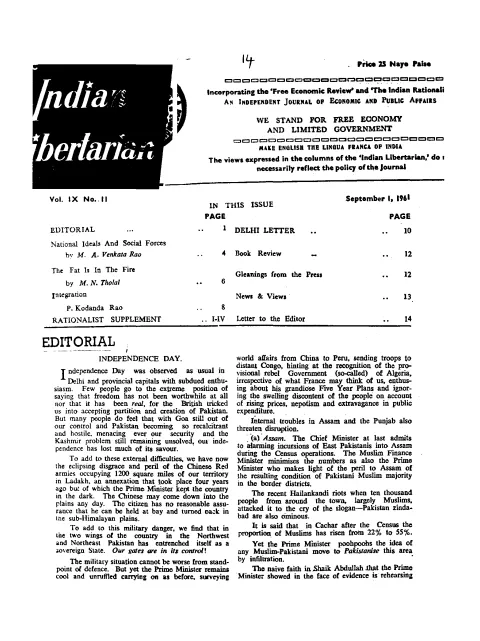
periodical issue
The Indian Libertarian
An Independent Journal of Economic and Public Affairs
The Indian Libertarian, Independent Journal of Free Economy and Public Affairs · Bombay · 1960
24 pages
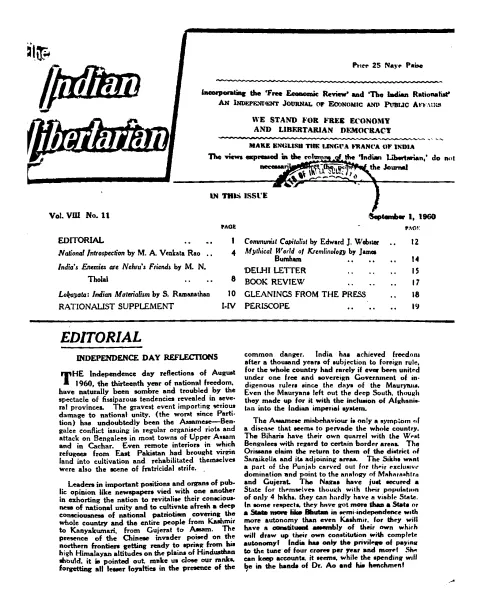
The Indian Libertarian
Summary
This 1 September 1960 issue of The Indian Libertarian (Vol. VIII No. 11), the Bombay fortnightly that ‘stands for free economy and libertarian democracy’ and incorporates the Free Economic Review and The Indian Rationalist, opens in the rendered pages with an Independence Day editorial (‘Independence Day Reflections’) brooding over fissiparous tendencies, the Assamese-Bengali conflict in Upper Assam, and the Chinese threat on the Himalayan frontier. The bylined articles in the rendered pages press the journal’s anti-statist, anti-communist line: M. A. Venkata Rao’s ‘National Introspection’ diagnoses national disunity and the failures of Congress nation-building; M. N. Thölal’s ‘India’s Enemies are Nehru’s Friends’ attacks Nehru’s foreign and domestic alignments; and S. Ramanathan’s ‘Lokayata: Indian Materialism’ recovers the ancient Indian materialist (Charvaka/Lokayata) tradition for the rationalist cause. The bound Rationalist Supplement leads with James Plender’s ‘Madame Blavatsky Unveiled,’ and the issue continues with cold-war pieces by Edward J. Webster (‘Communist Capitalist’) and James Burnham (‘Mythical World of Kremlinology’) plus standing departments.
Key points
-
The editorial ‘Independence Day Reflections’, marking the thirteenth anniversary of independence, dwells on the Assamese-Bengali riots in Upper Assam and Cachar and the Chinese threat poised on the northern frontier.
-
It argues that public opinion must revive a national patriotism transcending provincial and communal loyalties to meet these combined internal and external dangers together.
-
M. A. Venkata Rao’s ‘National Introspection’ faults the Congress’s record and the planning-era state for failing to build genuine national unity or sound institutions.
-
M. N. Tholal’s ‘India’s Enemies are Nehru’s Friends’ argues that Nehru cultivates figures hostile to India abroad while distrusting the country’s own defenders, framing this as a paradox of inverted loyalties.
-
S. Ramanathan’s ‘Lokayata: Indian Materialism’ reviews a book on the ancient Charvaka/Lokayata school, recovering it as an indigenous Indian precedent for rationalism and this-worldly scepticism.
-
The bound Rationalist Supplement leads with James Plender’s ‘Madame Blavatsky Unveiled’ and continues with Cold War pieces by Edward J. Webster and James Burnham.
-
Edward J. Webster’s ‘Communist Capitalist’ and James Burnham’s ‘Mythical World of Kremlinology’ extend the supplement’s anti-communist commentary into Cold War geopolitics.
Essays
Editorial: Independence Day Reflections
The unsigned editorial, ‘Independence Day Reflections,’ offers a sombre stocktaking on the thirteenth anniversary of independence. In the rendered pages it dwells on threats to national unity — the Assamese-Bengali riots in Upper Assam and Cachar, refugee strife, and the Chinese invader poised on the northern frontier — and argues that public opinion must revive a national patriotism transcending provincial and communal loyalties to meet the common danger.
- Frames Independence Day 1960 as an occasion for sombre self-examination.
- Treats the Assamese-Bengali conflict as a symptom of fissiparous tendencies.
- Names the Chinese frontier threat as the gravest external danger.
- Calls for a national patriotism above provincial and communal loyalties.
National Introspection
By MA Venkata Rao
M. A. Venkata Rao’s ‘National Introspection’ argues that India, having won freedom, has failed to build genuine national unity or sound institutions. In the rendered pages he criticises the Congress’s record and the planning-era state, traces present disorders to a want of liberal, integrative nation-building, and urges an honest self-examination of the nation’s political and moral condition.
- Calls for national self-examination thirteen years after independence.
- Faults Congress nation-building and the centralising state.
- Links present disorders to a failure of liberal integration.
- Argues unity must rest on shared institutions, not coercion.
India’s Enemies are Nehru’s Friends
By M. N. Tholal
M. N. Thölal’s polemic ‘India’s Enemies are Nehru’s Friends’ argues that the figures and forces Nehru cultivates abroad and indulges at home are precisely those hostile to India’s interests. In the rendered pages he indicts the government’s handling of the Congress, of frontier security, and of fellow-travelling sympathisers, casting Nehru’s judgement of friends and enemies as fatally inverted.
- Contends Nehru befriends India’s adversaries while distrusting its defenders.
- Criticises Congress conduct and frontier policy.
- Frames the argument as a paradox of inverted loyalties.
- Continues the journal’s anti-Nehru, anti-fellow-traveller line.
Lokayata: Indian Materialism
By S. Ramanathan
S. Ramanathan’s ‘Lokayata: Indian Materialism’ reviews a book on the ancient Indian materialist school and recovers the Charvaka/Lokayata tradition as an indigenous precedent for rationalism. In the rendered pages he draws on this materialist lineage to argue that scepticism and this-worldly reason are native to Indian thought, not foreign imports, situating contemporary Indian rationalism within a long domestic heritage.
- Treats Lokayata/Charvaka as ancient Indian materialism.
- Recovers a native Indian lineage for rationalism and scepticism.
- Argues this-worldly reason is indigenous, not a Western import.
- Frames the supplement’s rationalist project in Indian intellectual history.
Generated by the v1.5 extraction pipeline. Awaiting editorial review.
Metadata and summary are AI-extracted from the source PDF and reviewed for editorial accuracy. The original work is available via the Read PDF tab above (where present); paragraph-level citation inside the PDF is deferred to a future engagement.