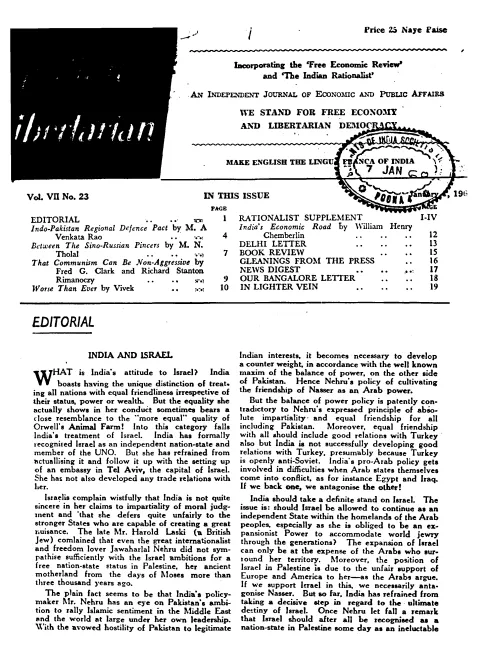
periodical issue
The Indian Libertarian
An Independent Journal of Economic and Public Affairs
The Indian Libertarian, Independent Journal of Free Economy and Public Affairs · Bombay · 1959
24 pages
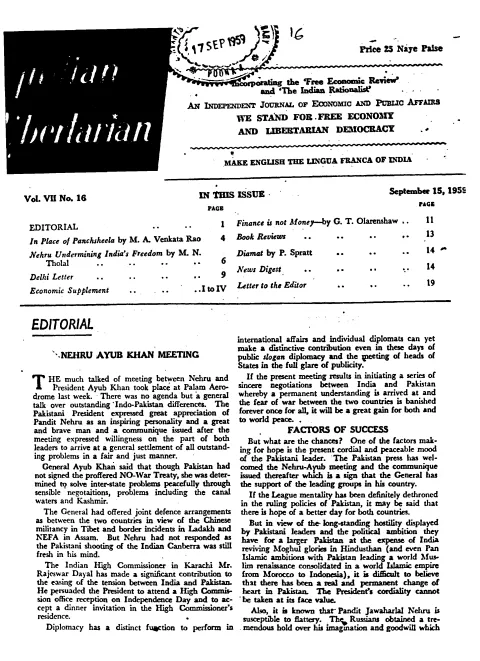
The Indian Libertarian
Summary
This 15 September 1959 issue of The Indian Libertarian (Vol. VII No. 16), the Bombay fortnightly edited by Kusum Lotvala, opens in the rendered pages with an editorial on the Nehru-Ayub Khan meeting at Palam, weighing the prospects of an India-Pakistan settlement against long-standing distrust. The bylined articles in the rendered pages press the journal’s liberal, anti-statist and anti-communist line: M. A. Venkata Rao’s ‘In Place of Panchsheela’ calls for a sterner alternative to the discredited Panchsheel doctrine after Chinese aggression, and M. N. Thölal’s ‘Nehru Undermining India’s Freedom’ argues that Nehru’s policies erode India’s liberty from within. The bound Economic Supplement leads with Prof. G. N. Lawande’s ‘Co-operative Farming: The Path To Serfdom,’ an attack on collectivised agriculture, and continues with G. T. Olarenshaw’s ‘Finance is not Money’ and P. Spratt’s ‘Diamat’ (on dialectical materialism). Standing departments (Delhi Letter, Book Reviews, News Digest, Letter to the Editor) round out the issue.
Key points
-
The 15 September 1959 issue of The Indian Libertarian (Vol. VII, No. 16), edited by Kusum Lotvala, opens with an editorial on the Nehru-Ayub Khan meeting at Palam aerodrome, which produced goodwill despite lacking a formal agenda.
-
The editorial weighs the prospects of a durable India-Pakistan settlement against the two countries’ long hostility and the mounting Chinese threat on the Himalayan frontier.
-
M. A. Venkata Rao’s ‘In Place of Panchsheela’ declares the doctrine of peaceful coexistence discredited by Chinese aggression in Ladakh and Tibet, calling for India to adopt a realistic defence policy in its place.
-
M. N. Tholal’s ‘Nehru Undermining India’s Freedom’ locates the gravest threat to Indian liberty not in external enemies but in the government’s own drift toward centralised, statist economic and political control.
-
The bound Economic Supplement leads with Prof. G. N. Lawande’s ‘Co-operative Farming: The Path To Serfdom’, which argues that pooling land under collectivised farming destroys peasant incentive and independence without solving the food problem.
-
Lawande reads the Nagpur resolution on cooperative farming as a coercive, anti-liberal turn in agricultural policy, extending the same road-to-serfdom argument he applies elsewhere to the welfare state.
-
The supplement also carries G. T. Olarenshaw’s ‘Finance is not Money’ and P. Spratt’s ‘Diamat’, a piece on dialectical materialism, rounding out the issue’s economic and philosophical commentary.
Essays
Editorial: Nehru Ayub Khan Meeting
The unsigned editorial assesses the much-discussed Nehru-Ayub Khan meeting at Palam aerodrome. In the rendered pages it notes that the talks proceeded without a formal agenda yet produced expressions of goodwill and a willingness to settle outstanding Indo-Pakistan differences, and it cautiously weighs the factors for and against a durable settlement given the two countries’ long hostility and the looming Chinese threat.
- Centres on the Nehru-Ayub Khan meeting at Palam aerodrome.
- Notes the talks had no agenda but yielded goodwill and a war-renunciation gesture.
- Weighs factors for and against a lasting Indo-Pakistan settlement.
- Reads the rapprochement against the backdrop of Chinese pressure.
In Place of Panchsheela
By MA Venkata Rao
M. A. Venkata Rao’s ‘In Place of Panchsheela’ argues that the Panchsheel doctrine of peaceful coexistence has been exposed as hollow by Chinese aggression on the Himalayan frontier. In the rendered pages he urges India to abandon the illusions of Panchsheela and adopt a clear-eyed policy of national defence and realistic alignment, treating the betrayal in Ladakh and Tibet as proof that liberal democracies cannot trust totalitarian neighbours’ professions of friendship.
- Declares the Panchsheel doctrine discredited by Chinese aggression.
- Calls for a realistic defence and foreign policy in its place.
- Reads Tibet and Ladakh as proof of totalitarian bad faith.
- Frames the lesson in liberal-democratic terms.
Nehru Undermining India’s Freedom
By M. N. Tholal
M. N. Thölal’s ‘Nehru Undermining India’s Freedom’ contends that the gravest threat to Indian liberty is not external but internal — the drift of Nehru’s government toward centralised, statist control. In the rendered pages he argues that the Prime Minister’s economic and political direction, his handling of dissent, and his accommodation of socialist and fellow-travelling forces are steadily hollowing out the freedoms independence was meant to secure.
- Locates the chief threat to Indian freedom in Nehru’s own policies.
- Criticises centralising, statist economic and political direction.
- Faults the government’s treatment of dissent.
- Casts internal illiberalism as more dangerous than external foes.
Economic Supplement
By G N Lawande
Prof. G. N. Lawande’s ‘Co-operative Farming: The Path To Serfdom,’ the lead piece of the bound Economic Supplement, attacks the official drive toward co-operative and collectivised farming as a step toward servitude. In the rendered pages he argues that pooling land and joint cultivation would destroy the peasant’s incentive and independence, that the food problem cannot be solved by such collectivism, and that Nagpur-style resolutions point India down a coercive, anti-liberal road in agriculture.
- Attacks co-operative/collective farming as ‘the path to serfdom’.
- Argues collectivisation destroys peasant incentive and independence.
- Denies that collective farming solves the food problem.
- Reads the Nagpur resolution as a coercive, anti-liberal turn.
Generated by the v1.5 extraction pipeline. Awaiting editorial review.
Metadata and summary are AI-extracted from the source PDF and reviewed for editorial accuracy. The original work is available via the Read PDF tab above (where present); paragraph-level citation inside the PDF is deferred to a future engagement.