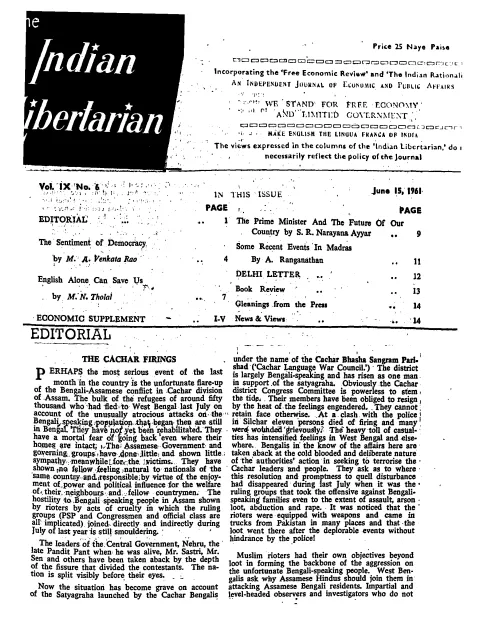
periodical issue
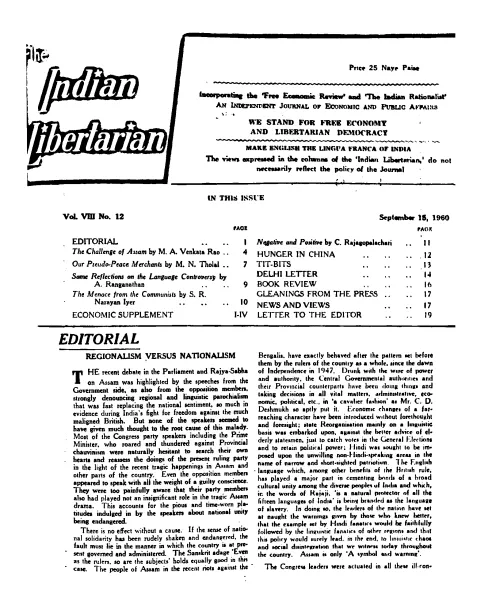
The Indian Libertarian
An Independent Journal of Economic and Public Affairs
By MA Venkata Rao, M. N. Roy, A Ranganathan, C. Rajagopalachari
The Indian Libertarian, Published by the Libertarian Publishers (Private) Ltd. · Bombay · 1960
24 pages
The Indian Libertarian
Summary
This September 15, 1960 issue (Vol. VIII No. 12) of The Indian Libertarian, an independent Bombay journal of free economy and libertarian democracy edited by Miss Kusum Lotwala, leads with an unsigned editorial on ‘Regionalism versus Nationalism’ that reads the contemporary Assam language agitation as a symptom of the Congress government’s centralising drift and provincial chauvinism. In the rendered pages the issue gathers commentary on the politics of the early 1960s: M. A. Venkata Rao on the Assam crisis, M. N. Tholal’s polemic against India’s ‘pseudo-peace merchants’ and Nehru’s foreign policy, A. Ranganathan’s reflections on the national language controversy, S. R. Narayan Iyer on the communist threat, and a separately paginated ‘Economic Supplement’ carrying Prof. G. N. Lawande’s essay ‘Socialism and Democracy.’ Across these pieces the journal argues a consistent classical-liberal line: against linguistic and provincial fragmentation, against socialist economic planning, and for English as a unifying link language and a free economy.
Key points
-
The unsigned editorial Regionalism versus Nationalism reads the contemporary Assam language agitation as a symptom of the Congress government’s centralising drift and provincial chauvinism.
-
M. A. Venkata Rao’s The Challenge of Assam argues that hasty, ill-considered linguistic reorganisation of Indian states has inflamed rather than settled provincial sentiment.
-
Venkata Rao connects the Assam disturbances to weak central leadership and treats them as a test of India’s ability to reconcile regional feeling with national unity.
-
M. N. Tholal’s Our Pseudo-Peace Merchants attacks Nehru’s foreign-policy professions of peace, treating them as a confession of weakness rather than principle.
-
Tholal further distinguishes genuine peace from what he characterises as outright capitulation to aggression dressed up as a peace policy.
-
A. Ranganathan’s Some Reflections on the Language Controversy opens from Frank Anthony’s denunciation of the President’s address and links the English-versus-regional-languages debate to the question of national cohesion.
-
S. R. Narayan Iyer’s The Menace from the Communists warns that the Communist Party represents a standing threat to Indian democracy, opening from a mid-August prime-ministerial speech.
-
Narayan Iyer reads the central government’s continued tolerance of communist agitation as a form of dangerous complacency in the face of that threat.
-
The issue’s separately paginated Economic Supplement carries Prof. G. N. Lawande’s essay Socialism and Democracy, extending the journal’s free-market line.
Essays
The Challenge of Assam
By MA Venkata Rao
M. A. Venkata Rao reads the Assam disturbances as the latest evidence of India’s failure to reconcile regional sentiment with national unity. He treats the linguistic and ethnic clashes in Assam as a test the Indian state is failing, arguing that hasty, ill-considered reorganisation along linguistic lines has inflamed rather than settled provincial feeling.
- Frames the Assam agitation as a national-unity failure, not a merely local dispute
- Criticises linguistic reorganisation of states as a destabilising policy
- Connects provincial chauvinism to weak central leadership
Our Pseudo-Peace Merchants
By M. N. Tholal
M. N. Tholal attacks what he calls India’s ‘pseudo-peace merchants’ — those who, in his view, mistake appeasement for peace in foreign policy. He fastens on Nehru’s record, treating professions of peace as a confession of weakness rather than principle, and ties the argument to a broader critique of the government’s posture toward aggression.
- Polemic against appeasement dressed up as peace policy
- Targets Nehru’s foreign-policy professions directly
- Distinguishes genuine peace from capitulation to aggression
Some Reflections on the Language Controversy
By A Ranganathan
A. Ranganathan offers reflections on the language controversy, opening from Frank Anthony’s denunciation of the President’s address and ranging across the place of English and the regional languages in the Indian polity. He treats the dispute as bound up with the larger question of national cohesion rather than mere administrative convenience.
- Engages the English-versus-regional-languages debate
- Opens from Frank Anthony’s critique of the President’s address
- Links language policy to national unity
The Menace from the Communists
By S. R. Narayan Iyer
S. R. Narayan Iyer warns of ‘the menace from the communists,’ opening from a mid-August speech by the Prime Minister and arguing that the Communist Party represents a standing threat to Indian democracy. The piece reads the government’s tolerance of communist agitation as dangerous complacency.
- Casts the Communist Party as a threat to Indian democracy
- Opens from a mid-August prime-ministerial speech
- Criticises governmental complacency toward communist agitation
Generated by the v1.5 extraction pipeline. Awaiting editorial review.
Metadata and summary are AI-extracted from the source PDF and reviewed for editorial accuracy. The original work is available via the Read PDF tab above (where present); paragraph-level citation inside the PDF is deferred to a future engagement.