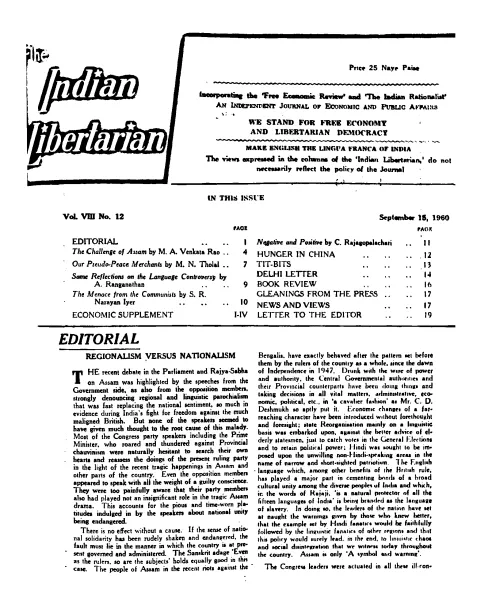
periodical issue
The Indian Libertarian
An Independent Journal of Economic and Public Affairs
By MA Venkata Rao, M. N. Tholal, J. M. Lobo Prabhu
The Indian Libertarian, Published by the Libertarian Publishers (Private) Ltd. · Bombay · 1961
20 pages
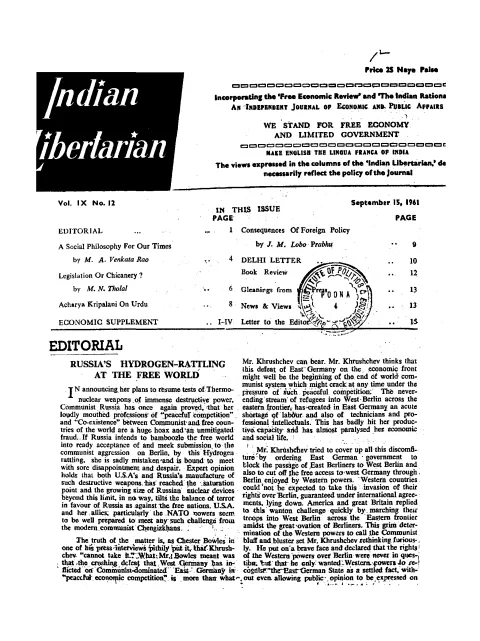
The Indian Libertarian
Summary
This September 15, 1961 issue (Vol. IX No. 12) of The Indian Libertarian, the Bombay journal of free economy and limited government edited by D. M. Kulkarni, opens with an unsigned editorial, ‘Russia’s Hydrogen-Rattling At The Free World,’ that reads the Soviet resumption of thermonuclear tests and the Berlin crisis as proof that Russia’s professions of ‘peaceful competition’ and ‘co-existence’ are a hoax. In the rendered pages the issue carries M. A. Venkata Rao’s ‘A Social Philosophy For Our Times,’ M. N. Tholal’s ‘Legislation Or Chicanery?,’ an unsigned piece on ‘Acharya Kripalani On Urdu,’ J. M. Lobo Prabhu’s ‘Consequences Of Foreign Policy,’ and a separately paginated Economic Supplement carrying Prof. G. N. Lawande’s ‘Keynes And The Trade Cycle.’ The issue argues a classical-liberal case against communism and economic planning, for limited government and a free economy, and engages the language question through the Urdu debate.
Key points
-
The unsigned editorial ‘Russia’s Hydrogen-Rattling At The Free World’ reads the Soviet resumption of thermonuclear tests and the Berlin crisis as proof that Moscow’s professions of peaceful coexistence are a hoax.
-
M. A. Venkata Rao’s ‘A Social Philosophy For Our Times’ sets a liberal-humanist conception of society, grounded in the value and freedom of the individual, against the collectivist and Marxist-Leninist creeds of the age.
-
M. N. Tholal’s ‘Legislation Or Chicanery?’ argues that a proposed Indian Penal Code amendment dresses up the curtailment of individual liberty in the language of reform, treating it as a case of state overreach.
-
An unsigned piece, ‘Acharya Kripalani On Urdu’, enters the language controversy through Kripalani’s stand on Urdu, framing the language’s status alongside Hindi and the regional languages as a test of linguistic freedom.
-
J. M. Lobo Prabhu’s ‘Consequences Of Foreign Policy’ argues that India’s professed non-alignment and idealism carry material security costs against Cold War realities that its rhetoric tends to obscure.
-
A separately paginated Economic Supplement carries Prof. G. N. Lawande’s ‘Keynes And The Trade Cycle’, extending the issue’s economic commentary.
-
Across its essays the issue presses a classical-liberal case against communism and economic planning while advocating limited government and a free economy.
Essays
A Social Philosophy For Our Times
By MA Venkata Rao
M. A. Venkata Rao sketches ‘a social philosophy for our times,’ setting a liberal-humanist conception of society against the dominant collectivist and Marxist-Leninist creeds of the age. He argues that a sound social philosophy must rest on the value and freedom of the individual rather than on the subordination of persons to the state or to a totalising ideology.
- Counters Marxist-Leninist collectivism with a liberal social philosophy
- Grounds society in the value and freedom of the individual
- Treats individual liberty as the test of a sound social order
Legislation Or Chicanery ?
By M. N. Tholal
M. N. Tholal asks whether a bill before the Indian Penal Code amounts to legislation or chicanery, using a proposed measure to argue that the government dresses up the curtailment of individual liberty in the language of reform. The piece treats the bill as a case study in how state power expands under cover of legislative legitimacy.
- Reads a Penal Code amendment as disguised restriction of liberty
- Argues legislation can be a vehicle for state overreach
- Defends individual liberty against legislative encroachment
Acharya Kripalani On Urdu
An unsigned piece on ‘Acharya Kripalani On Urdu’ enters the language controversy by way of Kripalani’s stand on Urdu, treating the question of Urdu’s place among India’s languages as a test of the country’s commitment to linguistic freedom and against narrow linguistic nationalism. It weighs Urdu’s status alongside Hindi and the regional languages.
- Engages the Urdu question through Acharya Kripalani’s position
- Frames language policy as a matter of liberal freedom
- Situates Urdu among Hindi and the regional languages
Consequences Of Foreign Policy
By J. M. Lobo Prabhu
J. M. Lobo Prabhu examines the consequences of India’s foreign policy, tracing how its professed non-alignment and idealism play out against the realities of the Cold War and the country’s security. The essay reads foreign-policy posture as carrying material costs that its rhetoric tends to obscure.
- Critiques the practical results of Indian foreign policy
- Sets non-alignment rhetoric against Cold War realities
- Stresses the material costs of foreign-policy posture
Generated by the v1.5 extraction pipeline. Awaiting editorial review.
Metadata and summary are AI-extracted from the source PDF and reviewed for editorial accuracy. The original work is available via the Read PDF tab above (where present); paragraph-level citation inside the PDF is deferred to a future engagement.