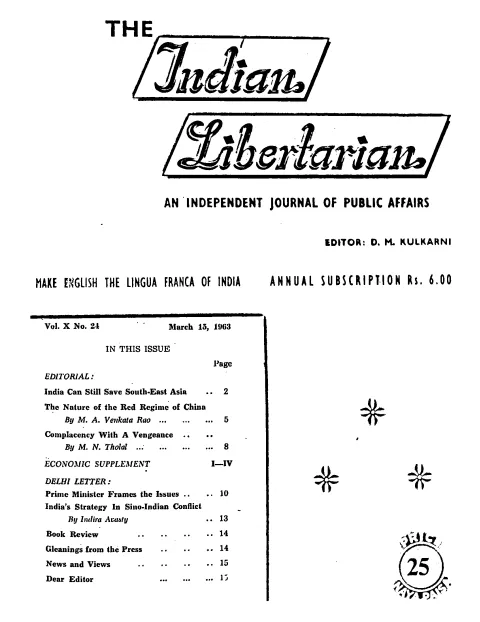
periodical issue
The Indian Libertarian
An Independent Journal of Economic and Public Affairs
By MA Venkata Rao, M. N. Tholal, P Kodanda Rao
The Indian Libertarian, Arya Bhuvan, Sandhurst Road, Bombay 4 · Bombay · 1962
16 pages
The Indian Libertarian
Summary
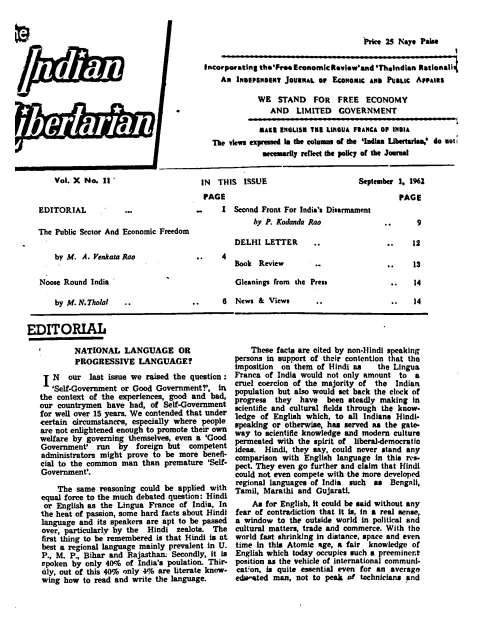
This September 1, 1962 issue (Vol. X No. 11) of The Indian Libertarian, a Bombay free-market and rationalist fortnightly edited by D. M. Kulkarni, leads with an editorial on India’s national-language controversy and carries signed articles on the public sector, China’s strategic encirclement of India, and disarmament, alongside standing departments (Delhi Letter, Book Review, Gleanings from the Press, News & Views). Its argumentative center is classical-liberal: it opposes the spread of the public sector, defends English as a progressive lingua franca against Hindi imposition, and reads Indian non-alignment skeptically in the shadow of Chinese pressure on the Himalayan frontier.
Key points
-
The unsigned editorial, “National Language or Progressive Language?”, argues Hindi, spoken natively by only about 40 percent of Indians, cannot yet serve as a scientific or administrative lingua franca and that imposing it coerces the non-Hindi majority.
-
The editorial defends English as the established gateway to modern science, technology and contact with the outside world, framing the debate as parallel to an earlier “Self-Government or Good Government?” editorial.
-
M. A. Venkata Rao’s “The Public Sector and Economic Freedom” argues that the expansion of state-run industry under planning erodes individual economic freedom and concentrates power dangerously in government hands.
-
Venkata Rao defends competition, private enterprise and dispersed initiative as the real engines of growth, warning that nationalisation substitutes bureaucratic control for the spur of free enterprise.
-
M. N. Tholal’s “Noose Round India,” replying to a Lok Sabha debate on Ladakh, argues that India’s professed non-alignment has become a “dishonourable” posture incompatible with Chinese encroachment on the Himalayan frontier.
-
Tholal contends genuine non-alignment is impossible between aggressor and victim, faulting the government for refusing to align for its own self-defence.
-
P. Kodanda Rao’s “Second Front for India’s Disarmament” reports on the Anti-Nuclear Arms Convention, calling for a second front on disarmament through both international and domestic channels.
-
The “Delhi Letter,” subtitled “Nonalignment, A Green Signal for China,” argues that Nehru’s renewed emphasis on non-alignment effectively emboldens Chinese pressure on the Ladakh frontier.
Essays
Editorial: National Language Or Progressive Language?
The unsigned editorial, ‘National Language Or Progressive Language?’, reframes the Hindi-versus-English debate by analogy to the journal’s earlier ‘Self-Government or Good Government?’ question. It argues that Hindi, spoken by only about 40% of India’s population and natively prevalent mainly in the northern states, cannot yet serve as a scientific or administrative lingua franca, and that imposing it amounts to a coercion of the non-Hindi majority that would set back cultural and scientific progress. English, by contrast, is defended as a window to the world and the established gateway to modern knowledge.
- Recasts the language question as ‘national’ versus ‘progressive’ rather than indigenous versus foreign.
- Notes Hindi is spoken by only ~40% of Indians and that only 40% of those are literate.
- Argues Hindi imposition coerces non-Hindi speakers (Bengali, Tamil, Marathi, Gujarati) and retards progress.
- Defends English as essential for science, technology, and contact with the outside world.
- Frames the debate as parallel to the earlier ‘Self-Government or Good Government?’ editorial.
The Public Sector And Economic Freedom
By MA Venkata Rao
M. A. Venkata Rao’s ‘The Public Sector And Economic Freedom’ argues that the steady expansion of the State-run public sector under planning erodes individual economic freedom and concentrates power dangerously in government hands. He traces the doctrine to socialist premises about the State as instrument of welfare, and contends that the conditions of genuine competition, private enterprise, and dispersed initiative are what actually drive growth and protect liberty, warning that nationalisation substitutes bureaucratic control for the spur of free enterprise.
- Frames the growth of the public sector as a threat to individual economic freedom.
- Links the public-sector drive to socialist assumptions about the State’s role.
- Defends private enterprise and competition as the real engines of growth.
- Warns that nationalisation concentrates economic power in government.
- Casts the debate as part of the wider contest between liberty and planning.
Noose Round India
By M. N. Tholal
M. N. Tholal’s ‘Noose Round India’ replies to a Lok Sabha debate on Ladakh, arguing that India’s professed non-alignment has become a ‘dishonourable’ and ‘idealistic’ posture incompatible with the hard fact of Chinese encroachment on the Himalayan frontier. Tholal maintains that genuine non-alignment is impossible between aggressor and victim, criticises the government’s reluctance to align for self-defence, and reads China’s moves as a tightening strategic noose around India.
- Responds to a Lok Sabha debate on the Ladakh/Chinese encroachment.
- Attacks non-alignment as dishonourable and unrealistic given Chinese aggression.
- Argues non-alignment cannot stand between aggressor and victim.
- Faults the government for refusing alignment needed for self-defence.
- Reads Chinese strategy as a noose tightening around India.
Second Front For India’s Disarmament
By P. Kodanda Rao
P. Kodanda Rao’s ‘Second Front For India’s Disarmament’ reports on the Anti-Nuclear Arms Convention and argues that India should open a ‘second front’ for disarmament by working through international and domestic channels. He weighs India’s moral position against the practical pressures of Chinese encroachment, surveying the convention’s resolutions and the tension between idealistic disarmament advocacy and the country’s concrete security needs.
- Reports on the Anti-Nuclear Arms Convention’s proceedings and resolutions.
- Calls for a ‘second front’ for disarmament through international and domestic action.
- Weighs India’s moral leadership on disarmament against its security pressures.
- Connects disarmament advocacy to the wider Cold War and frontier context.
Delhi Letter
The ‘Delhi Letter’, subtitled ‘Nonalignment, A Green Signal For China’, argues from the capital that Mr. Nehru’s renewed emphasis on non-alignment effectively gives China a green light on the frontier. The correspondent reads the Prime Minister’s stance as emboldening Chinese pressure in Ladakh and treats non-alignment as a diplomatic miscalculation in the prevailing strategic climate.
- Argues Nehru’s non-alignment signals weakness to China.
- Reads renewed non-alignment as emboldening Chinese moves on the frontier.
- Written as a capital-city political dispatch.
Generated by the v1.5 extraction pipeline. Awaiting editorial review.
Metadata and summary are AI-extracted from the source PDF and reviewed for editorial accuracy. The original work is available via the Read PDF tab above (where present); paragraph-level citation inside the PDF is deferred to a future engagement.