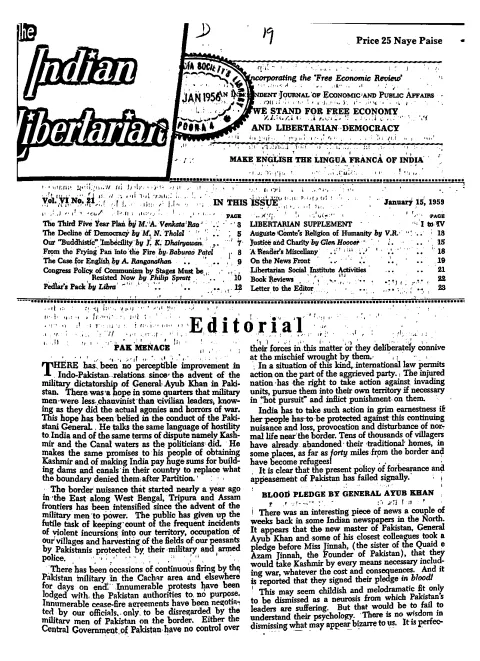
periodical issue
The Indian Libertarian
Independent Journal of Economic and Public Affairs
The Indian Libertarian, Arya Bhuvan, Sandhurst Road, Bombay 4 · Bombay · 1958
28 pages
The Indian Libertarian
Summary
This 15 September 1958 issue (Vol. VI No. 13) of The Indian Libertarian, the Bombay free-economy and liberal-democracy fortnightly edited by Kusum Lotwala, is dominated by Pakistan and the Cold War in the Middle East. Its editorial diagnoses ‘the psychology of Pakistan’; M. A. Venkata Rao argues against ceilings on landholdings; an anonymous ‘Libertarian’ assesses ‘the Pak menace’; T. L. Kantam examines Britain’s stake in the Middle East; and Peregrine Worsthorne’s reprinted piece reads the Soviet view of the West. Shorter items include a judge’s statement on tax justice, a commentary on the Noon-Nehru talks, a tribute to the late Glyn Thomas, and a supplement reporting on the Montreal Commonwealth conference and India’s food problem. The issue’s center is a classical-liberal, anti-collectivist treatment of foreign policy, defence, and property rights.
Key points
-
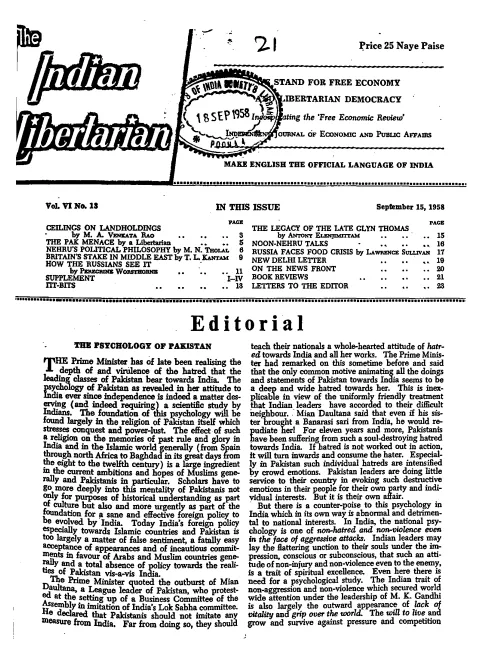
The editorial, ‘The Psychology of Pakistan’, traces Indo-Pakistani tension to a settled national psychology rooted in Pakistan’s founding premise rather than to isolated disputes.
-
M. A. Venkata Rao’s ‘Ceilings On Landholdings’ attacks proposed caps on agricultural holdings as an unjust interference with property rights that would fragment productive farms and deter investment.
-
‘The Pak-Menace’, by ‘A Libertarian’, characterises Pakistan’s military build-up and irredentist posture as a standing menace requiring policy grounded in strategic realism rather than sentimental hopes of friendship.
-
T. L. Kantam’s ‘Britain’s Stake In Middle East’ surveys the decline of British dominance in the Gulf after the 1958 upheavals, centring oil and the sheikhdoms in his analysis.
-
Peregrine Worsthorne’s reprinted ‘How The Russians See It’ argues Moscow reads Western disunity and hesitation as weakness and opportunity in the Cold War.
-
‘Noon-Nehru Talks’, by ‘Yaranamira’, reviews the negotiations between Pakistan’s Firoz Khan Noon and Jawaharlal Nehru sceptically, warning against expecting a durable settlement from summit diplomacy.
-
Anthony Elenjimittam’s tribute, ‘The Legacy Of The Late Glyn Thomas’, frames the late economist’s ideas as a genuine contribution to liberal economic thought.
-
A supplement reports on the Montreal Commonwealth conference and India’s food problem alongside a judge’s statement on tax justice.
Essays
Editorial: The Psychology of Pakistan
The editorial, ‘The Psychology of Pakistan’, argues that Pakistan’s hostility toward India is rooted less in specific disputes than in a settled national psychology shaped by its founding premise. It contends that Indian policy must grasp this mentality realistically rather than hoping that goodwill or concession will dissolve it, and reads recent friction on the frontier as a symptom of that deeper disposition.
- Traces Indo-Pak tension to Pakistan’s national ‘psychology’, not isolated disputes.
- Warns that concession and goodwill will not dissolve that hostility.
- Urges a realist Indian policy toward Pakistan.
- Reads frontier friction as a symptom of a deeper disposition.
Ceilings on Landholdings
By MA Venkata Rao
M. A. Venkata Rao’s ‘Ceilings On Landholdings’ attacks the proposal to cap agricultural holdings as an unjust and economically counterproductive interference with property rights. He argues that ceilings would fragment productive farms, deter investment, and substitute a doctrinaire egalitarianism for genuine agrarian improvement, treating the measure as part of the wider socialist assault on private property.
- Opposes ceilings on agricultural landholdings as an attack on property rights.
- Argues ceilings fragment productive farms and deter investment.
- Casts the measure as doctrinaire egalitarianism.
- Links land ceilings to the broader socialist programme.
The Pak-Menace
By A Libertarian
‘The Pak-Menace’, by ‘A Libertarian’, argues that Pakistan’s military build-up and irredentist posture constitute a standing menace to India that cannot be wished away. The writer reviews recent provocations and contends that India must base its policy on hard strategic facts rather than sentimental hopes of friendship.
- Characterises Pakistan’s posture as a standing menace to India.
- Reviews recent provocations on the frontier.
- Argues for a policy grounded in strategic realism.
- Rejects sentimental hopes of Indo-Pak friendship.
Britain’s Stake In Middle East
By T. L. Kantam
T. L. Kantam’s ‘Britain’s Stake In Middle East’ surveys the unravelling of British dominance in the Gulf and the wider Middle East after the oil-rich sheikhdoms and the 1958 upheavals. It weighs the clash of empires, the role of oil, and the strategic consequences for Britain of a receding imperial position.
- Surveys the decline of British dominance in the Middle East.
- Centres oil and the Gulf sheikhdoms in the analysis.
- Reads the 1958 upheavals as a ‘clash of empires’.
- Weighs the strategic costs of Britain’s imperial retreat.
How The Russians See It
By Peregrine Worsthorne
Peregrine Worsthorne’s reprinted ‘How The Russians See It’ reconstructs the Soviet view of the West, arguing that Moscow reads Western disunity and hesitation as weakness and opportunity. The piece urges the West to understand the adversary’s perspective if it is to respond effectively in the Cold War.
- Reconstructs the Soviet reading of Western disunity.
- Argues Moscow treats Western hesitation as opportunity.
- Urges the West to grasp the adversary’s perspective.
- Reprinted British Cold War commentary.
Noon-Nehru Talks
By Yaranamira
‘Noon-Nehru Talks’, by ‘Yaranamira’, reviews the talks between Pakistan’s Firoz Khan Noon and Jawaharlal Nehru against the backdrop of the Indian National Congress’s record. The column reads the negotiations skeptically, treating professions of goodwill as fragile and warning against expecting durable settlement from summit diplomacy alone.
- Reviews the Noon-Nehru talks between Pakistan and India.
- Sets the talks against the Congress’s record.
- Reads negotiations skeptically.
- Warns against over-reliance on summit diplomacy.
The Legacy Of The Late Glyn Thomas
By Anthony Elenjimittam
Anthony Elenjimittam’s ‘The Legacy Of The Late Glyn Thomas’ is a tribute reflecting on the economic and social ideas of Glyn Thomas, presenting his work as a contribution to liberal economic thought. The piece, seen through page 19, frames Thomas’s legacy in terms relevant to the journal’s free-economy outlook.
- A tribute to the economic thought of the late Glyn Thomas.
- Frames his legacy within liberal economic ideas.
- Connects his work to the journal’s free-economy outlook.
Generated by the v1.5 extraction pipeline. Awaiting editorial review.
Metadata and summary are AI-extracted from the source PDF and reviewed for editorial accuracy. The original work is available via the Read PDF tab above (where present); paragraph-level citation inside the PDF is deferred to a future engagement.