periodical issue
The Indian Libertarian
An Independent Journal of Economic and Public Affairs
By MA Venkata Rao, M. N. Tholal, G N Lawande
Published by D. M. Kulkarni at the Libertarian Publishers (Private) Ltd., 26, Durga Niwas, Vithalbhai Patel Road, Bombay 4, and printed by him at G. N. Printers · Bombay · 1962
20 pages
The Indian Libertarian
Summary
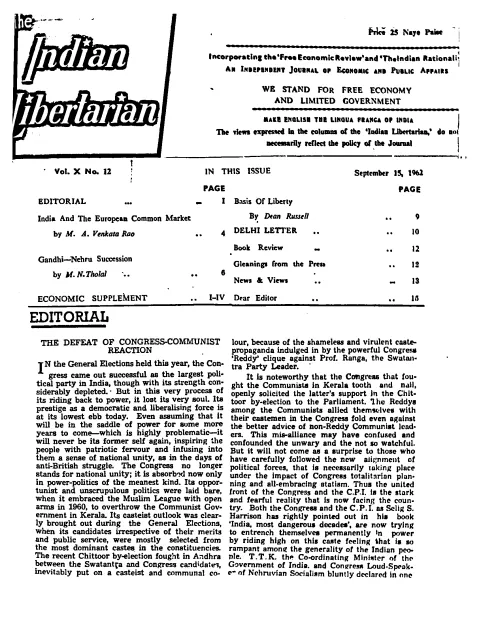
The Indian Libertarian, Vol. X No. 12 (September 15, 1962), is a fortnightly classical-liberal journal published from Bombay by Libertarian Publishers under the masthead motto ‘We Stand For Free Economy And Limited Government.’ This issue leads with an unsigned editorial, ‘The Defeat Of Congress-Communist Reaction,’ which reads the year’s general-election results as evidence that the Congress is ‘no longer the political party it once was’ and warns of a tacit Congress–Communist alignment. It is followed by M. A. Venkata Rao’s analysis of India and the European Common Market, the fourth instalment of M. N. Tholal’s serial ‘Gandhi–Nehru Succession,’ a reprinted Dean Russell piece, ‘Basis Of Liberty,’ and a four-page Economic Supplement carrying G. N. Lawande’s ‘Export Promotion And Foreign Collaboration.’ Standing departments — Delhi Letter, Book Review, Gleanings from the Press, News & Views, and Dear Editor — round out the number.
Key points
-
Volume ten, number twelve of The Indian Libertarian, dated 15 September 1962, leads with the editorial ‘The Defeat of Congress-Communist Reaction,’ arguing that although Congress remained the largest party after the year’s elections, its strength was ‘considerably depleted.’
-
The editorial alleges a tacit Congress-Communist alliance, citing Kerala and the Chittoor by-election, and frames totalitarian planning and ‘all-embracing statism’ as a programme shared by Congress and the CPI.
-
M. A. Venkata Rao examines India’s stance toward the European Common Market, weighing the loss of imperial-preference advantages for Indian exports if Britain enters, within a larger case for free trade over economic insularity.
-
The fourth instalment of M. N. Tholal’s serial ‘Gandhi-Nehru Succession’ compares British and Indian habits of compromise and faction, reading Congress’s internal manoeuvring as symptomatic of a deeper leadership crisis.
-
A reprinted essay by the American writer Dean Russell, ‘Basis of Liberty,’ restates the moral and institutional foundations of individual freedom in classical-liberal terms.
-
Prof. G. N. Lawande’s Economic Supplement piece, ‘Export Promotion and Foreign Collaboration,’ uses early Five-Year-Plan trade statistics to weigh the benefits and limits of foreign collaboration and capital.
Essays
Editorial: The Defeat Of Congress-Communist Reaction
The lead editorial argues that although the Congress emerged from the year’s general elections as the largest party, the result masks a deep erosion of its character: it has become an opportunist, office-seeking machine that has absorbed the meanest power-politics and, in Kerala and elsewhere, openly courted Communist support. The editorial reads a Congress–Communist convergence as the central danger to Indian liberty and singles out caste propaganda and statist planning as twin instruments of this decline.
- Congress returned as largest party but with its ‘strength considerably depleted.’
- Casteist and communal politics seen as corroding the party’s old nationalist purpose.
- Alleges a tacit Congress–Communist alliance, citing Kerala and the Chittoor by-election.
- Frames totalitarian planning and ‘all-embracing statism’ as the shared programme of Congress and the CPI.
India And The European Common Market
By MA Venkata Rao
M. A. Venkata Rao examines what India’s stance should be toward the European Common Market. He surveys the financial-press and political controversy the Common Market has stirred, weighs the consequences of Britain’s possible entry for Commonwealth and Indian trade preferences, and considers whether India should seek association, special arrangements, or stand apart. The argument situates the question within a broader case for free trade and against autarkic, inward-looking economic policy.
- Treats Britain’s prospective entry into the Common Market as a turning point for Commonwealth trade.
- Weighs the loss of imperial-preference advantages for Indian exports.
- Frames the choice as part of a larger argument about free trade versus economic insularity.
Gandhi—Nehru Succession
By M. N. Tholal
The fourth instalment of M. N. Tholal’s serial ‘Gandhi–Nehru Succession’ reflects on the question of political succession after Nehru and on the internal condition of the Congress. Tholal contrasts British and Indian habits of compromise and faction, and discusses the Congress’s internal composition and the manoeuvring among its leaders as the post-Nehru order is anticipated.
- Continues a multi-part meditation on the post-Nehru succession.
- Compares British and Indian political temperaments around compromise and faction.
- Reads Congress factional politics as symptomatic of a deeper crisis of leadership.
Basis Of Liberty
By Dean Russell
‘Basis Of Liberty,’ a short reprinted essay by the American free-market writer Dean Russell, restates a classical-liberal account of the moral and institutional foundations of individual freedom. It functions in the issue as a compact ideological touchstone alongside the journal’s commentary on Indian affairs.
- Reprinted American free-market essay used as an ideological anchor for the issue.
- Restates the moral grounding of individual liberty in classical-liberal terms.
Export Promotion And Foreign Collaboration (Economic Supplement)
By G N Lawande
In the issue’s Economic Supplement, Prof. G. N. Lawande discusses ‘Export Promotion And Foreign Collaboration,’ examining India’s export performance, the policy machinery built to promote exports, and the role of foreign collaboration and capital. He marshals trade figures across the early Plan years to argue about how export promotion should be organised and what foreign collaboration can and cannot deliver.
- Surveys India’s export drive and the institutions created to promote exports.
- Uses early Five-Year-Plan trade statistics to assess performance.
- Weighs the benefits and limits of foreign collaboration and capital.
Generated by the v1.5 extraction pipeline. Awaiting editorial review.
Metadata and summary are AI-extracted from the source PDF and reviewed for editorial accuracy. The original work is available via the Read PDF tab above (where present); paragraph-level citation inside the PDF is deferred to a future engagement.