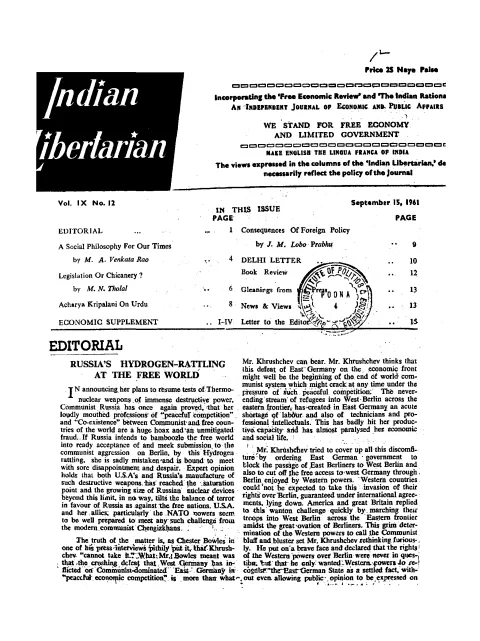
periodical issue
The Indian Libertarian
An Independent Journal of Public Affairs
By MA Venkata Rao, M. N. Tholal, J. M. Lobo Prabhu
Editor: D. M. Kulkarni. The Indian Libertarian, Independent Journal of Free Economy and Public Affairs. Published by D. M. Kulkarni at the Libertarian Publishers (Private) Ltd. · Bombay · 1963
20 pages
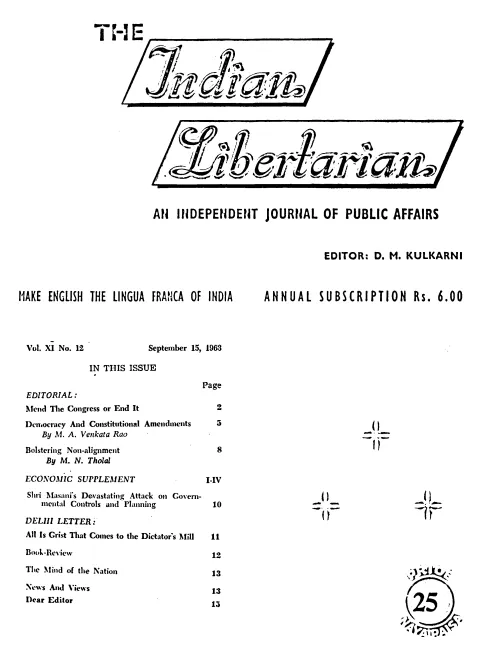
The Indian Libertarian
Summary
The Indian Libertarian, Vol. XI No. 12 (September 15, 1963), edited by D. M. Kulkarni and published from Bombay, is a fortnightly classical-liberal journal of public affairs. The issue opens with the editorial ‘Mend The Congress or End It,’ which argues that the ruling Congress has decayed into a corrupt, statist machine and presses the case for a credible non-Congress, democratic alternative. M. A. Venkata Rao follows with ‘Democracy And Constitutional Amendments,’ a constitutionalist critique of the post-independence amendments (notably the property and ‘rule of mind’ debates), and M. N. Tholal contributes ‘Bolstering Non-alignment,’ a sceptical reading of Nehruvian foreign policy. The four-page Economic Supplement bundles a note on Minoo Masani’s attack on governmental controls and planning together with J. M. Lobo Prabhu’s ‘A New Tax Structure,’ and the issue closes with the Delhi Letter, Book-Review, ‘The Mind of the Nation,’ News And Views, and Dear Editor departments.
Key points
-
This 15 September 1963 issue, Vol. XI No. 12, edited by D. M. Kulkarni, opens with the editorial Mend The Congress or End It, arguing the ruling party has decayed into a corrupt, statist machine.
-
The editorial distinguishes a latent democratic wing within Congress from its dominant controls-and-planning tendency, arguing for internal reform or replacement by a principled non-Congress democratic alternative.
-
M. A. Venkata Rao’s Democracy And Constitutional Amendments reads the wave of post-independence amendments touching property and fundamental rights as a test of whether the Constitution still protects individuals against the state.
-
M. N. Tholal’s Bolstering Non-alignment questions how far India’s non-aligned foreign policy actually serves Indian interests, weighing the gap between its professed neutrality and its real-world tilts.
-
The Economic Supplement reports Minoo Masani’s parliamentary attack on state monopolies, governmental controls and centralised economic planning as obstacles to India’s growth and enterprise.
-
J. M. Lobo Prabhu’s A New Tax Structure critiques the existing tax system’s effect on incentives and savings and proposes a redesign more favourable to enterprise and capital formation.
-
The issue closes with a Delhi Letter, a book review, The Mind of the Nation, News and Views, and a Dear Editor column.
Essays
Editorial: Mend The Congress or End It
The lead editorial, ‘Mend The Congress or End It,’ contends that the Congress as the party of independence has exhausted its moral capital and now survives as an opportunist, controls-and-planning machine. It distinguishes a genuinely democratic wing within the Congress from the dominant statist tendency, and argues that unless the party can be reformed from within it should be displaced by a principled democratic opposition committed to free economy and limited government.
- Frames the Congress as having decayed from a freedom movement into a statist political machine.
- Distinguishes a latent ‘democratic wing’ within the Congress from its dominant controls-and-planning tendency.
- Argues for either internal reform or replacement by a credible non-Congress democratic alternative.
Democracy And Constitutional Amendments
By MA Venkata Rao
In ‘Democracy And Constitutional Amendments,’ M. A. Venkata Rao examines the wave of constitutional amendments passed since independence and asks what they reveal about the health of Indian democracy. He treats amendments touching property and fundamental rights as tests of whether the Constitution still protects the individual against the state, and warns against treating the amending power as a licence for unchecked majoritarian or statist encroachment.
- Reads the post-independence constitutional amendments as a barometer of democratic health.
- Focuses on amendments affecting property and fundamental rights.
- Cautions against using the amending power to erode protections for the individual.
Bolstering Non-alignment
By M. N. Tholal
M. N. Tholal’s ‘Bolstering Non-alignment’ offers a sceptical assessment of India’s non-aligned foreign policy. Writing against the backdrop of Cold War manoeuvring and Soviet relations, he questions how far non-alignment as practised actually serves Indian interests, and weighs the gap between the doctrine’s stated even-handedness and its real-world tilts.
- Scrutinises the doctrine and practice of Indian non-alignment.
- Sets the discussion against Cold War rivalry and India’s Soviet relations.
- Probes the gap between non-alignment’s professed neutrality and its actual tilts.
Economic Supplement: Shri Masani’s Devastating Attack on Governmental Controls and Planning / A New Tax Structure
By J. M. Lobo Prabhu
The Economic Supplement carries two linked items. The first reports and endorses Minoo Masani’s parliamentary assault on state monopolies, governmental controls, and planning. The second, J. M. Lobo Prabhu’s ‘A New Tax Structure,’ proposes a recasting of India’s tax system, criticising the existing structure’s effect on incentives and savings and sketching an alternative more favourable to enterprise and capital formation.
- Reports Masani’s parliamentary attack on state monopolies, controls, and planning.
- Lobo Prabhu’s ‘A New Tax Structure’ critiques the existing tax system’s effect on incentive and savings.
- Proposes a redesigned tax structure more favourable to enterprise and capital formation.
Generated by the v1.5 extraction pipeline. Awaiting editorial review.
Metadata and summary are AI-extracted from the source PDF and reviewed for editorial accuracy. The original work is available via the Read PDF tab above (where present); paragraph-level citation inside the PDF is deferred to a future engagement.