speech
The Indian Press is a Private Industry in Public Service
By A. B. Nair
Published by M. R. Pai for Forum of Free Enterprise, "Sohrab House", 235 Dr. Dadabhai Naoroji Road, Bombay 1, and printed by B. G. Dhawale, at Karnatak Printing Press, Chira Bazar, Bombay 2. 8/August/1962. · Bombay · 1962
2 pages
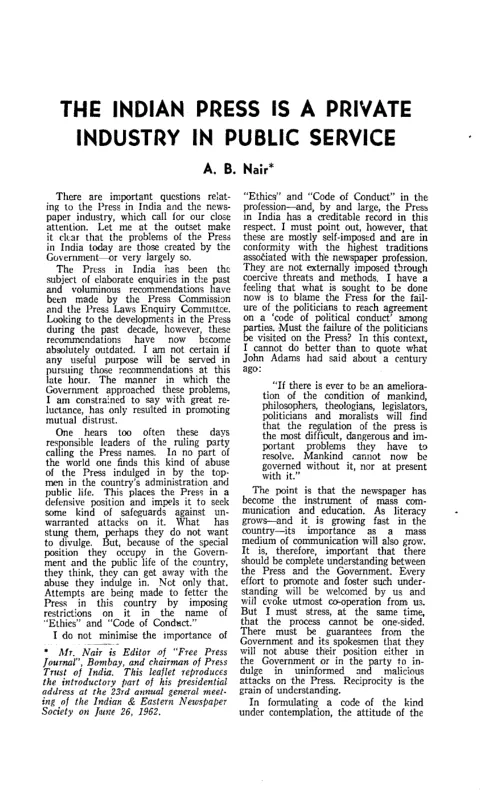
The Indian Press is a Private Industry in Public Service
By A. B. Nair
Summary
This two-page Forum of Free Enterprise leaflet reproduces the introductory part of A. B. Nair’s presidential address to the 23rd annual general meeting of the Indian & Eastern Newspaper Society, delivered on 26 June 1962. Nair, Editor of the Free Press Journal and chairman of the Press Trust of India, takes up the relationship between the press and the government in the wake of the Press Commission and the Press Enquiry Committee. He warns against the recent fashion for elaborate inquiries and recommendations that go unimplemented, and argues that a press indulged in by the government’s administration is, in fact, defensively positioned: every effort to set its house in order will be welcomed, but reform should not be imposed coercively in the name of ‘Ethics’ and a ‘Code of Conduct’.
Nair contends that the press, as a creditable record both during the past decade and earlier, is in the main self-imposed and conforms to the highest professional standards, and that a genuine code of conduct cannot be governed or dictated from outside the profession. Invoking John Adams’s century-old observation that a free press is so essential that ‘mankind cannot now be governed without it’, he resists official and party attacks made under cover of reform. He cautiously welcomes the popular recommendation for a Press Council — being set up under the new Information and Broadcasting Minister together with a Joint Press Consultative Council — to promote mutual understanding between the press and government, provided it works by sympathy rather than direction.
The address closes by framing the Indian press as ‘a private industry in public service’ and an instrument of national integration and public good. Nair holds that a press shackled at the risk of misleading a free people through dishonest reportage is a greater danger than a vigilant, independent, and competitively healthy press; in India, he concludes, a private industry today performs a great public service, and any measure that may be redundant must tend to strengthen rather than weaken this character of the press.
Key points
-
Two-page FFE leaflet reproducing the introductory part of A. B. Nair’s presidential address to the Indian & Eastern Newspaper Society’s 23rd AGM, 26 June 1962.
-
Nair was Editor of the Free Press Journal, Bombay, and chairman of the Press Trust of India.
-
Responds to the Press Commission and Press Enquiry Committee, criticising elaborate inquiries whose recommendations go unimplemented.
-
Argues a press ‘indulged in’ by government is defensively placed; reform should not be coercively imposed in the name of ‘Ethics’ and a ‘Code of Conduct’.
-
Holds that the Indian press’s standards are mainly self-imposed and that a code of conduct cannot be governed from outside the profession.
-
Quotes John Adams that a free press is so essential ‘mankind cannot now be governed without it’.
-
Cautiously welcomes a Press Council and Joint Press Consultative Council if they work by sympathy, not direction.
-
Frames the press as ‘a private industry in public service’ and an instrument of national integration; a shackled press is the greater danger.
Generated by the v1.5 extraction pipeline. Awaiting editorial review.
Metadata and summary are AI-extracted from the source PDF and reviewed for editorial accuracy. The original work is available via the Read PDF tab above (where present); paragraph-level citation inside the PDF is deferred to a future engagement.