pamphlet
The International Monetary System & the Role of Gold
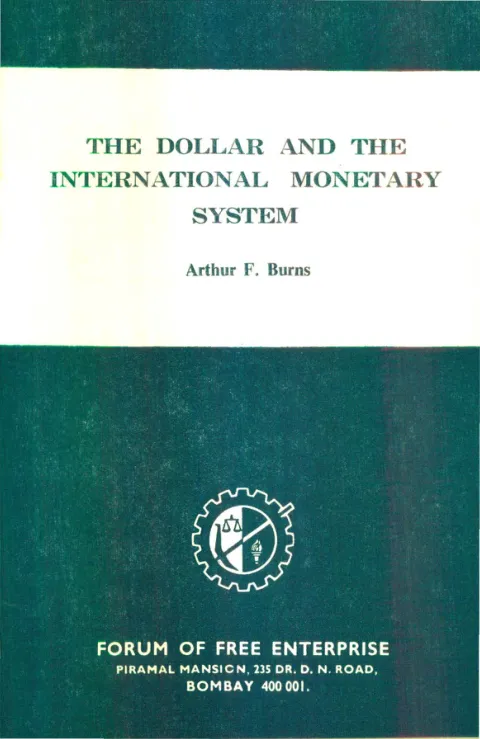
Published by M. R. PAI for the Forum of Free Enterprise, "Piramal Mansion", 235 Dr. Dadabhai Naoroji Road, Bombay-1, and printed by B. D. Nadirshaw at Bombay Chronicle Press, Sayed Abdulla Brelvi Road, Fort, Bombay-1. · Bombay · 1976
20 pages
The International Monetary System & the Role of Gold
By Robert S. Brown
Summary
In this Forum of Free Enterprise booklet, Robert S. Brown — Chairman and President of the First Federal Savings and Loan Association of Wisconsin — sets out to demystify the international monetary system for a general reader. He argues that domestic inflation, international inflation, and international monetary disorder are not separate problems but a single connected problem rooted in the over-creation of money and credit. Drawing on a long historical sweep, he traces money from primitive media of exchange to the eventual dominance of gold and silver, and warns that paper money, repeatedly tried since 13th-century China and 17th-century Europe, has chronically failed because governments cannot resist over-issuing it.
Brown defines money by three attributes — medium of exchange, measure of value, and trustworthy store of value — and contends that the store-of-value function is the one whose breakdown ultimately kills a currency, as it did in post-war Germany. He locates the cause of inflation in increases in ‘total demand’ that outrun production, financed either by government deficit spending or by credit expansion, and treats deficit-financed government as inherently inflationary.
Turning to the international system, Brown recounts how the inter-war abandonment of the gold standard unfolded — the 1931 collapse of Austria’s Kredit-Anstalt, Germany and Britain leaving gold, and the United States devaluing the dollar by 41 per cent in 1934 to fix gold at $35 an ounce. In the rendered pages he carries the story up to the dismantling of the gold link in the 1970s, closing with the August 1975 Group of Twenty Interim Committee agreement, the November 1975 Rambouillet summit, and the January 1976 Jamaica meeting that substituted SDRs for gold as the basis of the system. His parting argument is that a gold-tied system, like Bretton Woods, automatically limits the credit that can be created worldwide — and that this discipline is precisely what governments have sought to escape.
Key points
-
Brown frames domestic inflation, international inflation, and international monetary problems as one connected problem rather than isolated issues.
-
Money is defined by three attributes: medium of exchange, measure of value, and trustworthy store of value; the failure of the store-of-value function is what ultimately destroys a currency.
-
Paper money is presented as a chronically failing experiment (China in the 13th century, Europe from the 17th century), kept alive only because governments keep trying to use paper instead of gold.
-
Inflation is caused by ‘total demand’ rising faster than production, financed by government deficit spending or by credit expansion; deficit-financed government spending is treated as inherently inflationary.
-
The inter-war breakdown of the gold standard is narrated through the 1931 Kredit-Anstalt collapse and the 1934 US dollar devaluation that fixed gold at $35 an ounce.
-
The rendered text follows the unwinding of gold’s monetary role up to the August 1975 G-20 agreement, the November 1975 Rambouillet summit, and the January 1976 Jamaica meeting substituting SDRs for gold.
-
Brown’s central claim is that a gold-tied system, like Bretton Woods, automatically caps worldwide credit creation — a discipline governments have deliberately escaped.
Generated by the v1.5 extraction pipeline. Awaiting editorial review.
Metadata and summary are AI-extracted from the source PDF and reviewed for editorial accuracy. The original work is available via the Read PDF tab above (where present); paragraph-level citation inside the PDF is deferred to a future engagement.