book
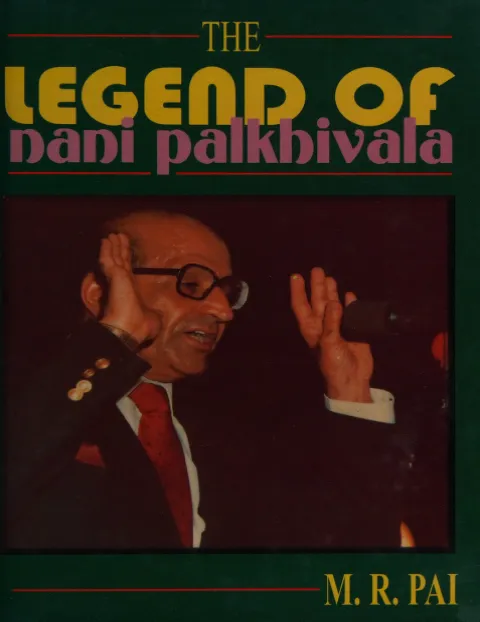
The Legend of Nani Palkhivala
By M. R. Pai
Popular Prakashan Pvt. Ltd., Mumbai · Mumbai · 2002
110 pages
The Legend of Nani Palkhivala
By M. R. Pai
Summary
The Legend of Nani Palkhivala is a personal tribute by the consumer activist and free-enterprise campaigner M. R. Pai, published by Popular Prakashan, Mumbai, in 2002, with the author taking no royalties so that the proceeds could go to the public causes dear to Palkhivala. Pai, who served as full-time Secretary of the Forum of Free Enterprise and followed Palkhivala “like a virtual shadow” through more than four decades of public life from 1957, is explicit that this is not a biography but an attempt to record the achievements of a man he regarded as the twentieth-century Dadabhai Naoroji and whom admirers called the Conscience of the Nation. The book is organised around Palkhivala’s qualities of head and heart and his contributions to public education, constitutional defence, public life and the corporate world.
Pai treats Palkhivala’s character as the real secret of his greatness — an uncompromising integrity that led him to declare his full income even when tax rates reached ninety-eight per cent, a deep sense of loyalty and moral debt to parents, teachers, clients and servants, a spontaneous compassion, and a humility that made him shrink from praise. These were joined to a rigorously cultivated mind: a photographic memory, rapid reading, total concentration and a near-obsessive mastery of time. This equipment underpinned his most famous public work, the annual budget lectures delivered under the Forum of Free Enterprise from 1958. Beginning before a few hundred listeners at Green’s Hotel, they grew until they filled the Brabourne Stadium with crowds reported at over a hundred thousand — described here as the largest public meetings ever held anywhere on an economic subject — turning the Union Budget into a matter of household discussion before he discontinued them after 1994.
Alongside the budget meetings the book records Palkhivala’s countrywide lecture tours on freedom, democracy and a rational, liberalised economy rooted in India’s traditional values, and his public-service writings — among them The Highest Taxed Nation, the standard reference The Law and Practice of Income-Tax written with Sir Jamshedji Kanga, Our Constitution Defaced and Defiled, We, the People and We, the Nation — from which he deliberately took no personal profit. It gives central place to his defence of the Constitution in the courts, above all the Kesavananda Bharati (Fundamental Rights) case, in which the Supreme Court held that Parliament could amend but not destroy the basic structure of the Constitution, and the 1975 attempt to have that ruling reconsidered, which was abandoned and the review bench dissolved after his arguments. Tributes from Justices H. R. Khanna and M. C. Chagla are quoted at length.
The closing sections turn to Palkhivala’s public life and lesser-known roles. Pai explains his subject’s deliberate refusal of political office — declining the Attorney-Generalship in 1968 and turning down cross-party offers of a safe parliamentary seat — on the ground that he could serve the country better from outside as its conscience, and recounts his term as India’s Ambassador to the United States (1977-79) under the Janata government and his decision to accept and then return Indira Gandhi’s brief when the Emergency was declared. A final chapter reveals his corporate leadership as a director of Tata companies and chairman of ACC, TCS and Tata Exports, while appendices reproduce his philosophy of life, his guiding principles, the best press profile of him and the written propositions he filed in the Kesavananda review.
Key points
-
A personal tribute (explicitly not a biography) by M. R. Pai, longtime Secretary of the Forum of Free Enterprise, drawn from over four decades of close association with Nani A. Palkhivala from 1957; published by Popular Prakashan, Mumbai (2002), with proceeds going to public causes.
-
Portrays Palkhivala’s “qualities of head and heart” — integrity (declaring his full income despite tax rates reaching ~98%), loyalty and moral debt, compassion, humility, patriotism, and a cultivated photographic memory and mastery of time — as the true source of his greatness.
-
Chronicles the legendary annual budget lectures under the Forum of Free Enterprise, from Green’s Hotel (1958) to Brabourne Stadium crowds exceeding 100,000 — described as the world’s largest public meetings on an economic subject — and his decision to discontinue them after 1994.
-
Recounts his countrywide lecture tours advocating freedom, democracy, a liberalised market economy and public morality, which earned him the title Conscience Keeper of the Nation.
-
Surveys his public-service writings — The Highest Taxed Nation, The Law and Practice of Income-Tax (Kanga and Palkhivala), Our Constitution Defaced and Defiled, We, the People — from which he took no personal profit.
-
Details his courtroom defence of the Constitution, above all the Kesavananda Bharati (Fundamental Rights) case and the basic-structure doctrine, and the 1975 review whose bench dissolved after his arguments; quotes tributes from Justices H. R. Khanna and M. C. Chagla.
-
Describes his deliberate choice to stay out of politics (declining the Attorney-Generalship in 1968 and cross-party offers of a parliamentary seat), his term as Ambassador to the USA (1977-79), and his return of Indira Gandhi’s brief when the Emergency was declared.
-
Notes his little-known corporate leadership — director of Tata companies and chairman of ACC, TCS and Tata Exports — and reproduces in appendices his philosophy of life, guiding principles and Kesavananda written propositions.
Ingested 2026-07-21 from the CCS source archive. AI-drafted summary awaiting editorial review.
Metadata and summary are AI-extracted from the source PDF and reviewed for editorial accuracy. The original work is available via the Read PDF tab above (where present); paragraph-level citation inside the PDF is deferred to a future engagement.