edited volume
The Liberal Budget 2005-06
The Way Forward
The Project for Economic Education · Mumbai · 2005
52 pages
No. 2 in The Liberal Budget
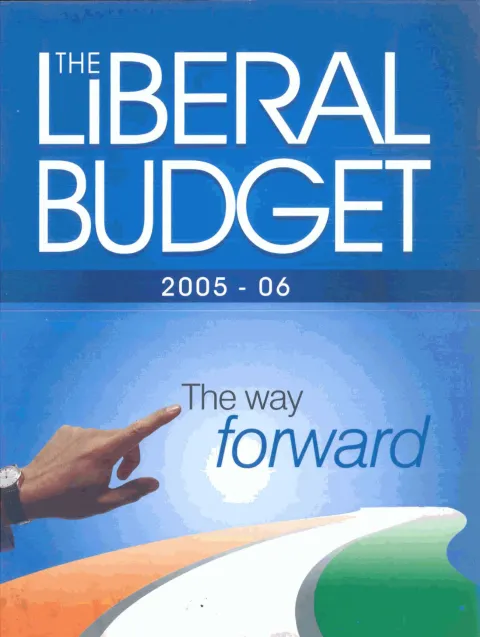
The Liberal Budget 2005-06
The Way Forward — Project for Economic Education (Drafting Group chaired by Sunil S. Bhandare)
Summary
The Liberal Budget 2005-06 – The Way Forward is the second annual “alternative budget” produced by the Project for Economic Education together with the Indian Liberal Group, drafted by a group chaired by Sunil S. Bhandare (formerly Economic Advisor, Tata Services Ltd.) and released in Mumbai in February 2005 with a preface by S. V. Raju and the assistance of the Friedrich Naumann Foundation. Opening with a C. Rajagopalachari epigraph and following the inaugural June 2004 volume (“Building an Equitable Society”), it is offered ahead of the Union Budget 2005-06 as a market-oriented template against which to benchmark the government’s own budget. Much of the document is a liberal critique of the newly elected UPA government’s two key policy statements — the National Common Minimum Programme (NCMP) and the Union Budget 2004-05 — welcoming areas of convergence (the operational FRBM Act, the Kelkar Task Force recommendations, VAT, Special Economic Zones and the targeting of subsidies to the poor) while attacking divergences such as the government’s U-turn on disinvestment, farm-price protection, reservations in the private sector and its defence of “navaratna” public-sector companies.
The drafting group’s central premise is that “the business of government is governance, not business” and that improving the common man’s welfare depends on faster growth, not on socialist means to socialist ends. It presents fully costed Liberal Budget estimates for 2005-06 and 2006-07: raising the Centre’s tax-to-GDP ratio from 9.2% in 2003-04 toward 12.1% by 2006-07, cutting the revenue deficit to about 1.5% and then 0.8% of GDP and the fiscal deficit to 3.5% and then 3.0%, and turning the primary balance into surplus — a sharper consolidation than the FRBM/government schedule, achieved through tax buoyancy and expenditure restraint rather than constant tinkering.
On public enterprises the budget urges a total ban on setting up new PSUs (bar atomic energy, space and critical defence), the immediate and full disinvestment of loss-making and BIFR-referred units, and at least Rs.35,000 crore of disinvestment proceeds “ring-fenced” for elementary education, basic health and civic amenities; an appendix lists roughly eighty PSUs recommended for immediate privatisation. On administration it proposes deep staff cuts — reducing central and state secretariat strength from over four lakh to under 50,000 via a liberal VRS — alongside merging fragmented ministries, separating regulatory functions from ownership functions, zero-based budgeting, paperless governance, and a reduction of subsidies of about 1% of GDP a year through better targeting and higher user charges. This gradualism is deliberate, invoking Gandhi’s “one step at a time” to justify conceding limited subsidies and not privatising every PSU at once.
On taxation the budget broadly endorses the Kelkar Task Force and seeks long-term rate stability by de-linking tax-law and tax-rate changes from the annual Budget (through a separate Tax Laws (Amendment) Act), ruling out retrospective amendments, deleting the Minimum Alternate Tax, harmonising depreciation with the Companies Act, extending presumptive taxation and the “one-by-six” net with a minimum Rs.1,000 tax on all individual and HUF return-filers, implementing State VAT from April 2005, cutting the Central Sales Tax from 4% to 1% and abolishing it by 2006, moving toward a unified national General Sales Tax, and bringing peak customs duty down to ASEAN-level (around 10%). A substantial “Social Sector Initiatives” chapter insists that social justice belongs to the liberal credo, calling for a doubling of health (to 3%) and education (to 6% of GDP) spending over five years, public-private partnership in Primary Health Centres, and outcome-based delivery of public services keyed to nine human-development targets.
Key points
-
The second annual “Liberal Budget” (after the June 2004 “Building an Equitable Society”), produced by the Project for Economic Education with the Indian Liberal Group; drafting group chaired by Sunil S. Bhandare, Mumbai, February 2005, aided by the Friedrich Naumann Foundation.
-
Framed as a market-oriented template presented ahead of the Union Budget 2005-06, critiquing the UPA’s National Common Minimum Programme and the Union Budget 2004-05 from a liberal viewpoint.
-
Fiscal targets: raise the Centre’s tax-to-GDP ratio from 9.2% (2003-04) toward 12.1% by 2006-07; cut the revenue deficit to ≈1.5% then 0.8% of GDP and the fiscal deficit to 3.5% then 3.0%, moving the primary balance into surplus — faster than the FRBM schedule.
-
Disinvestment: total ban on new PSUs (except atomic energy, space, defence), immediate full disinvestment of loss-making/BIFR units, at least Rs.35,000 crore of proceeds ring-fenced for education, health and civic amenities; an appendix lists ~80 PSUs for immediate sale, on the principle “the business of government is governance, not business”.
-
Administrative and expenditure reform: cut central and state secretariat staff from over 4 lakh to under 50,000 via a liberal VRS, merge fragmented ministries, separate regulator from owner, adopt zero-based budgeting and paperless governance, and trim defence spending toward 2.2–2.3% of GDP.
-
Subsidies: make them explicit and better targeted, reducing them by about 1% of GDP per year over five years through higher user charges — a Gandhian gradualism that stops short of privatising every PSU at once.
-
Tax reform: endorse the Kelkar Task Force; de-link tax-law and rate changes from the annual Budget; bar retrospective amendments; delete the Minimum Alternate Tax; extend presumptive tax and the “one-by-six” net with a minimum Rs.1,000 filer’s tax; implement State VAT from April 2005; cut Central Sales Tax 4% to 1% and abolish it by 2006; move to a unified national GST/VAT; bring peak customs duty to ASEAN-level (~10%).
-
Social sector: double health (to 3%) and education (to 6% of GDP) spending over five years, pursue public-private partnership in Primary Health Centres, and tie outcome-based service delivery to nine human-development targets.
Ingested 2026-07-21 from the CCS source archive. AI-drafted summary awaiting editorial review.
Metadata and summary are AI-extracted from the source PDF and reviewed for editorial accuracy. The original work is available via the Read PDF tab above (where present); paragraph-level citation inside the PDF is deferred to a future engagement.