speech · memorial lecture
The Need for Economic Statesmanship
Published by M. R. PAI for the Forum of Free Enterprise, "Sohrab House", 235 Dr. Dadabhai Naoroji Road, Bombay-1, and printed by Michael Andrades at Bombay Chronicle Press, Brelvi Syed Abdullah Road, Fort, Bombay-1. · Bombay · 1969
19 pages
No. 4 in A. D. Shroff Memorial Lecture
The Need for Economic Statesmanship
By S. L. Kirloskar
Summary
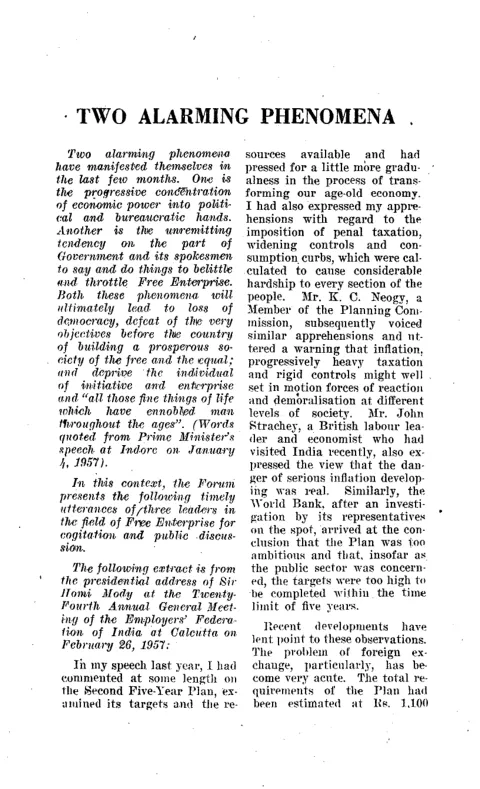
This Forum of Free Enterprise booklet is the text of the Fourth A. D. Shroff Memorial Lecture, delivered by the industrialist S. L. Kirloskar in Bombay on 29 October 1969. Kirloskar frames his subject around what A. D. Shroff had long pleaded for during his stewardship of the Forum: that the logic of the country’s long-range economic needs must be rescued from the influence of political expediency. Writing in the wake of the mid-1969 political upheavals, he announces that he will review the emerging political situation ‘more freely and frankly,’ rejecting the ‘fetish of academic caution’ that he feels constrains public pronouncements.
Kirloskar develops a portrait of the economic ‘statesman’ as a flesh-and-blood figure who tells hard truths and takes the long view, illustrating the type through historical contrasts: Neville Chamberlain the politician who ‘promised everything and gave nothing’ versus Winston Churchill who promised only ‘blood, toil, tears and sweat’; Sir Robert Peel sacrificing his premiership to repeal the Corn Laws for the sake of industry; and Abraham Lincoln staking his life on national unity. Against these he measures India’s leaders, charging that since 1947 they have substituted political zeal and a hunger for personal power for genuine economic statesmanship, expanding the government sector without first improving the performance of existing public industry.
The lecture is sharply critical of the rhetoric of his day. Kirloskar argues that the obsession with redistribution forgot that there must first be production to distribute, and that in a populous adult-franchise democracy leaders chose to ‘level everybody down’ rather than admit poverty had no socialist ‘sure-fire miracle’ cure short of sustained production. He pushes back on the Prime Minister’s charge that business lacks ‘social responsibility,’ retorting that strikes are uglier and more prolonged in the public sector and that the phrase has become a slogan leaders invoke to absolve themselves of spelling out concrete obligations. The rendered pages span the entire booklet.
Key points
-
Text of the Fourth A. D. Shroff Memorial Lecture, delivered by S. L. Kirloskar in Bombay on 29 October 1969.
-
Takes up Shroff’s plea to rescue long-range economic needs from political expediency.
-
Defines the economic ‘statesman’ as one who tells hard truths and takes the long view, not a folklore hero.
-
Illustrates statesmanship via Chamberlain vs Churchill, Robert Peel and the Corn Laws, Lincoln, and Kemal of Turkey.
-
Charges India’s leaders since 1947 with substituting personal-power politics for economic statesmanship.
-
Argues redistribution rhetoric forgot that production must precede distribution.
-
Contends democratic leaders chose to ‘level everybody down’ rather than admit poverty has no socialist quick fix.
-
Rebuts the Prime Minister’s ‘social responsibility of business’ charge, noting strikes are worse in the public sector.
Generated by the v1.5 extraction pipeline. Awaiting editorial review.
Metadata and summary are AI-extracted from the source PDF and reviewed for editorial accuracy. The original work is available via the Read PDF tab above (where present); paragraph-level citation inside the PDF is deferred to a future engagement.