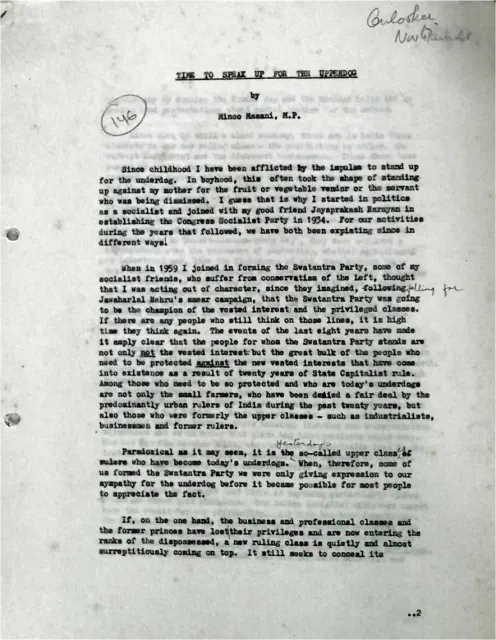
speech
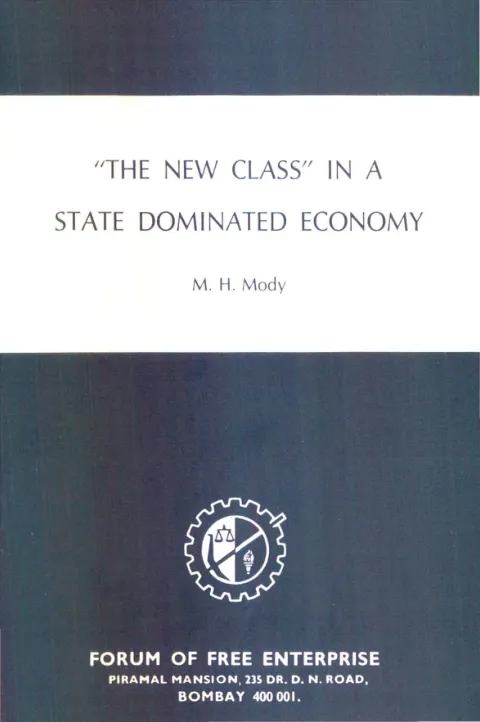
"The New Class" in a State Dominated Economy
By MH Mody
Published by M. R. PAI for the Forum of Free Enterprise, 235, Dr. Dadabhai Naoroji Road, Bombay-400 001, and printed at TATA PRESS Ltd., 414, Veer Savarkar Marg, Prabhadevi, Bombay 400 025. · Bombay · 1981
18 pages
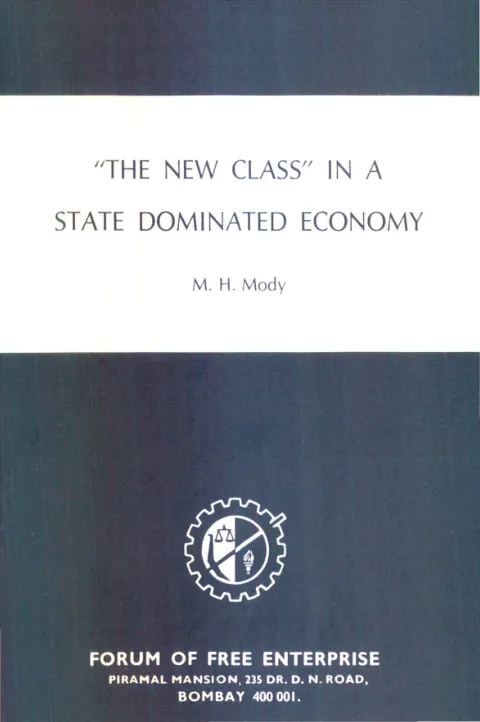
“The New Class” in a State Dominated Economy
By M. H. Mody
Summary
In this Forum of Free Enterprise booklet (colophon dated 15 October 1981), M. H. Mody — a past President of the Associated Chambers of Commerce & Industry — adapts an address delivered to an international seminar at Goa in December 1980 into a critique of the interventionist state. Borrowing the title from the Yugoslav dissident Milovan Djilas, Mody argues that the twentieth-century expansion of government, from the New Deal onward, has produced a ‘new class’: an educated, professionally entrenched group drawn from the ‘soft’ sciences (economics, politics, law, accountancy, sociology) who staff the bureaucracy, media, trade unions and public services and who derive their status from the very apparatus of state control.
Mody traces the consequences of a state-dominated economy: a high-cost economy in which every unit of output carries an additional cost from the system of controls, sluggish investment as entrepreneurs lose the motivation to grow, and a cycle of falling investment, rising unemployment, and recurrent stagnation. He catalogues India’s proliferating controls — industrial licensing, company law, foreign-exchange regulation, price controls, restrictions on essential commodities, limits on managerial remuneration, industrial-dispute law, import-export controls, and monopoly/restrictive-trade-practice law — noting that their failures are blamed by politicians not on inherent defects but on the controls ‘not being pervasive enough’.
The later pages turn to the bureaucracy itself: Mody contends it is subject to no quantitative test of efficiency, has no profit incentive, grows irrespective of relevance, and imposes uncounted costs of delay. He proposes American-style ‘sunset laws’ to give government departments a limited statutory life, and frames the bureaucrat, politician, businessman and trade-union boss as colluding partners in a self-perpetuating, mutually beneficial system. He closes with a qualified hopefulness that recognition of the need for radical reform is slowly emerging in India, while conceding ‘a lot of groping in the dark about what needs to be done’.
Key points
-
FFE booklet (colophon dated 15 October 1981) reprinting Mody’s address given at an international seminar in Goa in December 1980.
-
He credits the term ‘The New Class’ to Yugoslav leader Milovan Djilas, applying it to an educated professional stratum that thrives on state control.
-
The ‘new class’ is drawn from the ‘soft’ sciences and staffs education, media, public services, trade unions and business houses.
-
A state-dominated economy is characterised as a high-cost economy with sluggish investment, falling growth and rising unemployment.
-
India’s controls (licensing, company law, foreign exchange, price controls, etc.) are blamed by politicians for being insufficiently pervasive rather than inherently defective.
-
The bureaucracy is faulted for lacking any quantitative test of efficiency or profit incentive and for growing regardless of relevance.
-
Mody proposes ‘sunset laws’ giving government departments a limited statutory life (seldom exceeding ten years).
-
He frames bureaucrats, politicians, businessmen and trade-union bosses as colluding to perpetuate the system, but ends on cautious hope for reform.
Generated by the v1.5 extraction pipeline. Awaiting editorial review.
Metadata and summary are AI-extracted from the source PDF and reviewed for editorial accuracy. The original work is available via the Read PDF tab above (where present); paragraph-level citation inside the PDF is deferred to a future engagement.