pamphlet
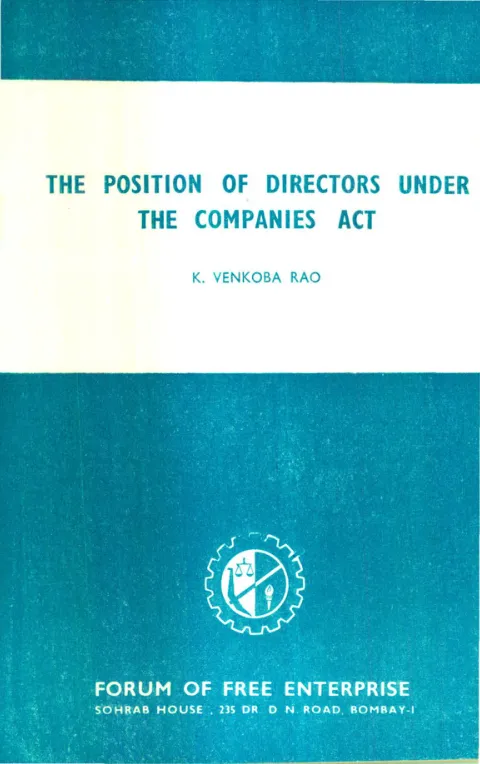
The Position of Directors Under the Companies Act
Forum of Free Enterprise, Sohrab House, 235 Dr. D. N. Road, Bombay-1 · Bombay · 1962
27 pages
The Position of Directors Under the Companies Act
By K. Venkoba Rao
Summary
In this Forum of Free Enterprise booklet, K. Venkoba Rao — described as the author of several books and articles on company and commercial law — offers a working exposition of the legal position of company directors under the Indian Companies Act as amended by the Amendment Act of 1960. He opens with the Act’s circular definition of a ‘director’ as ‘one who occupies the position of director’, and develops a political analogy: shareholders are both the electorate and the legislature, the board is at once a president (directly elected) and a cabinet (removable at any time). From there the booklet works systematically through the statutory machinery governing directors.
In the rendered pages, Rao covers the constitution of the board after the 1960 amendment (minimum numbers of directors, the treatment of ‘deemed public companies’ under Section 43A), share-qualification requirements and the exemptions for government-appointed directors, the grounds and procedure for vacation of office and removal, directors’ remuneration (the statutory ceilings on percentages of net profit), and the rules for board meetings, quorum, and notice. A recurring theme is the law on company political contributions: Rao notes that contributions to political parties must be disclosed in the profit-and-loss account, and argues pointedly that unless such contributions are banned and the election law tightened, ‘the prospect for real democracy in this country will indeed be very bleak.’ The treatment is practical and statute-anchored, aimed at directors, shareholders, and businessmen seeking to understand their obligations.
This summary is based on the first 20 of the work’s 27 pages; the booklet’s argument continues past the rendered set.
Key points
-
The Companies Act defines a director circularly as ‘one who occupies the position of director’; Rao likens the board to both a president and a cabinet.
-
After the Amendment Act of 1960, every public company must have at least three directors and every private company at least two.
-
Section 43A creates ‘deemed public companies’, complicating the application of director-number rules.
-
Directors must hold qualification shares and file a declaration with the Registrar within two months; government-appointed directors are exempt.
-
Directors vacate office for unsound mind, insolvency, failure to obtain qualification shares, absence from three consecutive meetings, conviction for moral turpitude, and other grounds; removal requires special notice.
-
Whole-time and managing directors’ remuneration is capped as a percentage of net profits, subject to Central Government approval.
-
Board meetings must be held at least once every three calendar months, with quorum of one-third of strength or two directors, whichever is higher.
-
Company contributions to political parties must be disclosed; Rao warns democracy is imperilled unless such contributions are banned and election law tightened.
Generated by the v1.5 extraction pipeline. Awaiting editorial review.
Metadata and summary are AI-extracted from the source PDF and reviewed for editorial accuracy. The original work is available via the Read PDF tab above (where present); paragraph-level citation inside the PDF is deferred to a future engagement.