speech
The Power Crisis
Published by M. R. Pai for the Forum of Free Enterprise, 3rd Floor, 235, Dr. D. N. Road, Bombay-400 001, and printed by H. Narayan Rao at H. R. Mohan & Co. (Press), 9-B, Cowasji Patel Street, Bombay-400 001. · Bombay · 1973
16 pages
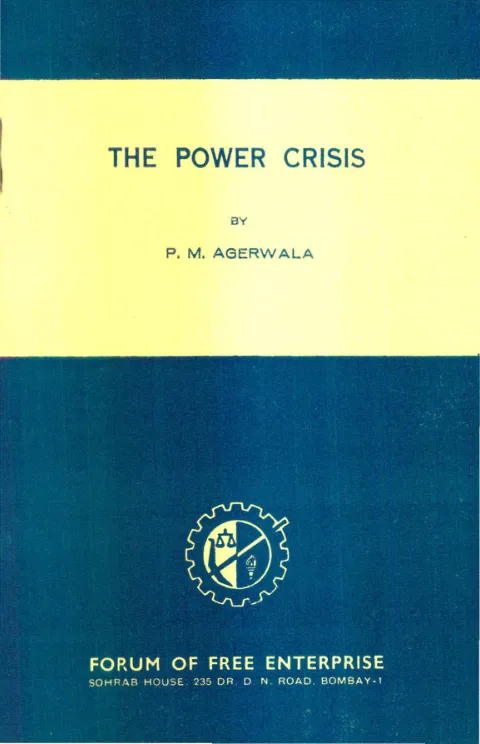
The Power Crisis
By P. M. Agerwala
Summary
This Forum of Free Enterprise booklet reprints a public lecture delivered in Bombay on 30th April 1973 by P. M. Agerwala, Managing Director of the Tata Electric Companies. Agerwala opens with the worsening power shortage in Western Maharashtra — what he calls ‘a power famine’ — recalling that the Tatas had warned the Government of Maharashtra of looming shortfalls as early as 1960 and again in 1965, only to be told their capacity additions would suffice. From this local case he builds a national diagnosis of why India’s power supply chronically lags demand.
The heart of the lecture is an indictment of how the power sector is run rather than merely a call for more capacity. Agerwala highlights heavy transmission and distribution losses — far above the 5.7-12.5% typical of European systems — as a waste of national resources that planners then compensate for by building still more generating capacity instead of fixing the network. He points to poor maintenance, inadequate training of operating staff, frequent unscheduled plant stoppages, and (quoting a 1972 power-sector journal) the ‘incompetent management’ of public-sector systems, particularly in West Bengal and the Eastern Region. Against this he sets the Tata Electric Companies’ own record: by deploying modern management techniques and computer control, they achieved an average output at Trombay of 6,800 kW-hours per annum in 1972-73, against a national average of 3,500 and the world’s best-maintained station’s 5,800.
Agerwala closes by lamenting that Indian public opinion is not strong enough to press the Government on the poor operation of electricity systems, and insists that a dependable electric service — a goal Parliament has endorsed — requires the cooperation of central and state regulatory bodies. The public, he argues, has a right to expect a response from the Government.
Key points
-
Western Maharashtra faces a ‘power famine’; the Tatas warned the state government of shortfalls as early as 1960 and 1965.
-
Transmission and distribution losses are a major waste of national resources, far above the 5.7-12.5% range typical of European systems.
-
Planners build additional generating capacity to compensate for high losses rather than reducing the losses themselves.
-
Poor maintenance, inadequate staff training, and frequent unscheduled plant stoppages are core weaknesses of the system.
-
Agerwala quotes a 1972 power-sector journal blaming the ‘incompetent management’ of public-sector systems in West Bengal and the Eastern Region.
-
Tata Electric achieved 6,800 kW-hours per annum at Trombay in 1972-73, versus a national average of 3,500 and the world’s best of 5,800.
-
Modern management techniques and computer control can reduce system losses and optimise grid operation.
-
Indian public opinion is too weak to hold the Government to account on power-sector performance; the public has a right to a response.
Generated by the v1.5 extraction pipeline. Awaiting editorial review.
Metadata and summary are AI-extracted from the source PDF and reviewed for editorial accuracy. The original work is available via the Read PDF tab above (where present); paragraph-level citation inside the PDF is deferred to a future engagement.