pamphlet
The Problem of Foreign Exchange
Published by M. R. PAI for Forum of Free Enterprise, "Sohrab House", 235, Dr. Dadabhai Naoroji Road, Bombay 1, and printed by P. A. RAMAN at Inland Printers, 55 Gamdevi Road, Bombay 7 · Bombay · 1961
4 pages
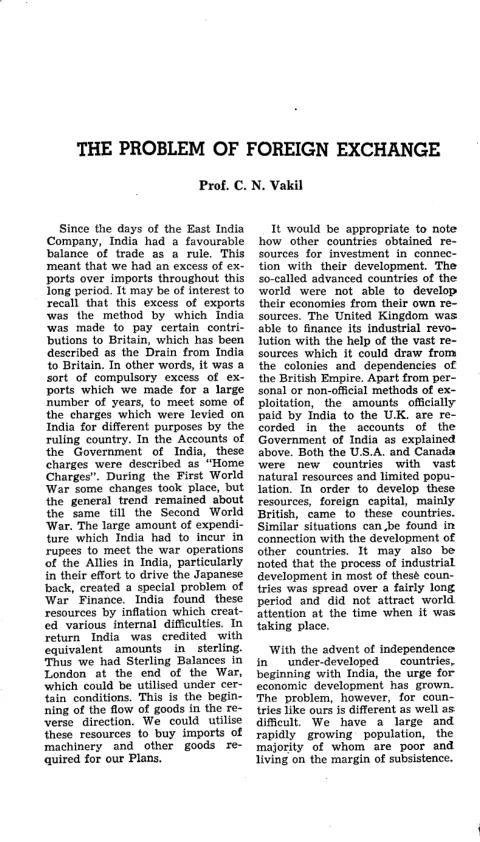
The Problem of Foreign Exchange
By Prof. C. N. Vakil
Summary
In this short Forum of Free Enterprise leaflet, the economist Prof. C. N. Vakil examines India’s chronic foreign-exchange problem in the early 1960s. He opens with a historical contrast: from the East India Company era through the two World Wars, India ran an export surplus and accumulated sterling balances in London, but with independence and the launch of planned economic development the country shifted to a large and persistent import surplus, driven by the need to buy machinery and goods for its Plans. Vakil situates India among under-developed countries with large, rapidly growing populations living near subsistence, for whom industrial development is both urgent and foreign-exchange-intensive.
Vakil argues that India can no longer rely on the colonial-era mechanisms or on long-term foreign loans alone, and that earning foreign exchange through exports must become a national priority. He stresses that export trade should be treated as a profitable business in the hands of specialists rather than as a by-product of other activity, and calls for a national code of honour among exporters, government incentives and subsidies in the early stages, research teams, and active government-business cooperation to study and capture world markets. The leaflet closes with a ten-point programme for developing ‘export consciousness’ so the country can earn the foreign exchange it requires.
Key points
-
India historically ran an export surplus and built sterling balances in London until independence.
-
Planned development created a persistent import surplus to buy machinery and goods for the Plans.
-
India is framed as a populous under-developed economy where industrialisation is urgent but foreign-exchange-hungry.
-
Long-term foreign loans alone are inadequate; exports must become a national priority.
-
Export trade should be a profitable business run by specialists, not a by-product of other activity.
-
Calls for a national code of honour among exporters, plus government subsidies/incentives in early stages.
-
Recommends research teams, exhibitions/fairs, and active government-business cooperation on world markets.
-
Concludes with a ten-point programme to build national ‘export consciousness’.
Generated by the v1.5 extraction pipeline. Awaiting editorial review.
Metadata and summary are AI-extracted from the source PDF and reviewed for editorial accuracy. The original work is available via the Read PDF tab above (where present); paragraph-level citation inside the PDF is deferred to a future engagement.