pamphlet
The Problem of Rising Prices — Causes and Remedy
Published by M. R. PAI for the Forum of Free Enterprise, 235, Dr. Dadabhai Naoroji Road, Bombay 1, and Printed by Michael Andrades at the Bombay Chronicle Press, Horniman Circle, Bombay-1 · Bombay · 1964
11 pages
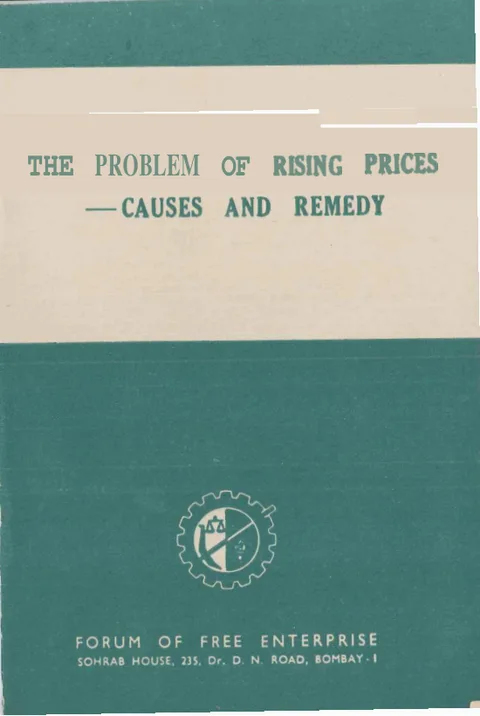
The Problem of Rising Prices — Causes and Remedy
By A. S. BHASKAR
Summary
Originally delivered as a speech at a Chamber’s first quarterly general meeting on 9 June 1964 and reprinted by the Forum of Free Enterprise, this booklet by A. S. Bhaskar, Financial Editor of the Times of India, diagnoses the causes of India’s rising prices and prescribes remedies. Bhaskar opens by clearing away three ‘common pitfalls’: the erroneous belief that absolute price stability is a prerequisite for progress (prices must fluctuate within reasonable limits as they reflect supply and demand), the habit of hunting for scapegoats instead of examining root causes, and the mistaken notion that prices respond to politicians’ pronouncements rather than economic forces.
The core of his analysis is the abnormal price rise since 1962, concentrated in foodgrains. He attributes it to a widening supply-demand gap: foodgrain production failing to keep pace with a population growing at about 2.3 per cent a year and rising per-capita consumption as incomes increase, compounded by hoarding and farmers withholding stocks in expectation of higher prices. He marshals tabular data on the shortfalls between Third Plan agricultural targets and actual attainment in irrigation, fertilisers, improved seeds and soil conservation, and notes heavy reliance on imports under P.L. 480.
Bhaskar is sharply critical of the government’s response, particularly zoning restrictions on the movement of foodgrains, state-to-state import arrangements, and creeping state trading, which he argues disrupt normal trade channels, eliminate the wholesaler, and fail to benefit consumers. His remedy is to treat increased production as the only durable cure, to relax movement controls and let surplus grain flow freely to deficit zones, and to avoid substituting state trading for the market mechanism.
Key points
-
Reprint of a speech given at a Chamber’s first quarterly general meeting on 9 June 1964.
-
Rejects three pitfalls: that absolute price stability is necessary, scapegoating, and that politicians control prices.
-
Locates the abnormal post-1962 inflation chiefly in foodgrains.
-
Root cause is a supply-demand gap: production lagging population growth (~2.3% p.a.) and rising consumption.
-
Hoarding and farmers withholding stocks in expectation of higher prices aggravate the rise.
-
Documents shortfalls against Third Plan agricultural targets and reliance on P.L. 480 imports.
-
Sharply criticises zoning controls, state-to-state arrangements and state trading as disruptive.
-
Remedy: boost production, free up grain movement to deficit zones, avoid replacing the market with state trading.
Generated by the v1.5 extraction pipeline. Awaiting editorial review.
Metadata and summary are AI-extracted from the source PDF and reviewed for editorial accuracy. The original work is available via the Read PDF tab above (where present); paragraph-level citation inside the PDF is deferred to a future engagement.