speech
The Relevance of Rajaji's Economic Thinking Today
By M. R. Pai
Bangalore Education Trust, Bangalore · Bangalore · 1984
11 pages
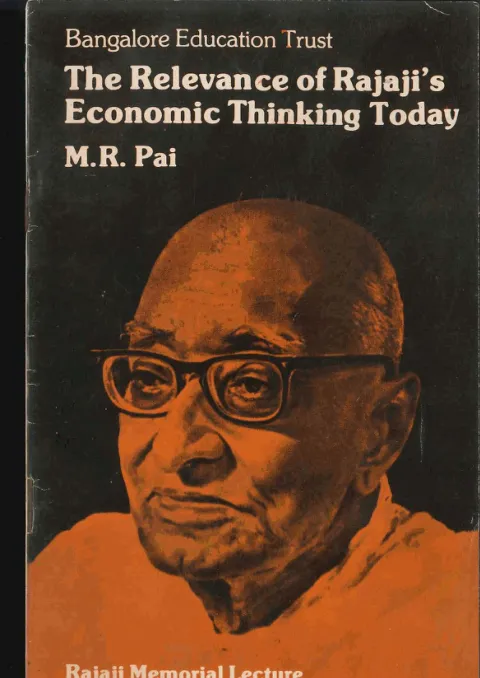
The Relevance of Rajaji’s Economic Thinking Today
By M. R. Pai
Summary
“The Relevance of Rajaji’s Economic Thinking Today” is the inaugural Rajaji Memorial Lecture, delivered by M. R. Pai — Vice-President of the Forum of Free Enterprise, Bombay — under the auspices of the Bangalore Education Trust on 5 December 1983 at the Gokhale Institute of Public Affairs Hall in Bangalore, and published as a free-distribution booklet in March 1984. Pai’s argument is that the free-market economic thinking of C. Rajagopalachari (Rajaji), set out chiefly in his “Swarajya” essays of the late 1950s and early 1960s and collected in the volumes titled “Satyam Eva Jayate”, has been vindicated by the economic events that followed. He opens with a personal recollection of meeting Rajaji in 1957, when Rajaji urged businessmen to give up their fears and speak out boldly on economic policy in the public interest.
The lecture locates the root of Rajaji’s economics in freedom. His overriding concern, Pai stresses, was the welfare of the poor, which Rajaji believed could be raised only by increasing production and economic opportunity rather than by redistributing existing wealth. From this followed his opposition to statism and to state intervention beyond legitimate limits — an all-pervasive control regime he memorably christened the “Permit-Licence-Quota Raj”. Rajaji held that monopolies arise from state trading and management, not from private enterprise, and drew a sharp line between regulations (factory and labour law, consumer protection, environmental measures), which he accepted as necessary in any society, and controls on production, distribution and prices, which he judged self-defeating except in the abnormal conditions of war or famine.
Pai then traces Rajaji’s relentless campaigns against deficit financing and inflation — for which Rajaji approvingly cited the economist Prof. B. R. Shenoy — and against heavy taxation. Inflation, Rajaji argued, impoverishes the masses and shifts income to the upper groups, while almost all taxes, direct or indirect, ultimately fall on the consumer; in one of his telling images, whether the donkey carries the load on its back or the rider carries it on his head, it is the donkey that bears the whole burden. Confiscatory rates such as the 98 per cent income tax, he held, merely encouraged evasion and yielded declining returns. Pai extends the same reasoning to Rajaji’s critique of an ideological public sector built for its own sake — captured in the essay “The Anti-Profit Slogan” — and marshals a battery of 1983 loss figures for state-owned hotels, electricity boards and transport undertakings. To retrieve the situation he proposes four reforms: closing or selling chronic loss-makers, selling 49 per cent of shares in other units to employees and the public, granting the enterprises full autonomy free of political interference, and requiring them to borrow on commercial terms instead of leaning on budgetary support.
Finally, the lecture sets out Rajaji’s condemnation of totalitarian, Soviet-style comprehensive planning in favour of indicative planning that leaves maximum scope for the peasant, the weaver and the artisan, together with his warning against depressing farm prices and his plea (in the 1957 booklet “Our Democracy”) for greater autonomy to the States as a remedy for over-centralisation and Centre-State tension. Underlying it all, Pai argues, is Rajaji’s governing concept of Dharma, or righteousness, in which the individual performs his own duty and the State performs its “Swadharma” — defence, law and order, infrastructure, education, public health, sound currency and the machinery of justice — while regulating rather than supplanting individual enterprise. Pai concludes that, in the light of subsequent economic events, Rajaji’s economic philosophy is more relevant than ever.
Key points
-
The inaugural Rajaji Memorial Lecture, delivered by M. R. Pai (Vice-President, Forum of Free Enterprise, Bombay) for the Bangalore Education Trust on 5 December 1983 and published as a free-distribution booklet in March 1984.
-
Argues that Rajaji’s free-market economics — drawn from his “Swarajya” essays, collected as “Satyam Eva Jayate” — has been vindicated by events; opens with Pai’s 1957 memory of Rajaji urging businessmen to speak out fearlessly.
-
Roots Rajaji’s thinking in freedom: the poor are helped by more production, not redistribution; hence his opposition to statism, which he branded the “Permit-Licence-Quota Raj”.
-
Holds that monopolies arise from state trading and management, not private enterprise; distinguishes acceptable regulations from self-defeating controls on production, distribution and prices (justified only in war or famine).
-
Recounts Rajaji’s war on deficit financing and inflation (citing Prof. B. R. Shenoy) and on heavy taxation — all taxes ultimately fall on the consumer, and the 98 per cent income tax was confiscatory and self-defeating.
-
Presents Rajaji’s critique of an ideological public sector (“The Anti-Profit Slogan”), backed by 1983 loss figures for state-owned hotels, electricity boards and transport undertakings.
-
Sets out Pai’s four-step reform: close or sell hopeless loss-makers; sell 49 per cent of shares to employees and the public; grant full autonomy free of political interference; make units borrow on commercial terms rather than take budgetary support.
-
Covers Rajaji’s rejection of Soviet-style totalitarian planning for indicative planning, his defence of peasants, weavers and artisans, his call for greater State autonomy (in “Our Democracy”, 1957), and the unifying concept of Dharma / Swadharma.
Ingested 2026-07-21 from the CCS source archive. AI-drafted summary awaiting editorial review.
Metadata and summary are AI-extracted from the source PDF and reviewed for editorial accuracy. The original work is available via the Read PDF tab above (where present); paragraph-level citation inside the PDF is deferred to a future engagement.