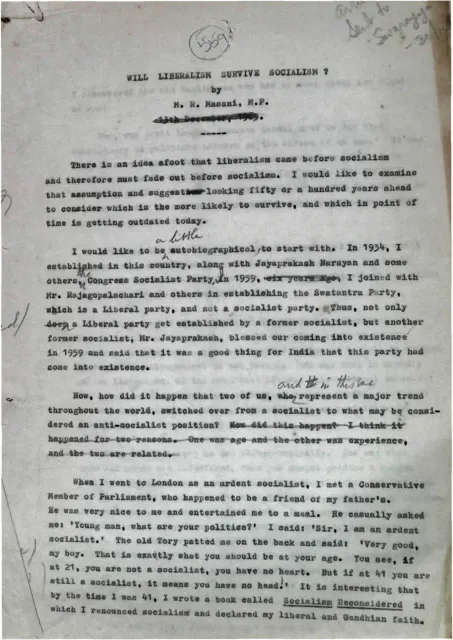
edited volume · anthology
Socialism
By K. Santhanam, Dr. R. C. Cooper
Published by M. R. PAI for the Forum of Free Enterprise. "Sohrab House", 235 Dr. Dadabhai Naoroji Road, Bombay-1. and printed by Michael Andrades at Bombay Chronicle Press. Syed Abdullah Brelvi Road. Fort, Bombay-1. · Bombay · 1970
17 pages
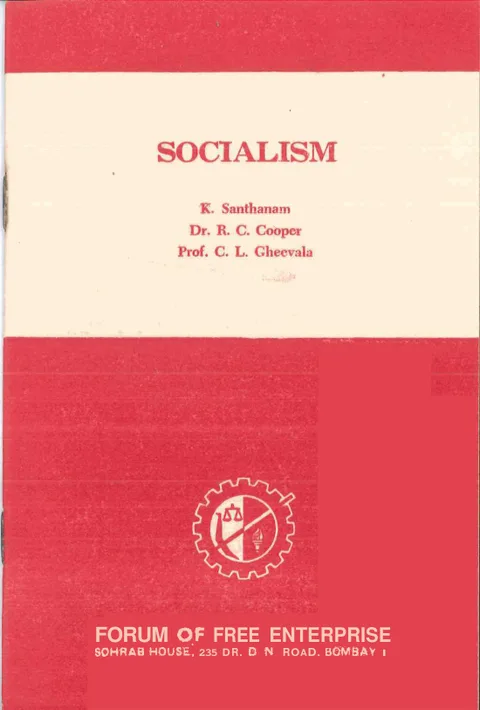
Socialism
Summary
This 28-page Forum of Free Enterprise booklet, dated 10 November 1970, gathers three essays on socialism by K. Santhanam (former Minister of State for Railways and Chairman of the Second Finance Commission), Dr. R. C. Cooper (Chartered Accountant and FFE Vice-President), and Prof. C. L. Gheevala (Secretary of the Indian Merchants’ Chamber, Bombay). The contributions converge on a single argument: India’s actually-existing socialism, organised around expanding State enterprise and nationalisation, has degenerated into State Capitalism — wasteful, bureaucratised, corruption-prone, and indifferent to its declared aims of full employment, equality, and social security.
The volume is editorially polemical but draws on heterogeneous authorities — Marx and Engels are read historically rather than dismissed, while the contributors cite J. R. D. Tata’s praise of Singapore, B. R. Shenoy on income redistribution, A. B. Shah on socialism’s Indian patronage class, and the British revisionists Crosland and Crossman on the limits of nationalisation. The cumulative case is that genuine socialist objectives — productive employment, social security, dispersed economic power — are better served by a regulated mixed economy with a strong private sector than by the steady extension of bureaucratic State ownership.
Key points
-
K. Santhanam argues that twentieth-century Western capitalism has transformed since Marx’s day, diffusing ownership through shareholders and redistributing surpluses through welfare-state taxation.
-
Santhanam holds that Stalin’s Soviet Union did not achieve socialism but built total State Capitalism, with the State itself acting as a single, totalitarian capitalist.
-
Santhanam faults India’s Planning Commission for equating State Capitalism with socialism by extending state ownership into consumer industries such as cars, scooters, hotels, sugar mills and textiles.
-
For Santhanam, genuine socialism means full employment on a living wage, free social services and comprehensive social security, pursued through decentralised private production rather than nationalisation.
-
Dr R. C. Cooper distinguishes a modern ‘20th Century Socialism’, which rejects Marxian class warfare and absolute equality in favour of equality of opportunity and dispersed ownership.
-
Cooper cites B. R. Shenoy’s finding that Indian nationalisation has transferred income upward from the middle and lower classes rather than redistributing it downward.
-
Cooper contrasts J. R. D. Tata’s account of Singapore’s pro-enterprise growth with India’s stagnation, alongside Australia, Japan, Hong Kong, Formosa, Thailand and Malaysia as evidence that prosperity follows when the state governs rather than trades.
-
Cooper lists nine features of 20th Century Socialism, including reliance on private enterprise, removal of paralysing controls and hostility to confiscatory taxation, and warns the Fourth Plan will leave 27 million unemployed by 1975.
-
Both essayists conclude that a regulated mixed economy with a strong private sector serves socialism’s declared goals of employment, equality and social security better than continued extension of bureaucratic State ownership.
Essays
Socialism or State Capitalism?
By K. Santhanam
Santhanam opens the booklet by historicising the dispute between capitalism and socialism. He reconstructs the conditions of early industrialisation that produced Marx’s doctrine — low agrarian wages, harsh factory conditions, surpluses appropriated by a tiny capitalist class — and argues that 20th-century capitalism in advanced countries has transformed itself almost into the opposite of its 19th-century form, with diffuse shareholder ownership, managerial control, and welfare-state taxation that redirects profits into social services. Soviet ‘industrialisation’ under Stalin, by contrast, simply substituted total State Capitalism for private capitalism, with the State assuming the role of a single, totalitarian capitalist.
Applying this lens to India, Santhanam attacks the Planning Commission’s habit of treating State Capitalism as identical to socialism. He concedes the State’s necessary role in infrastructure (railways, posts, roads, irrigation) but condemns its proliferation into car and scooter manufacturing, hotels, sugar mills and textiles, where bureaucratic management produces neither efficiency nor genuine worker benefit. He calls instead for full employment on a living wage, free social services, and a comprehensive social-security system — pursued through wide decentralisation of economic initiative and active encouragement of private production rather than through nationalisation.
- Capitalism and socialism must be re-examined because both have changed radically since Marx’s time, with modern Western capitalism diffusing ownership through shareholders and redistributing surpluses through taxation.
- Soviet ‘socialism’ under Stalin became total State Capitalism — the State acting as the sole, totalitarian capitalist — rather than a genuine emancipation of labour.
- India’s Planning Commission has wrongly equated State Capitalism with socialism by extending State undertakings into consumer industries (cars, scooters, hotels, textiles, sugar) where they are wasteful and inefficient.
- True socialism, for Santhanam, means full employment on a living wage, free social services for all, and comprehensive social security — objectives State Capitalism in India has manifestly failed to deliver.
- The path forward is wide decentralisation of economic initiative, active encouragement of private production, and concrete housing and employment programmes rather than further nationalisation.
Twentieth Century Socialism
By Dr. R. C. Cooper
Cooper argues that socialism as a creed has not stood still since Marx, and that a distinct ‘20th Century Socialism’ has emerged outside the Iron Curtain that India would do well to adopt. He distinguishes this modern conception from both ‘classical capitalism’ and ‘19th-century’ socialism on three grounds: it no longer relies wholly on nationalisation of the means of production, it rejects Marxian class-warfare as the route to human upliftment, and it abandons absolute equality in favour of equality of opportunity and dispersed ownership. The Indian variant, by contrast, remains tethered to obsolete dogmas that have entrenched a corrupt nexus of politicians, bureaucrats and businessmen — a charge he pins on Prof. A. B. Shah — while B. R. Shenoy’s work shows that nationalisation has actually transferred large incomes from middle and lower classes upward.
The essay’s argumentative centrepiece is a long comparison drawn from a recent speech of J. R. D. Tata, contrasting Singapore’s growth miracle under pragmatic, pro-enterprise leadership with India’s stagnation. Singapore, Australia, Japan, Hong Kong, Formosa, Thailand and Malaysia are presented as proof that prosperity follows when ‘the business of the State is to govern and not trade’. Cooper closes by identifying nine features of 20th Century Socialism — primary reliance on private enterprise, removal of paralysing controls, hostility to confiscatory taxation, encouragement of private wealth-creation — and warns that India’s Fourth Plan, on the Government’s own figures, will leave 27 million people unemployed by 1975.
- 20th Century Socialism has moved decisively away from nationalisation and class-war Marxism toward private enterprise, equality of opportunity, and dispersed ownership.
- Indian socialism, by clinging to 19th-century dogmas, has produced a ‘most loyal champion’ class of corrupt politicians, bureaucrats and businessmen rather than genuine egalitarian outcomes.
- Nationalisation in India, far from levelling incomes, has — as B. R. Shenoy has shown — transferred wealth from the middle and lower classes upward, with senior officials drawing 848 times the per capita income.
- J. R. D. Tata’s data on Singapore (and parallel evidence from Australia, Japan, Hong Kong, Formosa, Thailand and Malaysia) demonstrates that prosperity tracks pragmatic pro-enterprise policy, not socialist rhetoric.
- On the Government’s own Fourth Plan figures, unemployment will reach 27 million by 1975, exposing the practical bankruptcy of India’s State-led model.
Socialist Dilemma
By Prof. C. L. Gheevala
Gheevala frames the socialist predicament as one of identification: socialists today increasingly accept that private enterprise, nationalisation, central planning and bureaucratisation are tools, not ends, and must be judged by results. Drawing on C. A. R. Crosland’s evidence that Western capitalism has lifted living standards without delivering the catastrophic immiseration Marx predicted, he argues that the Marxian equation of socialism with collective ownership of production has been overtaken. The Socialist Union’s ‘Twentieth Century Socialism’ is cited approvingly for treating the economy as a mixed system in which private spending and ownership and private enterprise have an indispensable, positive role — not as a relic to be tolerated but as a necessary check on the State and a guarantor of individual freedom.
The essay’s polemical edge falls on bureaucratic over-centralisation and what Gheevala, citing R. H. Crossman, calls the danger to liberty posed by a State apparatus whose authority must be increased to discipline the Public Sector itself. Echoing Gandhi’s warning against the State as Leviathan and quoting John Jewkes on the ‘creeping paralysis’ of planning, he closes by invoking an 1846 Times warning — that ‘the greatest tyranny has the smallest beginnings’ — to make the case for eternal vigilance against the gradual capitulation of the planner-democrat to total planning.
- Socialists are abandoning the doctrinaire identification of socialism with collective ownership and instead measuring it by employment, welfare and self-expression outcomes.
- C. A. R. Crosland and the British Socialist Union demonstrate that modern capitalism has raised living standards without Marx’s predicted collapse, so the Marxian thesis has ‘become irrelevant’.
- A genuine socialist economy must be a mixed one in which private enterprise plays a positive, indispensable role — not a tolerated relic — as a check on State power.
- Bureaucratic over-centralisation produces inefficiency, debased culture and the concentration of unaccountable power, threatening the very freedoms socialism claims to defend.
- Citing Gandhi, Jewkes, and an 1846 Times warning, Gheevala urges ‘eternal vigilance’ against the planner who ‘starts as an ardent lover of freedom’ but capitulates to total planning.
Generated by the v1.5 extraction pipeline. Awaiting editorial review.
Metadata and summary are AI-extracted from the source PDF and reviewed for editorial accuracy. The original work is available via the Read PDF tab above (where present); paragraph-level citation inside the PDF is deferred to a future engagement.