speech · memorial lecture
The Role of the Judiciary in Parliamentary Democracy
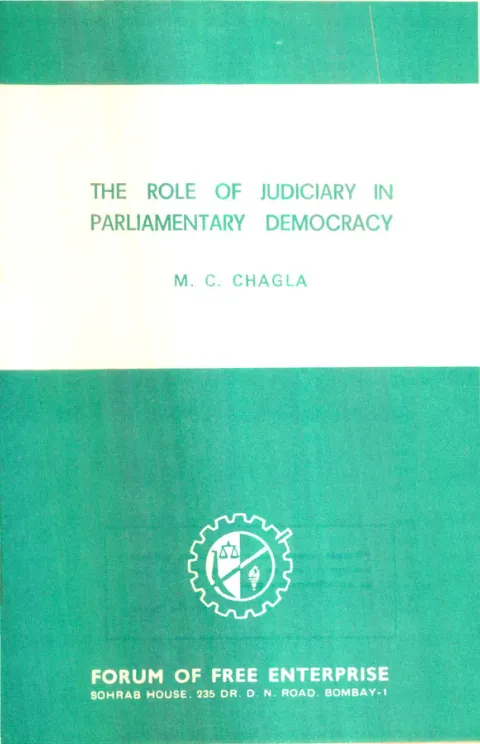
By M. C. Chagla
Published by S. S. Bhandare for the Forum of Free Enterprise, Peninsula House, 2nd Floor, 235, Dr. D. N. Road, Mumbai 400001, and Printed by S. V. Limaye at India Printing Works, India Printing House, 42 G. D. Ambekar Marg, Wadala, Mumbai 400 031. · Mumbai · 2011
14 pages
No. 9 in A. D. Shroff Memorial Lecture
The Role of the Judiciary in Parliamentary Democracy
By M. C. Chagla
Summary
This Forum of Free Enterprise pamphlet (issued January 2011) reproduces the text of Justice M. C. Chagla’s ninth A. D. Shroff Memorial Lecture, delivered in Bombay on 28th October 1974. Chagla — eminent jurist and former Chief Justice of Bombay, Ambassador to the U.S.A. and Education Minister in the Government of India — examines the unique and crucial role of the Judiciary in a parliamentary democracy. He argues that although Parliament in England is supreme and sovereign, in India the Constitution is supreme, and the Judiciary, while in one sense a subsidiary organ interpreting the law, plays a major role that in a sense places it above Parliament because it decides on the constitutionality of legislation and can strike down any law that oversteps the Constitution.
Chagla contends that the founding fathers wisely preferred the American model of judicial review to the British model of parliamentary supremacy, particularly given Indian conditions where a single dominant party can lack a viable opposition. Without the power of judicial review, he warns, a one-party Government could resolve itself into the dictatorship of a single individual; the most dangerous dictatorship is one based on democratic forms and the paraphernalia of democracy, in which a dictator masquerades as the representative of the people while carrying out his own whims. He frames the other central function of the Judiciary as the protection of individual rights against an ever-expanding, increasingly monolithic Government that tends to suppress dissent — a negation of real democracy, which postulates the dispersal of power and the freedom to think and write what may be unpalatable to Government.
The lecture insists that to be the custodian of citizens’ rights the Judiciary must be independent and impartial, owing no master and consigning to the waste paper basket any directions even from the President or Prime Minister; every judge brings a personal philosophy — what Holmes called the inarticulate major premise — but must revere only the Constitution. Chagla devotes pointed attention to the supersession of three senior Supreme Court judges and the manipulated appointment of the Chief Justice of India, condemning these as attempts to make the Judiciary partisan and to render judges henchmen of those in authority. He closes by affirming that the will of the people can only be manifested through public opinion and that an independent, dignified Judiciary can prevent Government from undermining the Constitution. The booklet appends a biographical note on A. D. Shroff (1899-1965), the FFE founder in whose memory the lecture series runs.
Key points
-
The text is Justice M. C. Chagla’s ninth A. D. Shroff Memorial Lecture, delivered in Bombay on 28 October 1974, reprinted by FFE in January 2011.
-
In India the Constitution, not Parliament, is supreme, and the Judiciary can strike down laws that overstep it.
-
The founding fathers wisely preferred the American model of judicial review over British parliamentary supremacy.
-
Without judicial review, one-party government risks becoming the dictatorship of a single individual cloaked in democratic forms.
-
A second core function of the Judiciary is protecting individual rights against an expanding, monolithic Government that suppresses dissent.
-
Judicial independence requires impartiality and owing no master — directions even from the President or PM go ‘to the waste paper basket’.
-
Chagla condemns the supersession of three senior Supreme Court judges and the manipulated appointment of the Chief Justice of India.
-
The booklet appends a biographical note on A. D. Shroff (1899-1965), FFE’s founder.
Generated by the v1.5 extraction pipeline. Awaiting editorial review.
Metadata and summary are AI-extracted from the source PDF and reviewed for editorial accuracy. The original work is available via the Read PDF tab above (where present); paragraph-level citation inside the PDF is deferred to a future engagement.