speech
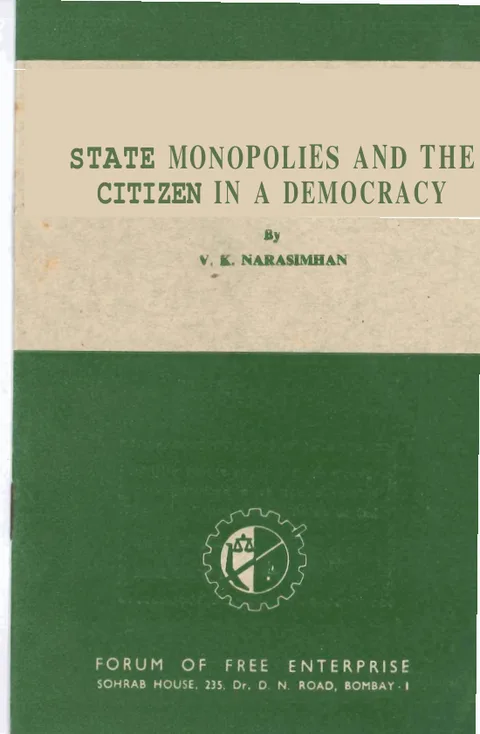
State Monopolies and the Citizen in a Democracy
Published by M. R. Pai for the Forum of Free Enterprise, 235, Dr. Dadabhai Naoroji Road. Bombay 1. and Printed by Michael Andrades at the Bombay Chronicle Press. Horniman Circle, Bombay-I. · Bombay · 1959
12 pages
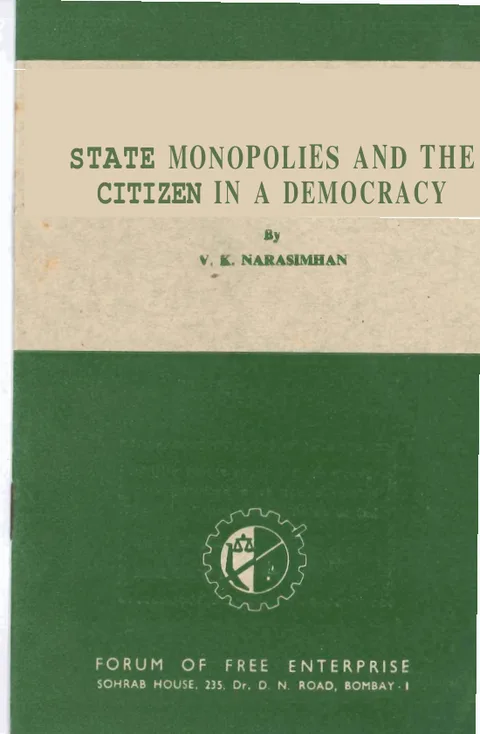
State Monopolies and the Citizen in a Democracy
By V. K. NARASIMHAN
Summary
In this Forum of Free Enterprise booklet, based on a lecture delivered in Bombay on 22 May 1959, V. K. Narasimhan (Assistant Editor of The Hindu) examines how far the promotion of State monopolies in the production of goods or operation of services is compatible with the rights of citizens in a democracy to run similar enterprises. He traces his interest to the 1956 nationalisation of the life insurance companies and the creation of the monopolistic Life Insurance Corporation, arguing that a democratic state has no moral right to take over a well-run, legitimate, socially useful private business simply because it can.
Narasimhan is especially troubled by the sweeping amendment to Article 19(6) made by the Constitution (First Amendment), which he reads as licensing the State or a state corporation to exclude citizens completely or partially from ‘any trade, business, industry or service’. He notes that this ‘astonishing provision’ passed with little parliamentary scrutiny or public protest, and recounts that only a couple of members — including Pandit Hridayanath Kunzru and Shyam Nandan Sahaya — challenged it during the debates, with a safeguarding amendment that was, by his account, mishandled in the official record.
Using the LIC and examples of State trading — notably a State rice-milling takeover in the Nowgong district of Assam that displaced thirty private mills and disrupted procurement — he argues that monopoly breeds bureaucracy, complacency, indifference to the consumer, and the misuse of large public funds, while destroying the freedom of choice and competitive discipline that benefit citizens. He closes with a set of safeguards: state monopolies should be confined to genuine public utilities, prior public-interest enquiry should precede any takeover, compensation should be paid for losses inflicted, and an impartial quasi-judicial body (like a Tariff or Monopolies Commission) should review state enterprises and hear public complaints. A sidebar carries A. D. Shroff’s line that ‘Free Enterprise was born with man and shall survive as long as man survives.‘
Key points
-
Asks how far State monopolies are compatible with citizens’ democratic right to run similar enterprises.
-
Traces the concern to the 1956 nationalisation of life insurance and creation of the monopolistic LIC.
-
Argues a democratic state has no moral right to take over a well-run, legitimate private business.
-
Attacks the Article 19(6) amendment (First Amendment) as an anti-democratic, barely-scrutinised provision.
-
Notes few MPs challenged it; cites Hridayanath Kunzru and Shyam Nandan Sahaya, and a mishandled safeguarding amendment.
-
Holds that monopoly breeds bureaucracy, complacency, and indifference to the consumer (LIC; Assam rice-milling case).
-
Proposes safeguards: confine monopolies to public utilities, prior public-interest enquiry, compensation, and an impartial review body.
-
Closes with a boxed A. D. Shroff quotation defending free enterprise.
Generated by the v1.5 extraction pipeline. Awaiting editorial review.
Metadata and summary are AI-extracted from the source PDF and reviewed for editorial accuracy. The original work is available via the Read PDF tab above (where present); paragraph-level citation inside the PDF is deferred to a future engagement.