essay
The Taxation Laws (Amendment) Bill, 1973
By HP Ranina
Forum of Free Enterprise, Sohrab House, 235 Dr. D. N. Road, Bombay-1 · Bombay · 1973
28 pages
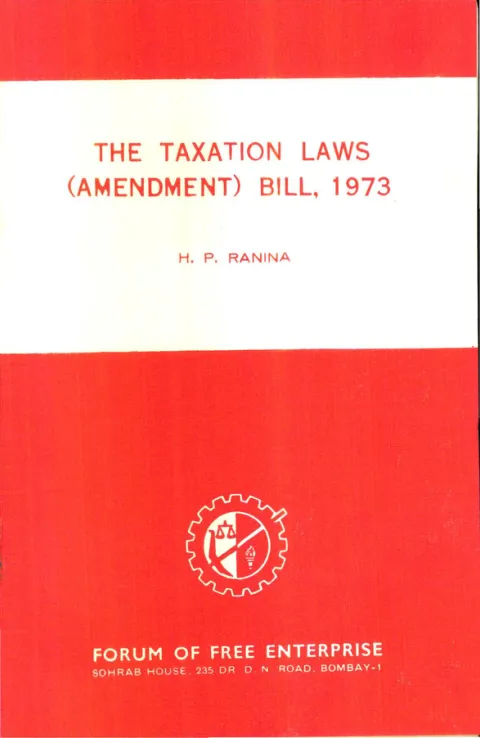
The Taxation Laws (Amendment) Bill, 1973
By HP Ranina
Summary
In the rendered pages of this Forum of Free Enterprise booklet, the chartered accountant H. P. Ranina offers a clause-by-clause critique of the Taxation Laws (Amendment) Bill, 1973, in a series of articles originally contributed to the Financial Express. The first section, ‘Charitable Trusts’, argues that although the Wanchoo Committee praised private philanthropy as enriching India’s cultural, educational, medical and religious life and supplementing the work of a welfare state, the Bill’s recommendations treat philanthropy as a vice rather than a virtue, tarnishing all trustees with the brush of the few ‘black sheep’ and tightening already-stringent provisions of the Income-tax Act, 1961 against charitable trusts.
In the rendered pages Ranina works through the technical machinery of the Bill: the conditions under which a charitable or religious trust may accumulate income without losing exemption (Sections 11(2) and 11(3)), the new definition of ‘substantial contribution’ (total contribution exceeding Rs. 5,000) that can deny exemption under Section 13, and the relief available to donors under Section 80-G. He then turns to the expanded powers of the income-tax authorities — extended powers of survey, entry and inspection, the power to demand information, and a new authority (Section 133A(5)) to record statements and gather information about ‘ostentatious expenditure’ incurred at functions, marriages or ceremonies, which he warns would affect not only tax evaders but also those who have fully disclosed their income.
The rendered pages also cover the new search-and-seizure powers granted to income-tax and wealth-tax authorities (modelled on Section 132 of the Income-tax Act and Section 37A of the Wealth-tax Act), and the settlement machinery under the proposed Chapters XIX-A and V-A, by which a committee of the Central Board of Direct Taxes may settle cases except where concealment is already established. Ranina calls the search-and-seizure power ‘extremely rigorous’ and warns that, unless used discreetly and only in essential cases, its abuse would grossly interfere with every citizen’s right to privacy and the sanctity of his home. He notes the Wanchoo Committee’s own recommendation that the maximum marginal rate of income-tax, including surcharge, be cut from 97.75 per cent to 75 per cent in one stroke, arguing that confiscatory rates drive evasion and can even reduce the Government’s revenue.
Key points
-
Section-by-section critique of the Taxation Laws (Amendment) Bill, 1973, from articles first published in the Financial Express (May 1973).
-
Section I, ‘Charitable Trusts’: argues the Bill treats philanthropy as a vice despite the Wanchoo Committee’s praise of it.
-
Works through trust-accumulation rules (Sections 11(2)/11(3)), the new ‘substantial contribution’ definition (over Rs. 5,000), and donor relief under Section 80-G.
-
Critiques expanded survey/inspection powers and a new power (Section 133A(5)) to record statements on ‘ostentatious expenditure’.
-
Warns the expenditure-survey power would catch even those who have fully disclosed their income.
-
Examines new search-and-seizure powers (modelled on Section 132 / Section 37A of the Wealth-tax Act) as ‘extremely rigorous’.
-
Holds that abuse of search powers would violate citizens’ right to privacy and the sanctity of the home.
-
Notes the Wanchoo Committee’s recommendation to cut the top marginal rate from 97.75% to 75% at one stroke; argues high rates drive evasion.
Generated by the v1.5 extraction pipeline. Awaiting editorial review.
Metadata and summary are AI-extracted from the source PDF and reviewed for editorial accuracy. The original work is available via the Read PDF tab above (where present); paragraph-level citation inside the PDF is deferred to a future engagement.