speech
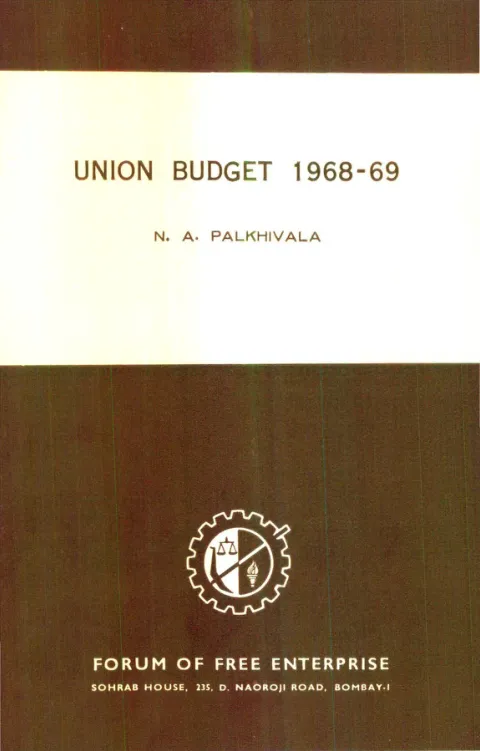
Union Budget 1968-69
Published by M. R. PAI for the Forum of Free Enterprise, "Sohrab House", 235 Dr. Dadabhai Naoroji Road, Bombay-1. and printed by H. NARAYAN RAO at H. R. MOHAN & CO. (Press), 9-B, Cawasjee Patel Street, Bombay-1. · Bombay · 1968
20 pages
Part of The Union Budget
Union Budget 1968-69
By N. A. PALKHIVALA
Summary
In this Forum of Free Enterprise booklet, based on a talk delivered in Bombay on 4 March 1968, N. A. Palkhivala analyses the Union Budget for 1968-69. He observes that the year was notable for the ‘pre-Budget technique’ by which the public mind was conditioned to expect heavier taxation, so that a Budget which merely maintained — rather than increased — already crushing tax levels was welcomed with relief. The crucial question, he argues, is whether the Budget inspires confidence and holds out hope for a brighter economic future, against a background of mass unemployment (3.5 million registered, perhaps more than 7 million in reality) growing at over a lakh a month.
Palkhivala faults the Finance Minister for missing four alternatives that could have opened a new chapter in India’s economic history: a determined cut in unproductive government expenditure (civil-administration spending having risen from Rs. 107 crores in 1964-65 to Rs. 186 crores, with 6.5 million government employees); an end to bailing out fiscally indisciplined States; a halt to the ‘positive drag’ of an inefficient public sector that returned only about Rs. 12 crores (0.57 per cent) on roughly Rs. 2,100 crores of investment; and genuine relief from confiscatory taxation. He marshals comparative data to show that India taxes honest enterprise more heavily than any other country, with combined income- and wealth-tax able to exceed 100 per cent of income and the corporate-and-shareholder incidence piercing a 94 per cent barrier — declaring memorably that ‘the most expensive hobby of Indians is work’ and that, in its treatment of corporate profits, India has ‘almost reached Kelvin zero’.
He argues that high taxation in a developing economy is not disinflationary but positively inflationary, because it shrinks the margin of saving and investment while destroying cost-consciousness and the ethics of honest dealing — a citizen ‘has to be honest when it is more profitable to evade tax on Rs. 20 than to earn Rs. 100.’ The closing pages turn to the Finance Bill’s expanded powers against tax-payers: while severe punishment is warranted for dishonest evaders, Palkhivala warns that the new powers make it easy for the Department to strike fear into the honest tax-payer, and that inspiring confidence and co-operation requires a more scrupulous regard for justice, fairness and public morality than the Bill displays.
Key points
-
Analyses the Union Budget 1968-69; based on a talk delivered in Bombay on 4 March 1968.
-
Notes the ‘pre-Budget technique’ conditioned the public to welcome a Budget that merely maintained crushing tax levels.
-
Frames unemployment as the central failure: 3.5 million registered (likely 7 million+), growing over a lakh a month.
-
Identifies four missed alternatives: cut unproductive expenditure, stop bailing out indisciplined States, end public-sector drag, give tax relief.
-
Cites the public sector returning ~Rs. 12 crores (0.57%) on ~Rs. 2,100 crores invested.
-
Argues India taxes honest enterprise more heavily than any country; combined tax can exceed 100% of income.
-
Coins ‘the most expensive hobby of Indians is work’ and likens corporate taxation to ‘Kelvin zero’.
-
Holds high taxation is inflationary, not disinflationary, and warns new Finance Bill powers terrify honest tax-payers.
Generated by the v1.5 extraction pipeline. Awaiting editorial review.
Metadata and summary are AI-extracted from the source PDF and reviewed for editorial accuracy. The original work is available via the Read PDF tab above (where present); paragraph-level citation inside the PDF is deferred to a future engagement.