speech
The Union Budget - 1969-70
Published by M. R. Pai for the Forum of Free Enterprise, 235, Dr. Dadabhai Naoroji Road, Bombay-1, and Printed by Michael Andrades at the Bombay Chronicle Press, Horniman Circle, Bombay-1. · Bombay · 1969
15 pages
Part of The Union Budget
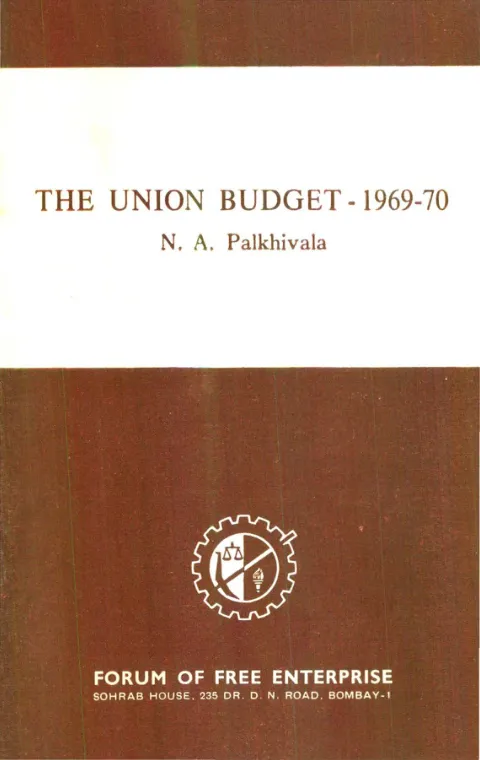
The Union Budget - 1969-70
By N. A. Palkhivala
Summary
In this Forum of Free Enterprise booklet, based on a public lecture delivered in Bombay on 3 March 1969, N. A. Palkhivala assesses the Union Budget for 1969-70. Borrowing a frame from a Somerset Maugham short story about the difficulty of judging a man’s character, he asks whether this is a good Budget with some bad features or a bad Budget with some good ones. He notes a few basic points: there is no increase in corporate taxation, only a small personal-tax cut (about Rs. 275 on the income slab between Rs. 10,000 and Rs. 20,000), and — apart from changes to advance payment of tax — no significant Income-tax Act reform, with a ‘massive dose of amendments’ deferred to a later Bill, deepening the confusion in fiscal law already worsened by the Finance Acts of 1967 and 1968.
Palkhivala argues that a budget should be moulded by the needs of a nation and contain the seeds of economic growth, but that this one is the prisoner of four chronic ailments: the unapproachability of the agricultural sector to Central taxation, the inefficiency of public-sector undertakings, the irrepressibility of Central Government expenditure, and the indiscipline of the States. He recounts how agricultural income fell outside Central taxation by a ‘pure historical accident’ dating to James Wilson’s first Indian income tax of 1860, and details how State deficits had ballooned — from Rs. 17 crores across the whole First Plan to a proposed Rs. 250 crores in the single year 1969-70 — financed by a Centre that can never confine taxation within reasonable limits while State extravagance continues.
On taxation he holds that India retains ‘the dubious distinction of remaining, by and large, the highest taxed nation’: the top marginal rate of personal tax, nominally cut from 89.4 to 82.5 per cent, offers only an illusory reduction because it is fully offset by a higher wealth-tax on the slab producing unearned income in high brackets. Citing the heavy taxation of the automobile industry (taxes representing 44 per cent of the capital cost of commercial vehicles and 15 per cent of all Central and State tax revenue) and a comparison of twelve developing Asian countries — where the six with the fastest growth cap marginal income tax at 50 per cent while slow-growing India and Burma tax far more — he presses the link between confiscatory taxation and stagnant growth.
Key points
-
Assesses the Union Budget 1969-70; based on a public lecture in Bombay on 3 March 1969.
-
Opens with a Somerset Maugham frame: is it a good Budget with bad features or a bad one with good features?
-
Notes no rise in corporate tax, only a small personal-tax cut, and no significant Income-tax Act reform (a ‘massive dose of amendments’ deferred).
-
Identifies four structural ailments: untaxable agriculture, inefficient public sector, unchecked Central expenditure, indiscipline of States.
-
Traces agriculture’s exemption to James Wilson’s first Indian income tax of 1860.
-
Shows State deficits ballooning from Rs. 17 crores (whole First Plan) to a proposed Rs. 250 crores in 1969-70 alone.
-
Argues the top marginal personal-tax cut (89.4% to 82.5%) is illusory, offset by higher wealth-tax.
-
Links confiscatory taxation to slow growth, citing Asian comparisons and heavy automobile-industry taxation.
Generated by the v1.5 extraction pipeline. Awaiting editorial review.
Metadata and summary are AI-extracted from the source PDF and reviewed for editorial accuracy. The original work is available via the Read PDF tab above (where present); paragraph-level citation inside the PDF is deferred to a future engagement.