speech
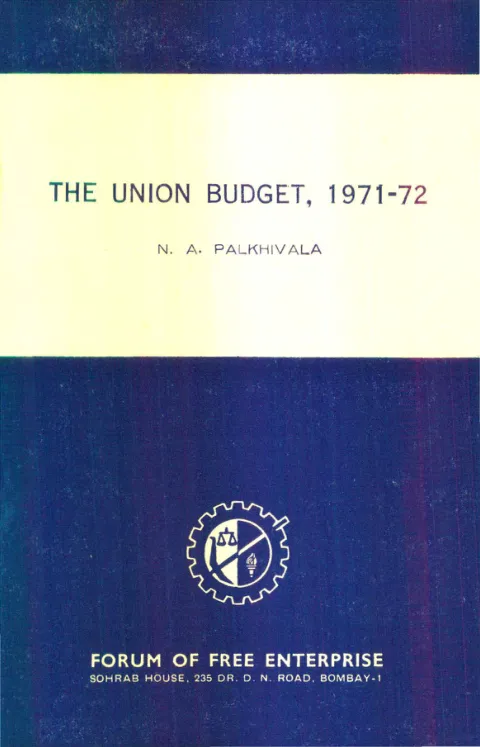
The Union Budget, 1971-72
FORUM OF FREE ENTERPRISE, SOHRAB HOUSE, 235 DR. D. N. ROAD, BOMBAY-1 · Bombay · 1971
24 pages
Part of The Union Budget
The Union Budget, 1971-72
By N. A. PALKHIVALA
Summary
In this Forum of Free Enterprise public lecture, delivered in Bombay on 5 June 1971, the constitutional lawyer N. A. Palkhivala mounts a sustained attack on the Union Budget for 1971-72, which he calls ‘ideology-oriented’ in conception and ‘poverty-oriented’ in effect. Opening with the history of Indian income-tax since James Wilson’s first 2% levy in 1860, he argues that ‘the wheel has now turned full circle’: where the early assessee kept 98% of his income, he now keeps 2%. He lays out the budget’s ‘inarticulate major premises’ satirically, chief among them that it is easier to impoverish the rich (‘Amiri hatao’) than to enrich the poor (‘Garibi hatao’), and that Parliament behaves as though it can repeal the laws of human nature.
The bulk of the lecture is a tax-by-tax indictment: marginal income-tax rates reaching 97.75% and wealth-tax up to 8% (15% on urban property) which together amount to ‘annual confiscation’; the removal of the Rs. 1 lakh wealth-tax exemption; sharply higher capital-gains tax; and the gutting of corporate incentives through abolition of the development rebate and exclusion of capital-intensive industries from the priority list. Palkhivala marshals comparative data — the U.S. capping earned-income rates at 50%, the U.K. cutting its top rate from 91.25% to 75%, and only Puerto Rico, the U.A.R. and Zambia approaching India’s rate — to argue that India ‘takes the palm’ as the highest-taxed nation. He insists that confiscatory rates are inflationary, not disinflationary, because they destroy saving, investment and cost-consciousness, and that they breed black money, benami transactions and a ‘losing battle’ against the acquisitive instinct.
Throughout, Palkhivala enlists socialist and official authorities against the budget’s own logic — Nicholas Kaldor, W. Arthur Lewis, and finance minister T. T. Krishnamachari’s own 1957 and 1964 Budget Speeches all conceded that punitive top rates corrode the tax base and sap incentive. The rendered pages run through the corporate-sector critique and the comparative tax tables; the closing pages on agriculture argue that the urban sector bears a ‘staggering burden of direct taxation’ while agriculture, ‘politically too important to be taxed’, is almost wholly spared, before the text breaks off mid-argument at the start of the four alternatives to the projected deficit. The booklet’s tone is polemical and aphoristic throughout, aimed at a lay business and professional audience.
Key points
-
The 1971-72 Budget is characterised as ‘ideology-oriented’ in conception and ‘poverty-oriented’ in effect; it reduces disparity between the honest rich and the poor only by impoverishing the former.
-
Income-tax history since 1860 (James Wilson’s 2% levy) is invoked to show ‘the wheel has now turned full circle’: the assessee now keeps 2% and pays 98%.
-
Top marginal income-tax of 97.75% plus wealth-tax up to 8% (15% on urban property) amount, Palkhivala argues, to annual confiscation of income and wealth.
-
High taxation is held to be inflationary rather than disinflationary because it destroys saving, investment, cost-consciousness and ethics, and it breeds black money and benami transactions.
-
Comparative data: U.S. earned-income cap 50%, U.K. top rate cut from 91.25% to 75%; only Puerto Rico, U.A.R. and Zambia approach India’s 97.75% — ‘India takes the palm’.
-
The Budget guts corporate incentives: abolition of the development rebate from May 1974, exclusion of high-technology industries (cement, trucks, aluminium, petro-chemicals) from the priority list, harsher capital-gains and wealth-tax treatment.
-
Palkhivala turns socialist and official authorities against the Budget — Kaldor, W. Arthur Lewis, and T. T. Krishnamachari’s own Budget Speeches of 1957 and 1964.
-
Agriculture, ‘politically too important to be taxed’, is almost wholly spared while the politically unrepresented urban sector bears a staggering direct-tax burden; the text breaks off before listing alternatives to the deficit.
Generated by the v1.5 extraction pipeline. Awaiting editorial review.
Metadata and summary are AI-extracted from the source PDF and reviewed for editorial accuracy. The original work is available via the Read PDF tab above (where present); paragraph-level citation inside the PDF is deferred to a future engagement.