pamphlet
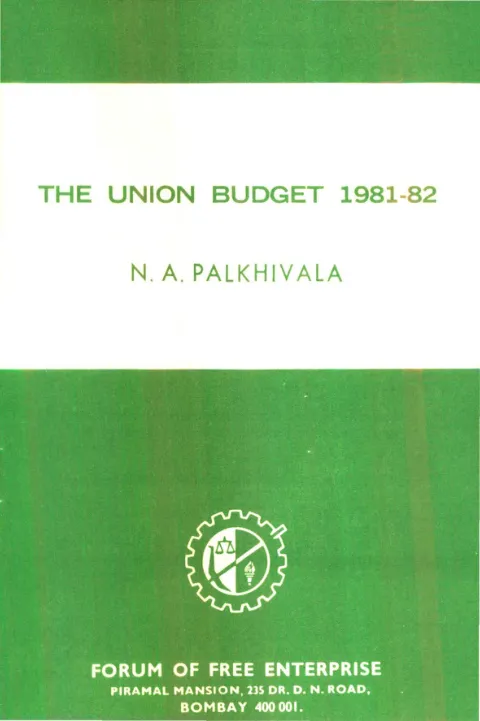
The Union Budget 1981-82
Published by M. R. PAI for the Forum of Free Enterprise, 235, Dr. Dadabhai Naoroji Road, Bombay-400 001, and printed at TATA PRESS Ltd., 414, Veer Savarkar Marg, Prabhadevi, Bombay 400 025. · Bombay · 1981
18 pages
Part of The Union Budget
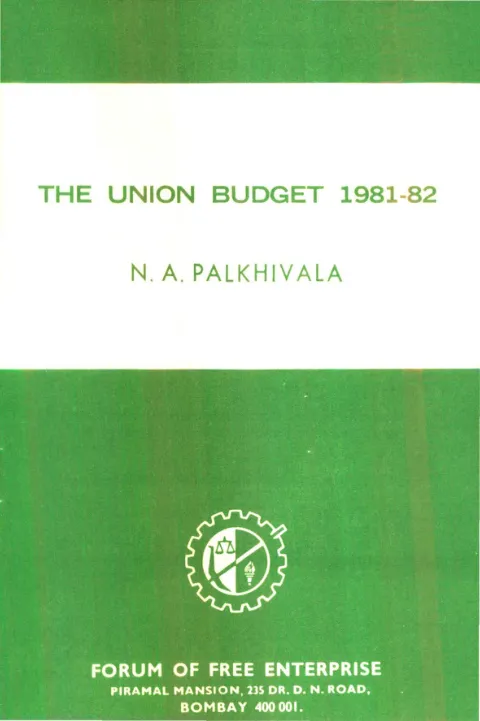
The Union Budget 1981-82
By N. A. Palkhivala
Summary
In this Forum of Free Enterprise booklet, N. A. Palkhivala delivers his trademark annual critique of the Union Budget, here the 1981-82 Budget presented by the Finance Minister. He judges it against ‘the anaemic condition of the national economy’, arguing that the government’s rosy presentation rests on selective comparison (1980-81 against the disastrous 1979-80) and a switch from average-index to point-to-point inflation figures that he likens to corporate window-dressing. He warns that per-capita GNP actually fell 2.2 per cent over two years and that foreign-exchange reserves, propped up by IMF borrowing, cover barely five months of imports.
Palkhivala organizes his verdict around four ‘ingredients’ of any budget — psychology, politics, economics and strategy — and concludes the Budget is ‘psychologically perfect, politically clever, economically unsound, and strategically a costly failure.’ He grants that the income-tax exemption changes are politically shrewd and personally gratifying to the middle classes, but shows that the relief is merely an inadequate adjustment for inflation (‘fiscal drag’), and that the apparent give-away in fact extracts substantial net additional taxation. The rich farmer and the corporate sector, he argues, are left untouched or unrelieved even as industry, which contributes the bulk of revenue, gets nothing to spur growth.
The pamphlet’s analytical heart is a list of ‘six basic flaws’ in India’s economic administration mirrored in the Budget — chief among them the failure to treat infrastructural inadequacy (coal, power, steel, transport) as a crisis, and the incompatibility of an ever-expanding government with fast economic growth (‘So long as India continues to be over-governed, it will continue to be under-developed’). Palkhivala closes on a characteristically rhetorical note, lamenting wasted opportunity, calling on Mrs. Gandhi to take a ‘U-turn’ in fiscal policy given her parliamentary dominance, and proposing open pre-legislative debate, lower tax rates and the abolition of octroi. The booklet states it is based on his March 1981 public talks in Bombay, Madras and Bangalore and articles in the Times of India and Hindustan Times.
Key points
-
Frames the 1981-82 Budget against an ‘anaemic’ economy; argues official optimism rests on selective base-year comparisons and a change in the inflation-measurement basis.
-
Central verdict: the Budget is ‘psychologically perfect, politically clever, economically unsound, and strategically a costly failure.’
-
Income-tax ‘relief’ is merely an inadequate adjustment for inflation (‘fiscal drag’); citizens end up worse off in real terms.
-
Behind the give-away appearance, the Budget imposes net additional taxation of about Rs 196 crores, aggregating to Rs 2,200 crores with pre-budget increases.
-
Rich farmers and the corporate sector are left untouched/unrelieved; nothing in the Budget spurs industrial growth though industry supplies 79% of central revenue.
-
Lists ‘six basic flaws’, led by ignoring infrastructural inadequacy as a crisis and the incompatibility of big government with fast growth.
-
Calls on Mrs. Gandhi to take a ‘U-turn’ in fiscal policy and advocates open pre-legislative budget debate, lower tax rates, and abolition of octroi.
-
Based on March 1981 public talks in Bombay, Madras (M. Ct. M. Chidambaram Chettyar Memorial Lecture) and Bangalore, plus newspaper articles.
Generated by the v1.5 extraction pipeline. Awaiting editorial review.
Metadata and summary are AI-extracted from the source PDF and reviewed for editorial accuracy. The original work is available via the Read PDF tab above (where present); paragraph-level citation inside the PDF is deferred to a future engagement.