speech
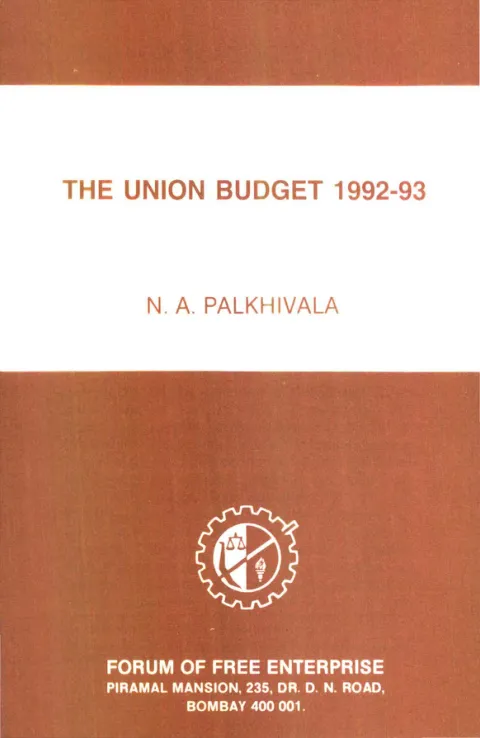
The Union Budget 1992-93
Published by M. R. PAI for the Forum of Free Enterprise, 235, Dr. Dadabhai Naoroji Road, Bombay-400 001, and printed at TATA PRESS Ltd., 414, Veer Savarkar Marg, Prabhadevi, Bombay 400 025. · Bombay · 1992
14 pages
Part of The Union Budget
The Union Budget 1992-93
By Nani A. Palkhivala
Summary
In this Forum of Free Enterprise booklet, reproducing a public talk given in Bombay on 3 March 1992 (and later in Calcutta and Delhi), N. A. Palkhivala welcomes the 1992-93 Union Budget as a landmark of India’s economic reorientation. He calls it ‘not a budget for the greedy, paid for by the needy’ and identifies four main thrusts: liberalization, integration of India into the global economy, reduction of taxes, and a stable balance of payments. Liberalization, he argues, is the key — a ‘Watershed Budget’ that marks the end of India’s ‘forty-year affair with shabby State socialism,’ even if it ‘measures out liberalization with coffee spoons.’
Palkhivala situates the budget against India’s relative decline, marshalling comparative data: a GDP smaller than that of greater Los Angeles, per-capita income a fraction of South Korea’s and Hong Kong’s despite similar starting points, and a UN Human Development Index ranking of 123rd out of 160 nations for the second year running. He attributes this not to colonialism or external forces but to ‘self-complacency and obstinate refusal to face the truth,’ and endorses Finance Minister Manmohan Singh’s insistence that recovery requires a change of national values. He enumerates the budget’s merits — breaking the bureaucratic command system, acknowledging the danger of runaway government liabilities (Rs. 32,000 crore, some 23 per cent of expenditure, to go on debt servicing), and restoring the balance of payments.
The later pages turn critical on the tax provisions, especially the restructuring of capital-gains tax via an ‘indexed cost of acquisition’ rushed through without full examination, and above all the re-imposition of wealth-tax on companies in which the public are substantially interested — which Palkhivala calls ‘the most objectionable feature of the Finance Bill’ and ‘a most reprehensible step.’ He notes the stock markets’ failure to register the bill’s consequences for millions of shareholders.
Key points
-
Reproduces Palkhivala’s public talk on the 1992-93 Union Budget, delivered in Bombay on 3 March 1992 and later in Calcutta and Delhi.
-
Hails the budget as a ‘Watershed Budget’ ending India’s ‘forty-year affair with shabby State socialism.’
-
Identifies four thrusts: liberalization, global integration, tax reduction, and balance-of-payments stability.
-
Marshals comparative data on India’s decline: GDP smaller than greater Los Angeles; HDI rank 123rd of 160.
-
Attributes India’s plight to self-complacency rather than colonialism or external forces; endorses Manmohan Singh’s call for changed values.
-
Credits the budget with breaking the bureaucratic command system and recognising the danger of national debt (Rs. 32,000 crore on debt servicing, ~23% of expenditure).
-
Criticises the rushed capital-gains restructuring (‘indexed cost of acquisition’).
-
Condemns re-imposition of wealth-tax on widely-held companies as ‘the most objectionable feature of the Finance Bill.’
Generated by the v1.5 extraction pipeline. Awaiting editorial review.
Metadata and summary are AI-extracted from the source PDF and reviewed for editorial accuracy. The original work is available via the Read PDF tab above (where present); paragraph-level citation inside the PDF is deferred to a future engagement.