speech
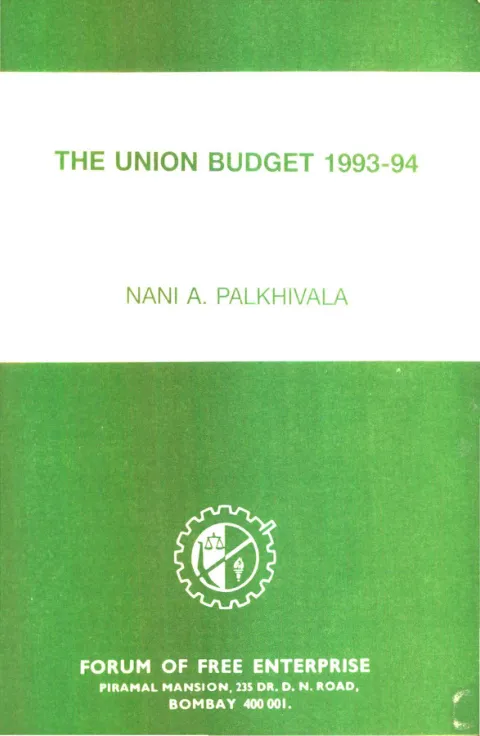
The Union Budget 1993-94
Published by M. R. PAI for the Forum of Free Enterprise, 235, Dr. Dadabhai Naoroji Road, Bombay-400 001, and printed at TATA PRESS Ltd., 414, Veer Savarkar Marg, Prabhadevi, Bombay 400 025. · Bombay · 1993
14 pages
Part of The Union Budget
The Union Budget 1993-94
By Nani A. Palkhivala
Summary
In this Forum of Free Enterprise booklet, reproducing a public talk delivered in Bombay on 3 March 1993 (and subsequently across India and in Muscat and Dubai), N. A. Palkhivala defends the 1993-94 Union Budget against hostile early reactions, which he attributes to vested interests, party politics and ideology. He calls it ‘a creative and nutritive Budget’ and praises Finance Minister Manmohan Singh as ‘not a politician but a technocrat’ who introduced measures ‘a mere politician would have thought possible only through witchcraft or fraud,’ echoing The Economist. He surveys the budget’s goals: promoting agriculture and agro-processing, boosting exports (noting that Holland, with 15 million people, exports six times as much as India), and curbing inflation and the fiscal deficit.
Palkhivala situates the budget within global currents — observing that where nationalization was the fashion of the 1940s and privatization that of the 1980s, education has become the watchword of the 1990s, and citing John Smith’s repudiation of high taxes in the British Labour Party. He links development spending on health, education and family planning to the quality of life, invoking the Ayodhya, Bombay and Surat riots to argue for value-based education. A central thread is the moral dimension of taxation: drawing on Thomas Jefferson, he insists the fiscal system must possess not merely legality but legitimacy, and condemns governmental ‘breaches of faith’ — promises of tax relief and exemptions later withdrawn — as a corrosion of an ‘invaluable but fragile national asset.’
The talk closes on a characteristically pointed verdict: the budget is ‘a harbinger of good times to come’ that ‘will not take India to heaven but it will check India’s precipitate slide to hell.‘
Key points
-
Reproduces Palkhivala’s public talk on the 1993-94 Union Budget, delivered in Bombay on 3 March 1993 and repeated in many cities including Muscat and Dubai.
-
Defends the budget against hostile reactions traced to vested interests, party politics and ideology.
-
Praises Manmohan Singh as a technocrat rather than a politician; calls the budget ‘creative and nutritive.’
-
Outlines goals: agriculture and agro-processing, export promotion, and curbing inflation (17% to 7%) and the fiscal deficit (8.4% to ~5% of GDP).
-
Situates the budget in global trends, with education the watchword of the 1990s.
-
Argues development spending on health, education and family planning determines quality of life; invokes Ayodhya/Bombay/Surat riots for value-based education.
-
Stresses the moral legitimacy of taxation (citing Thomas Jefferson) and condemns governmental ‘breaches of faith’ over withdrawn tax reliefs.
-
Concludes the budget will ‘check India’s precipitate slide to hell’ even if it won’t ‘take India to heaven.’
Generated by the v1.5 extraction pipeline. Awaiting editorial review.
Metadata and summary are AI-extracted from the source PDF and reviewed for editorial accuracy. The original work is available via the Read PDF tab above (where present); paragraph-level citation inside the PDF is deferred to a future engagement.