speech
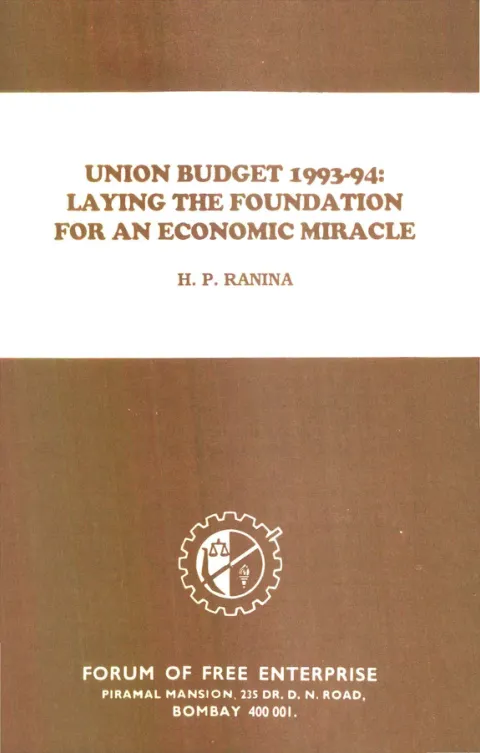
Union Budget 1993-94: Laying the Foundation for an Economic Miracle
By HP Ranina
Published by M. R. PAI for the Forum of Free Enterprise, "Piramal Mansion", 235, Dr. D. N. Road, Bombay - 400 001. Laser Typesetting by RAJESH BHAGAT, Prime Systemware Tel.: 2854706 and printed by TUSHAR GOSHALIA at Tara Enterprises, 81/7, Raju Villa, Scheme 6, Road 9, Bombay - 400 019. · Bombay · 1993
16 pages
Part of The Union Budget
Union Budget 1993-94: Laying the Foundation for an Economic Miracle
By HP Ranina
Summary
In this Forum of Free Enterprise booklet, based on a talk given at a public meeting in Bombay on 1 March 1993, the tax expert H. P. Ranina offers an enthusiastic, technically detailed appraisal of the 1993-94 Union Budget, which he predicts ‘will go down in the fiscal history of India as the one which will create the right environment for engineering an economic miracle.’ He credits Finance Minister Manmohan Singh — presenting his third successive budget in twenty months — with the ‘miraculous feat’ of cutting indirect taxes by Rs. 4,522 crore while increasing developmental plan expenditure and lowering the budgetary deficit to Rs. 4,314 crore, ‘the lowest ever in the fiscal history of India.’
Ranina works through the budget’s mechanisms with a practitioner’s eye: the cut in excise and customs duties (a revenue sacrifice of nearly Rs. 4,500 crore) intended to compensate industry for higher costs and revive the recession-hit industrial sector; the demand-oriented boost to the consumer-goods industry via higher rural purchasing power and farm procurement prices; the benefits of a more competitive exchange rate and the move toward full rupee convertibility for exports; and the tax holidays under Section 80-IA for new industrial undertakings, especially power generation, in backward areas. He welcomes the Finance Minister’s candid admission that many procedures ‘remain archaic and cumbersome’ and the promise to modernise corporate and commercial laws.
Looking ahead, Ranina foresees full capital-account convertibility by 1998 (perhaps 1996 if Singh remains in office), a 9 per cent annual growth rate from 1995, and per-capita income rising from US$350 to over US$1,000 by the century’s end — lifting many out of ‘grinding poverty.’ He concludes that posterity will regard Manmohan Singh’s twenty-month tenure as ‘the turning point in India’s economic history.’ A printed disclaimer notes the views are not necessarily those of the Forum.
Key points
-
Based on H. P. Ranina’s talk at a public meeting in Bombay on 1 March 1993; the author is described as a noted tax expert.
-
Predicts the 1993-94 Budget will create the conditions for an Indian ‘economic miracle.’
-
Credits Manmohan Singh’s third budget in 20 months with cutting indirect taxes by Rs. 4,522 crore and the lowest-ever budgetary deficit (Rs. 4,314 crore).
-
Explains the excise/customs cut (~Rs. 4,500 crore revenue loss) as a means to revive the recession-hit industrial sector.
-
Argues higher rural purchasing power and procurement prices will drive a demand-led consumer-goods boom.
-
Highlights a competitive exchange rate, moves toward rupee convertibility, and export incentives.
-
Details Section 80-IA tax holidays for new undertakings, especially power generation, in backward areas.
-
Forecasts full capital-account convertibility by 1998, 9% growth from 1995, and per-capita income above US$1,000 by 2000; deems Singh’s tenure ‘the turning point in India’s economic history.’
Generated by the v1.5 extraction pipeline. Awaiting editorial review.
Metadata and summary are AI-extracted from the source PDF and reviewed for editorial accuracy. The original work is available via the Read PDF tab above (where present); paragraph-level citation inside the PDF is deferred to a future engagement.