edited volume · proceedings
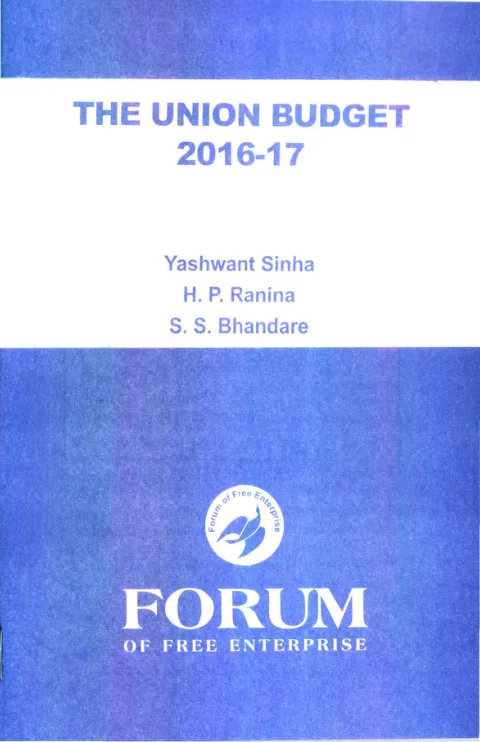
The Union Budget 2016-17
By HP Ranina
Forum of Free Enterprise · Bombay · 2016
48 pages
Part of The Union Budget
The Union Budget 2016-17
Summary
This Forum of Free Enterprise booklet reproduces presentations on the Union Budget 2016-17 delivered at a public meeting held in Mumbai on 1 March 2016, jointly organised by the Forum, the Nani A. Palkhivala Memorial Trust, the Bombay Chartered Accountants’ Society and the Council for Fair Business Practices. The contributors are veteran tax expert H. P. Ranina and former Union Finance Minister Yashwant Sinha, who spoke at the meeting, together with an analysis of the budget’s economic implications by S. S. Bhandare; Minoo R. Shroff, President of the Forum, supplies the Introduction. In the rendered pages, Shroff’s Introduction reports that both speakers judged the economy basically healthy and the budget ‘well crafted and refreshingly different’, awarding it 8 out of 10, while flagging concern over the quality of the fiscal deficit and the burden of the Seventh Pay Commission and OROP. Yashwant Sinha’s lead address dwells on fiscal-deficit quality, the FRBM framework he steered as Finance Minister, and the use of public investment in roads, railways and housing to drive growth.
Key points
-
The booklet reproduces presentations from a 1 March 2016 Mumbai meeting on the Union Budget 2016-17, jointly organised by the Forum of Free Enterprise, the Nani A. Palkhivala Memorial Trust, the Bombay Chartered Accountants’ Society and the Council for Fair Business Practices.
-
Minoo R. Shroff’s Introduction reports that both speakers rated the budget well crafted and refreshingly different, awarding it 8 out of 10 while flagging the fiscal deficit’s quality.
-
Shroff’s Introduction also flags concern over the burden the Seventh Pay Commission award and One Rank One Pension impose on the exchequer alongside the budget’s other commitments.
-
Yashwant Sinha distinguishes the headline fiscal deficit from the revenue deficit, arguing that the quality of the deficit matters more than its headline size in assessing the budget.
-
Sinha recalls persuading Prime Minister Vajpayee to back the FRBM Act, passed in 2003 and notified in 2004, to compel fiscal discipline on future governments.
-
Sinha frames excessive government borrowing as a breach of intergenerational equity, in which the present generation imposes financial burdens on generations not yet born.
-
Sinha blames the revenue deficit’s sharp deterioration in 2008-09 on populist measures including the farmers’ debt waiver, the Sixth Pay Commission award and NREGA spending.
-
Sinha notes the 2016-17 budget meets its 3.5 per cent fiscal-deficit target but still misses the 2.4 per cent revenue-deficit target he considers the more telling figure.
-
Sinha recalls that raising the housing-loan interest deduction from Rs. 15,000 to Rs. 1,50,000 during his own tenure as Finance Minister produced a veritable boom in housing.
Essays
The Union Budget 2016-2017
By Yashwant Sinha
Yashwant Sinha, a former Union Finance Minister, opens by praising Mumbai’s tradition (founded by Nani Palkhivala) of holding public meetings to analyse the budget. In the rendered pages he picks up H. P. Ranina’s point about the fiscal deficit, distinguishing the headline fiscal deficit from the more telling revenue deficit and arguing that the quality of the deficit is what matters. He recalls persuading Prime Minister Vajpayee to back the FRBM legislation, passed in 2003 and notified in 2004, to compel fiscal discipline, and frames excessive borrowing as a breach of intergenerational equity in which the present generation imposes burdens on generations yet unborn. He traces how the revenue deficit deteriorated sharply in 2008-09 through populist measures (the farmers’ debt waiver, the Sixth Pay Commission, NREGA) and notes that, while the current budget meets the fiscal-deficit target (3.5%), it still fails on the revenue-deficit side (2.4%). He closes the rendered portion by recounting, from his own tenure beginning in 1998, how raising the housing-loan interest deduction from Rs. 15,000 to Rs. 1,50,000 produced a ‘veritable boom’ in housing, illustrating his preference for using public investment in roads, railways and housing to create virtuous demand cycles.
- Celebrates Mumbai’s Palkhivala-founded tradition of public meetings to analyse the budget.
- Distinguishes the headline fiscal deficit from the revenue deficit, insisting the ‘quality’ of the deficit is decisive.
- Recounts steering the FRBM Act (passed 2003, notified 2004) by persuading PM Vajpayee, to enforce fiscal discipline.
- Frames deficit financing as a breach of intergenerational equity — burdening generations yet unborn.
- Blames the 2008-09 deterioration on populist measures: farmers’ debt waiver, Sixth Pay Commission, NREGA.
- Notes the budget meets the 3.5% fiscal-deficit target but still misses on the 2.4% revenue deficit.
- Cites his 1998-era rise in the housing-loan interest deduction (Rs. 15,000 to Rs. 1,50,000) as creating a housing boom.
Generated by the v1.5 extraction pipeline. Awaiting editorial review.
Metadata and summary are AI-extracted from the source PDF and reviewed for editorial accuracy. The original work is available via the Read PDF tab above (where present); paragraph-level citation inside the PDF is deferred to a future engagement.