edited volume · proceedings
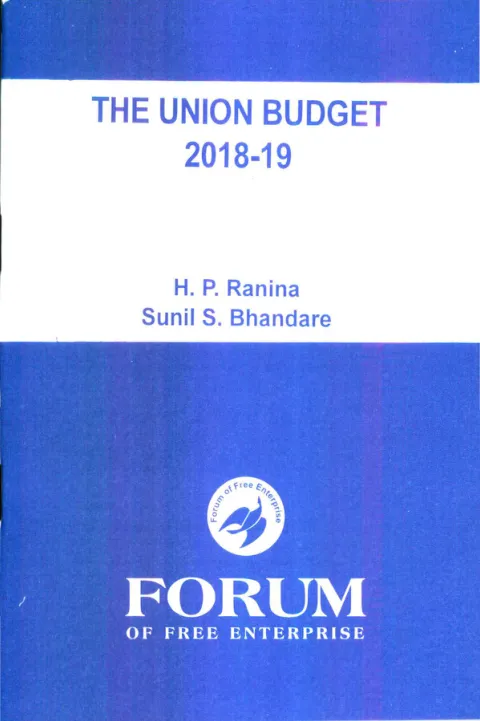
The Union Budget 2018-19
By HP Ranina, Sunil S. Bhandare
Forum of Free Enterprise · Bombay · 2018
43 pages
Part of The Union Budget
The Union Budget 2018-19
Summary
This Forum of Free Enterprise booklet collects commentary on the Union Budget 2018-19 by tax expert H. P. Ranina and economist Sunil S. Bhandare. In the rendered pages, Ranina’s lead essay, ‘A Vision Document for Inclusive Growth’, is based on a talk he delivered in Mumbai on 1 February 2018 at a meeting organised jointly by the Nani A. Palkhivala Memorial Trust, the Forum of Free Enterprise and the Bombay Chartered Accountants’ Society. Reading from a pro-market, fiscally cautious vantage, Ranina treats this last full budget before the next general elections as a tightrope walk between fiscal consolidation and growth, surveying its tax-revenue assumptions, the new National Health Protection Scheme, agriculture and minimum support prices, ease-of-living measures, and incentives for small enterprises and start-ups. Sunil S. Bhandare’s companion analysis lies beyond the rendered pages.
Key points
-
This Forum of Free Enterprise booklet collects commentary on the Union Budget 2018-19 by tax expert H. P. Ranina and economist Sunil S. Bhandare, though only Ranina’s essay appears in the rendered pages.
-
Ranina’s essay, “A Vision Document for Inclusive Growth,” is based on a talk delivered in Mumbai on 1 February 2018 at a meeting jointly organised by the Nani A. Palkhivala Memorial Trust, the Forum of Free Enterprise and the Bombay Chartered Accountants’ Society.
-
Ranina frames the 2018-19 budget, the last full budget before the next general elections, as a tightrope walk between fiscal consolidation and growth, built on an 11.5 percent nominal growth assumption.
-
He welcomes the National Health Protection Scheme, covering more than 100 million families with up to Rs. 5 lakh of cover per family, as a shift toward universal welfare.
-
He warns that the health scheme, higher minimum support prices set on the Swaminathan formula, oil prices and bank recapitalisation may make the 3.3 percent fiscal deficit target hard to hold.
-
Ranina notes marked GST-driven tax buoyancy for 2017-18 and observes that net tax revenue is largely consumed by establishment costs, pensions, defence and interest payments.
-
He praises “ease of living” measures such as free LPG and electricity connections and rural and urban housing, alongside education and tourism initiatives.
-
Ranina reads incentives for small and medium enterprises and start-ups, including the liberalised Section 80-JJAA employment deduction and Section 80-IAC tax holiday, as steps toward labour reform and job creation.
Essays
A Vision Document for Inclusive Growth
By HP Ranina
H. P. Ranina frames the 2018-19 budget — the last full budget before the next general elections — as a tightrope walk reconciling fiscal consolidation with the need to sustain growth, built on an 11.5% nominal growth assumption and 5% inflation amid rising oil prices, with large outlays for agriculture, social security and infrastructure. In the rendered pages he reports marked GST-driven tax buoyancy for 2017-18 and welcomes the ‘big bang’ National Health Protection Scheme covering more than 100 million families with up to Rs. 5 lakh cover per family as a shift toward universal welfare, while cautioning that the scheme, higher minimum support prices on the Swaminathan formula, oil prices and bank recapitalisation may make the 3.3% deficit target hard to hold. He details the budget’s revenue and expenditure arithmetic — the sums collected from individuals, corporations and indirect taxes, the roughly 35% devolution to states, and how net tax revenue is largely consumed by establishment costs, pensions, defence and interest, leaving development to be financed substantially by borrowing. He highlights pro-poor ‘ease of living’ steps (free LPG and electricity connections, rural and urban housing), education and tourism initiatives, and incentives for small and medium enterprises and start-ups — including the liberalised Section 80-JJAA employment deduction and Section 80-IAC tax holiday — which he reads as steps toward labour reform and turning the young into job creators rather than job seekers.
- Reads the 2018-19 budget, the last full one before elections, as a tightrope walk between fiscal consolidation and growth.
- Notes marked GST-driven tax buoyancy in 2017-18 and a built-in 11.5% nominal growth assumption.
- Welcomes the National Health Protection Scheme (100 million+ families, up to Rs. 5 lakh cover) as a move toward universal welfare.
- Warns the health scheme, higher MSP on the Swaminathan formula, oil prices and bank recapitalisation threaten the 3.3% deficit target.
- Walks through revenue/expenditure arithmetic: net tax revenue is largely eaten by establishment, pensions, defence and interest.
- Praises ‘ease of living’ measures — free LPG and electricity connections, rural and urban housing.
- Backs incentives for SMEs and start-ups (Sections 80-JJAA and 80-IAC) as labour reform and job-creation policy.
Generated by the v1.5 extraction pipeline. Awaiting editorial review.
Metadata and summary are AI-extracted from the source PDF and reviewed for editorial accuracy. The original work is available via the Read PDF tab above (where present); paragraph-level citation inside the PDF is deferred to a future engagement.