speech
Third Five-Year Plan — Its Premises Examined
Published by M. R. Pai, for Forum of Free Enterprise, "Sohrab House", 235, Dr. Dadabhai Naoroji Road, Bombay 1, and printed by J. V. Patel at New Onlooker Printing Press Pvt. Ltd., Sassoon Dock, Colaba, Bombay-5. · Bombay · 1961
11 pages
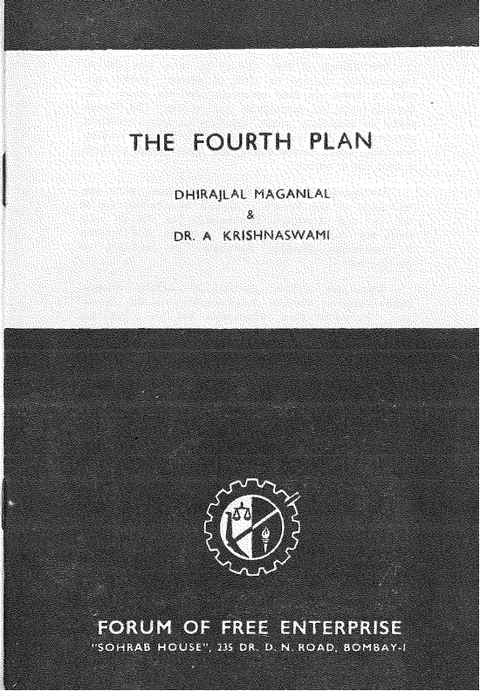
Third Five-Year Plan — Its Premises Examined
By Dr. A. Krishnaswami, M.P.
Summary
In this Forum of Free Enterprise pamphlet — the printed text of a lecture delivered in Bombay on 21 August 1961 — Dr. A. Krishnaswami, M.P., subjects the premises of India’s Third Five-Year Plan to a sceptical, pro-private-enterprise examination. He opens by defending the duty of public-spirited citizens to scrutinise the Plan’s assumptions even when planners treat constructive critics as denigrators, and notes that the public sector’s Rs. 7,500-crore outlay (of which about Rs. 8,300 crore is investment) dwarfs the Rs. 4,300 crore allotted to the private sector, while inflation erodes the real value of all of it.
Krishnaswami argues that India’s central economic problem is low per-capita income and inadequate domestic savings, and that heavy taxation to force savings risks eating into the subsistence consumption of a population already living near the margin. He presses the case that state enterprises must be run on commercial principles and not subsidised at a loss, that the Plan neglects agriculture despite its providing roughly half of national income, and that land must increasingly be treated as a scarce factor whose alternative uses the Planning Commission has failed to weigh. He warns against rigid adherence to the Plan’s schedule when inflation and shortages threaten, and advocates labour-intensive rural employment — buffer stocks of food, brick factories, irrigation and village-based small-area plans — to absorb seasonal unemployment without fuelling inflation.
Throughout, Krishnaswami urges austerity directed at non-essentials rather than showy gestures, criticises the diversion of scarce capital and skilled labour into prestige or import-dependent projects, and calls for export-oriented production and improved quality and efficiency. The pamphlet closes with the Forum’s customary disclaimer and A. D. Shroff’s motto that ‘Free Enterprise was born with man and shall survive as long as man survives.‘
Key points
-
Defends the right and duty of citizens to examine the Third Plan’s premises against planners who treat critics as spoilers.
-
Contrasts the public sector’s large Rs. 7,500-crore outlay with the Rs. 4,300 crore allotted to the private sector, both eroded by rising prices.
-
Argues low per-capita income and weak savings are the core constraints, and that forced savings via high taxation hit subsistence consumption.
-
Insists state enterprises be run commercially and not knowingly subsidised at a loss.
-
Identifies neglect of agriculture — about half of national income — as the Plan’s ‘major lacuna’, and urges treating land as a scarce factor.
-
Advocates labour-intensive rural employment (food buffer stocks, brick factories, irrigation, village small-area plans) to absorb seasonal unemployment without inflation.
-
Calls for austerity on non-essentials, export-led production, and better quality and efficiency rather than prestige or import-dependent projects.
Generated by the v1.5 extraction pipeline. Awaiting editorial review.
Metadata and summary are AI-extracted from the source PDF and reviewed for editorial accuracy. The original work is available via the Read PDF tab above (where present); paragraph-level citation inside the PDF is deferred to a future engagement.