book
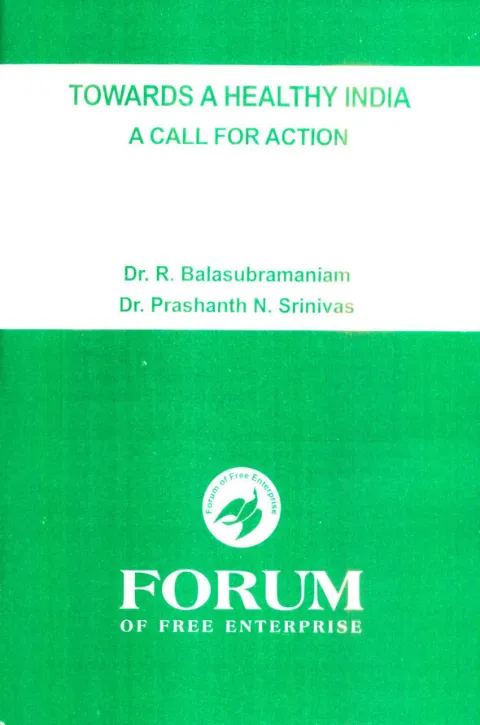
Towards a Healthy India
A Call for Action
Forum of Free Enterprise · Mumbai
77 pages
Towards a Healthy India
By Dr. R. Balasubramaniam, Dr. Prashanth N. Srinivas
Summary
In the rendered pages, this co-authored Forum of Free Enterprise monograph by Dr. R. Balasubramaniam (‘Balu’) and Dr. Prashanth N. Srinivas presents an action agenda for India’s health sector, with particular emphasis on affordable and equitable healthcare. The FFE Editorial Introduction (printed pp.3-5) frames the work as a monograph arguing that state-led efforts at ensuring equitable healthcare and promoting public health can drive the next decade of socio-economic progress, and it situates health within development theory as a determinant of human-capital quality and economic growth.
The rendered pages document a sharp critique of how healthcare is financed in India: the authors note, in the rendered pages, that over three-fourths of healthcare payments are made out-of-pocket, that roughly 46 million households are estimated to have suffered catastrophic health expenditure (29 million on medicines alone), and that low government spending of about 1% to 1.2% of GDP combines with fragmented pooling and inequitable use of scarce public funds.
The core of what is rendered is a framework of cardinal principles for a responsive health system, opened by an argument that health is a collective responsibility of state, communities and individuals, and that a systems approach to public health must complement biomedical solutions through the ‘de-medicalization’ of healthcare. The enumerated principles seen in the rendered pages begin with equity and social justice and universality, and continue through appropriate technology and public-oriented partnerships. Because only about a quarter of the work was rendered, this summary is confined to those pages and does not characterise the monograph as a whole.
Key points
-
In the rendered pages, the FFE Editorial Introduction frames the work as a monograph on India’s health sector with emphasis on affordable healthcare.
-
The authors argue, in the rendered pages, that state-led equitable healthcare can drive the next decade of socio-economic progress.
-
Over three-fourths of healthcare payments in India are out-of-pocket; ~46 million households suffered catastrophic health expenditure (29 million on medicines alone).
-
Government health spending is low at about 1% to 1.2% of GDP, with fragmented pooling and inequitable use of scarce public funds.
-
The rendered text opens a framework of cardinal principles for a responsive health system, beginning with equity/social justice and universality.
-
Health is framed as a collective responsibility of state, communities and individuals, with the State bearing the greater responsibility.
-
A systems approach to public health is urged to complement biomedical solutions via ‘de-medicalization’ of healthcare.
-
Later rendered principles include appropriate technology (evidence-based, cost-effective) and public-oriented partnerships.
Generated by the v1.5 extraction pipeline. Awaiting editorial review.
Metadata and summary are AI-extracted from the source PDF and reviewed for editorial accuracy. The original work is available via the Read PDF tab above (where present); paragraph-level citation inside the PDF is deferred to a future engagement.