edited volume · anthology
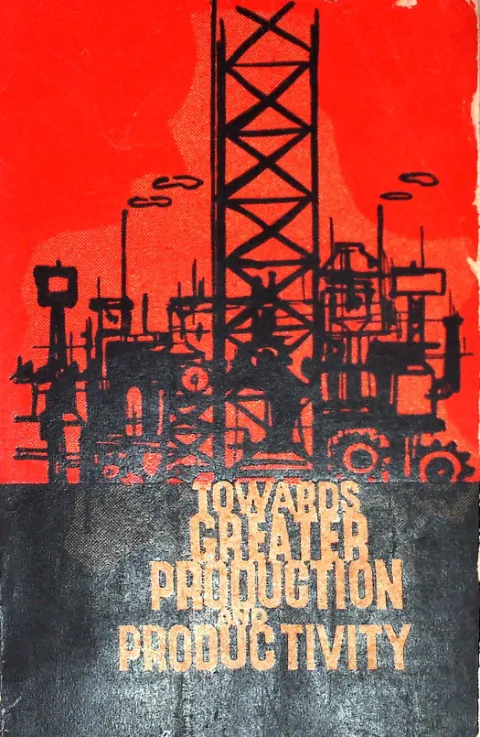
Towards Greater Production & Productivity
A Symposium Organised by the Forum of Free Enterprise
By h-b-dhondy, B. S. Kalsi, s-v-ghatalia, Dr. F. S. Noorani, Dr. R. M. Shah, T. V. Lalvani, S. P. Hatte
Published by G. R. Bhatkal, Popular Prakashan, 35-C Tardeo Road, Bombay 34 WB · Bombay · 1964
145 pages
Towards Greater Production & Productivity
Summary
In the rendered pages, ‘Towards Greater Production & Productivity’ presents itself as a symposium organised by the Forum of Free Enterprise and published as a popular pocketbook by Popular Prakashan (May 1964). An introduction signed by A. D. Shroff, President of the Forum, frames the volume’s purpose: economic development in an underdeveloped country is the elimination of poverty, there is ‘no royal path’ to it, and greater production and productivity from existing resources is the essential pre-requisite because only that maximises the wealth available for savings and investment. The book collects seven practical essays — on forms of business organisation, personnel policy, standard costing, modern marketing, decision-making, industrial relations, and materials management — based on a series of Forum lectures and aimed at improving the production and productivity of enterprises. In the rendered pages only the opening of the first essay is visible; the remaining essays fall outside this chunk.
Key points
-
A. D. Shroff’s introduction frames the book’s purpose: since there is ‘no royal path’ to eliminating poverty in an underdeveloped country, raising production and productivity from existing resources is the essential prerequisite for savings and investment.
-
The pocketbook collects seven essays drawn from Forum of Free Enterprise lectures, covering business organisation, personnel policy, standard costing, modern marketing, decision-making, industrial relations, and materials management.
-
Chartered accountant H. B. Dhondy opens the volume by arguing that businessmen carefully plan machinery, finance and markets but routinely neglect the choice of legal form for their enterprise.
-
Dhondy illustrates the cost of this neglect with an international firm whose Indian business suffered after being converted into a public company unsuited to its need for continuous, on-the-spot managerial risk-taking.
-
He surveys the forms of business organisation available to a small or medium entrepreneur — sole proprietorship, partnership, and private or public company — weighing independence against corporate structure.
-
Dhondy identifies limited liability of shareholders, arising from a company’s separate legal personality, as the single most important factor behind the growth of joint-stock companies.
Essays
Forms of Business Organisation: Tax, Company Law and other Considerations
By H. B. Dhondy
In the rendered pages, H. B. Dhondy — described as a leading chartered accountant — opens ‘Forms of Business Organisation: Tax, Company Law and other Considerations’ by observing that the businessman starting an enterprise attends carefully to machinery, men, finance, markets and raw materials but rarely gives thought to which legal form of organisation best suits his circumstances, leaving it to chance or his legal advisers. He argues this neglect is costly, citing a large international firm whose Indian business suffered after being converted into a public company unsuited to its need for continuous on-the-spot managerial risk-taking. Writing for the layman about to set up a small or medium business, he surveys the available forms — sole proprietorship, partnership, and private or public company (subsidiary or non-subsidiary) — weighing the independence of the sole proprietor against the corporate form, whose key advantage in the rendered pages he identifies as the limited liability of shareholders behind the company’s separate legal personality.
- Businessmen lavish attention on resources but neglect the choice of legal form of organisation, often deciding it by chance.
- The wrong organisational form can damage a business, illustrated by an international firm hurt after conversion to a public company.
- Surveys the main forms: sole proprietorship, partnership, and private/public company.
- The sole proprietor gains maximum independence and flexibility with minimal legal formalities.
- In the rendered pages, limited liability is presented as the single most important factor behind the growth of joint-stock companies.
Generated by the v1.5 extraction pipeline. Awaiting editorial review.
Metadata and summary are AI-extracted from the source PDF and reviewed for editorial accuracy. The original work is available via the Read PDF tab above (where present); paragraph-level citation inside the PDF is deferred to a future engagement.