edited volume · anthology
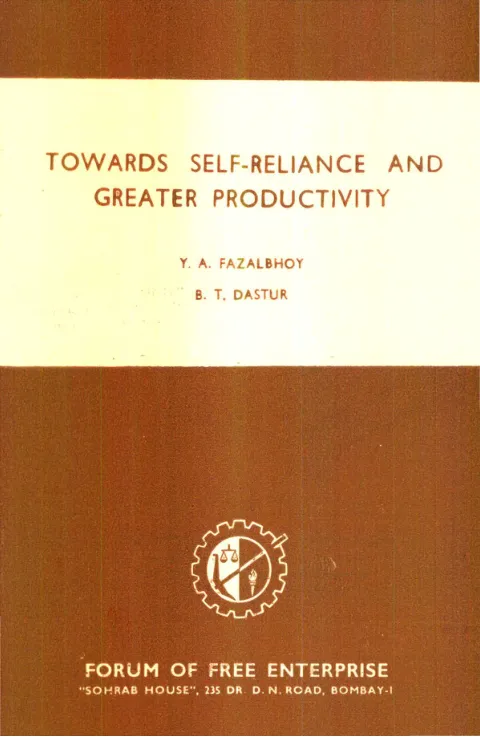
Towards Self-Reliance and Greater Productivity
By y-a-fazalbhoy, B. T. Dastur
Forum of Free Enterprise, "Sohrab House", 235 Dr. D. N. Road, Bombay-1 · Bombay · 1966
20 pages
Towards Self-Reliance and Greater Productivity
Summary
This Forum of Free Enterprise booklet, issued for the 1966 India Productivity Year, gathers two essays under the banner of self-reliance and greater productivity. In an introduction dated 12 April 1966, FFE President Murarji J. Vaidya frames the volume as the Forum’s educative contribution to the national drive for greater production and productivity amid economic crisis. The first essay, by industrialist Y. A. Fazalbhoy (President of the Bombay Productivity Council), argues for self-reliance through indigenous research, improved productivity and quality in private enterprise; the second, by business executive B. T. Dastur, offers a practical catalogue of measures for raising office productivity. Together the essays press the case that free enterprise must earn its place by lowering costs, cutting waste and building indigenous technological capacity.
Key points
-
Issued for the 1966 India Productivity Year, this Forum of Free Enterprise booklet gathers two essays under FFE President Murarji J. Vaidya’s introduction of 12 April 1966, framing productivity as the nation’s educative response to economic crisis.
-
Y. A. Fazalbhoy, President of the Bombay Productivity Council, writes against the backdrop of the Fourth Plan, the 1962 and 1965 wars, and a foreign-exchange deficit, quoting Lal Bahadur Shastri that self-reliance is ‘an attitude of mind’.
-
Fazalbhoy argues free enterprise must lower costs through higher productivity, improve quality and plant layout, and build indigenous research facilities to limit dependence on foreign technology.
-
He holds that placing dynamic, progressive personalities in key private-sector positions is the essential prerequisite for harnessing Indian scientific research, concluding that research and industry must become part and parcel of each other.
-
B. T. Dastur’s ‘Office Productivity’ laments that India’s Productivity Year focused attention on factories and raw materials while excluding office-economy gains even from national incentive awards.
-
Dastur diagnoses office waste as arising from delay, a ‘Backlog Syndrome’, poor arrangement, uncodified responsibilities, functional rigidity and neglect of the working environment.
-
He prescribes a review technique questioning every form and procedure, minimising correspondence and copies, re-using envelopes and files, economising on stationery, and rewarding staff strictly by results and merit.
Essays
Towards Self-Reliance
By Y. A. Fazalbhoy
Fazalbhoy opens against the backdrop of the Fourth Plan, the 1962 China and 1965 Pakistan wars, and a large foreign-exchange deficit, arguing that the national emergency demands a closer study of development plans and a serious pursuit of self-reliance. Quoting Lal Bahadur Shastri that self-reliance is “an attitude of mind”, he contends free enterprise is not secure unless it lowers the cost of indigenous products through higher productivity, improves quality and plant layout, and creates research facilities to develop indigenous know-how and limit foreign dependence. He stresses that the rate of scientific discovery depends on the funds and number of scientists employed, and that placing dynamic, progressive personalities in key positions in the private sector is the most essential prerequisite for harnessing Indian scientific research — concluding that research and industry must become part and parcel of each other.
- Written amid the Fourth Plan, the 1962/1965 wars and a Rs. 1,998-crore foreign-exchange deficit, framing self-reliance as a national-emergency priority.
- Self-reliance defined (after Shastri) as an attitude of mind: making do with what one has, not total self-sufficiency.
- Free enterprise must lower costs via higher productivity, improve quality and plant layout, and build indigenous research capacity.
- Scientific discovery’s rate depends on funds and the number of scientists employed; research can be planned.
- Placing dynamic, progressive people in key private-sector positions is the essential prerequisite for using Indian research; research and industry must merge.
Office Productivity
By B. T. Dastur
Dastur’s essay “Office Productivity” laments that while India’s Productivity Year drew abundant attention to raw materials and the factory floor, office productivity was neglected — even national awards for useful suggestions excluded office-economy gains because they seem less tangible than cuts in coal or yarn consumption. He insists the office can and must be made a productive unit and that management by measurement applies as much there as in a mine or workshop. He diagnoses common causes of office waste — delay, the “Backlog Syndrome”, poor arrangement, uncodified responsibilities, functional rigidity, and neglect of the working environment — then offers a long, granular list of practicable economies: question every form and procedure via review technique, minimise correspondence and office copies, re-use envelopes, files and packing material, economise on stationery, maintain a “Flying Squad” for peak absenteeism, codify individual responsibilities in a manual, and reward by results and merit alone.
- Office productivity is neglected relative to factory and raw-material economies, even in incentive schemes.
- Two premises: the office is (and can be made) a productive unit; management by measurement applies as in a mine or workshop.
- Diagnoses delay, the “Backlog Syndrome”, poor arrangement, uncodified duties, functional rigidity and poor work environment as causes of low productivity.
- Prescribes review technique to question every form and procedure, and merit/results-based reward.
- Offers concrete economies: minimise correspondence and office copies, re-use envelopes/files/packing, economise stationery, and keep a “Flying Squad” for peak periods.
Generated by the v1.5 extraction pipeline. Awaiting editorial review.
Metadata and summary are AI-extracted from the source PDF and reviewed for editorial accuracy. The original work is available via the Read PDF tab above (where present); paragraph-level citation inside the PDF is deferred to a future engagement.