edited volume · anthology
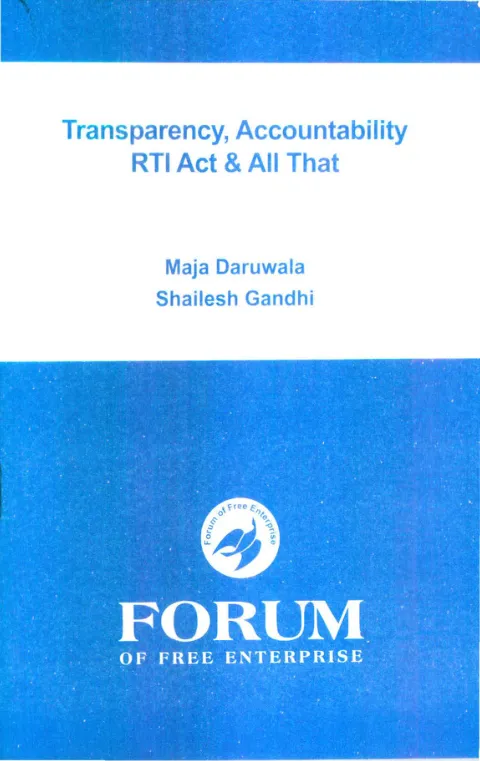
Transparency, Accountability RTI Act & All That
Forum of Free Enterprise · Mumbai · 2016
39 pages
Transparency, Accountability RTI Act & All That
Summary
This Forum of Free Enterprise booklet collects two speeches delivered at the Twelfth M. R. Pai Memorial Award Function in Mumbai on 6 May 2016 — by Maja Daruwala, Director of the Commonwealth Human Rights Initiative and the function’s Chief Guest, and by Shailesh Gandhi, the foremost RTI activist and former Central Information Commissioner who received the award. In an introduction signed by editor Sunil S. Bhandare, the Forum frames transparency and accountability as the key hallmarks of good governance and the weak links of India’s political ethos, and identifies common threads between the two speeches: both build on the Supreme Court’s landmark Jayantilal N. Mistry judgment compelling RBI disclosure of bank inspection reports, both warn of mounting political resistance to the Right to Information Act, and both call on citizens to take active responsibility for defending it. The rendered pages cover the editor’s introduction and the whole of Daruwala’s essay; Shailesh Gandhi’s essay falls in the unrendered tail of the booklet.
Key points
-
The booklet collects two speeches from the Twelfth M. R. Pai Memorial Award Function in Mumbai on 6 May 2016, by Chief Guest Maja Daruwala and award recipient Shailesh Gandhi, a former Central Information Commissioner.
-
Editor Sunil S. Bhandare’s introduction identifies common threads in both speeches, reliance on the Supreme Court’s Jayantilal N. Mistry judgment and warnings of mounting political resistance to the Right to Information Act.
-
Maja Daruwala’s address centres on the Jayantilal N. Mistry judgment, which forced RBI disclosure of bank inspection and audit reports under the RTI Act.
-
Daruwala rejects the RBI’s claims that disclosure would breach a fiduciary duty, harm the national economic interest, or violate banks’ commercial confidence.
-
Daruwala argues that an informed, sovereign citizenry is better placed to evaluate the legislature and executive, so disclosure of irregularities strengthens rather than endangers economic security.
-
Daruwala uses banks’ own RTI statistics, submitted to the Central Information Commission, to refute the constraint theory and burden theory that portray RTI requests as a bureaucratic nuisance.
-
Daruwala calls for data-driven rather than assertion-driven policy analysis before any government moves to restrict citizens’ access to information under the Right to Information Act.
-
Daruwala warns that resistance to RTI now ranges from non-compliance and intimidation to the murder of more than two dozen RTI activists, with questioning increasingly recast as anti-national.
-
Bhandare’s introduction frames transparency and accountability as key hallmarks of good governance and identifies them as persistent weak points in India’s political culture.
Essays
The Value of Transparency and Accountability
By Maja Daruwala
Maja Daruwala’s address, “The Value of Transparency and Accountability,” opens with a wry conceit about being held to account before her maker, then turns to the Supreme Court’s Jayantilal N. Mistry judgment, which rejected the RBI’s claim that disclosing bank inspection and audit reports under the RTI Act would breach a fiduciary duty, harm the national economic interest, or violate banks’ commercial confidence. She reads the judgment as a defence of openness as a public good: an informed, sovereign citizenry is better placed to evaluate the legislature and executive, and disclosure of irregularities strengthens rather than endangers economic security. Marshalling the RTI statistics that banks themselves submitted to the Central Information Commission, Daruwala argues the data do not support the “constraint theory” or “burden theory” by which public authorities portray RTI as a nuisance, and insists that data-driven analysis — not mere assertion — must govern any restrictive policy shift. She closes the rendered pages on a darker note, warning that resistance to RTI now ranges from non-compliance and intimidation to the murder of activists, that questioning is being recast as anti-national, and that even the highest in the land are unwilling to lead on transparency.
- Delivered as Chief Guest’s address at the 12th M. R. Pai Memorial Award Function, 6 May 2016, Mumbai.
- Centres on the Supreme Court’s Jayantilal N. Mistry judgment forcing RBI disclosure of bank inspection/audit reports under the RTI Act.
- Rejects the RBI’s ‘fiduciary duty’, ‘economic interest’ and ‘commercial confidence’ grounds for withholding information.
- Argues openness serves economic progress: an informed sovereign citizenry can better evaluate government.
- Uses banks’ own CIC-submitted RTI statistics to refute the ‘constraint theory’ and ‘burden theory’ of RTI as a nuisance.
- Calls for data-driven rather than assertion-driven policy on restricting information access.
- Warns that resistance to RTI ranges from non-compliance and intimidation to the murder of over two dozen RTI activists.
Generated by the v1.5 extraction pipeline. Awaiting editorial review.
Metadata and summary are AI-extracted from the source PDF and reviewed for editorial accuracy. The original work is available via the Read PDF tab above (where present); paragraph-level citation inside the PDF is deferred to a future engagement.