edited volume · anthology
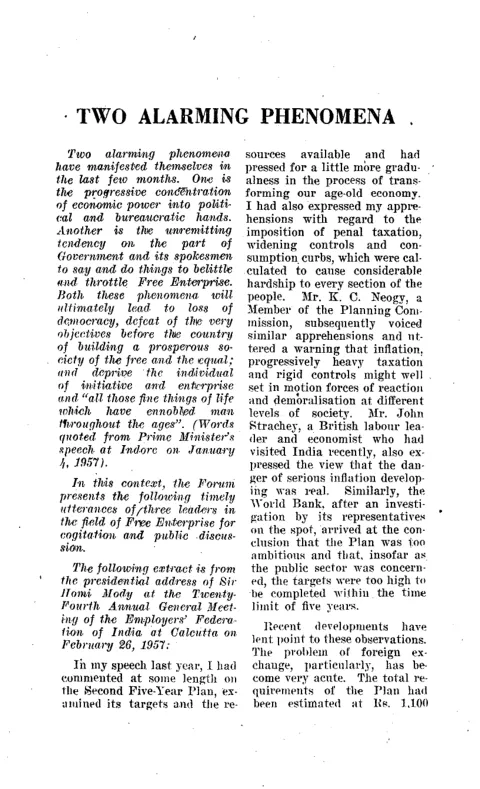
Two Alarming Phenomena
FORUM OF FREE ENTERPRISE, "Sohrab House", 235, Dr. Dadabhai Naoroji Road, Bombay-1 · Bombay · 1957
6 pages
Two Alarming Phenomena
Summary
This short Forum of Free Enterprise leaflet (February 1957) gathers three contemporary utterances by leaders in the field of free enterprise to dramatise what it calls ‘two alarming phenomena’: the progressive concentration of economic power in political and bureaucratic hands, and an unremitting tendency on the part of Government and its spokesmen to belittle and throttle free enterprise. The Forum presents excerpts from Sir Homi Mody’s presidential address to the Employers’ Federation of India, S. L. Kirloskar’s presidential address to the Indian Machine Tool Manufacturers’ Association, and a press statement by the industrialist Ramnivas R. Ruia. Together the three voices warn that heavy taxation, exchange controls, expanding State trading, and policy-induced fear are sapping private initiative and enterprise at a critical moment in India’s Second Five-Year Plan.
Key points
-
Sir Homi Mody, addressing the Employers’ Federation of India’s twenty-fourth annual general meeting in Calcutta on 26 February 1957, warns that the Second Five-Year Plan under-estimated its foreign-exchange needs and will provoke dangerously high additional taxation.
-
Mody argues liberty is lost not in one stroke but through gradual, step-by-step abridgement, and criticises the revised Industrial Policy Statement’s expansion of State trading into private enterprise’s legitimate sphere.
-
Mody invokes Abraham Lincoln’s dictum on the proper limits of government to argue that commerce and trade are ill-suited to bureaucratic administration.
-
S. L. Kirloskar, in his presidential address to the Indian Machine Tool Manufacturers’ Association’s tenth annual general meeting, contends that recent political, financial, industrial and labour policies have dampened new and existing private enterprise.
-
Kirloskar warns that innumerable rules and regulations deter entrepreneurs from risk-taking, and that constant government criticism of the private sector breeds fear that saps entrepreneurial spirit.
-
Ramnivas R. Ruia’s February 1957 press statement calls for coordination among the Ministries of Finance, Commerce and Industries, and Agriculture to make the Second Plan succeed.
-
Ruia defends cotton forward and futures trading as a legitimate hedging mechanism against the government’s prior ban, arguing that suppressing forward contracts merely displaces speculation and raises prices.
-
Ruia criticises the Commerce and Industries Minister’s conditions on forward trading, likening regulation that ignores crop considerations to racing without permitting speculation.
Essays
Presidential address of Sir Homi Mody at the Twenty-Fourth Annual General Meeting of the Employers’ Federation of India at Calcutta on February 26, 1957
By Sir Homi Mody
In his presidential address to the 24th Annual General Meeting of the Employers’ Federation of India (Calcutta, 26 February 1957), Sir Homi Mody warns that the Second Five-Year Plan has under-estimated its foreign-exchange needs and that the resulting gap is likely to be met by additional taxation reaching alarming figures. He argues that the real issue is whether the Plan’s objectives are pursued in a way that breaks the country’s economy and undermines liberty and democratic institutions, insisting that liberty is lost not by a single stroke but ‘by a gradual and step by step abridgement.’ He laments the State’s growing encroachment on areas that are the legitimate sphere of private enterprise — citing the revised Industrial Policy Statement and the extension of State trading — and quotes Abraham Lincoln on the proper limits of government, contending that commerce and trade are ill-suited to bureaucratic handling.
- Delivered as the presidential address to the Employers’ Federation of India’s 24th AGM, Calcutta, 26 Feb 1957.
- Argues the Second Plan under-estimated foreign-exchange requirements, prompting dangerous additional taxation.
- Frames liberty as eroded gradually rather than at one stroke, urging vigilance against creeping abridgement.
- Criticises State trading and expanding government encroachment on enterprise’s legitimate sphere.
- Invokes Abraham Lincoln’s dictum on the limited proper object of government.
Presidential address of Mr. S. L. Kirloskar at the Tenth Annual General Meeting of the Indian Machine Tool Manufacturers’ Association in Bombay on February 28, 1957
By Mr. S. L. Kirloskar
In his presidential address to the 10th Annual General Meeting of the Indian Machine Tool Manufacturers’ Association (Bombay, 28 February 1957), S. L. Kirloskar contends that recent laws and announcements in political, financial, industrial and labour policy have acted as ‘a great damper’ on the starting of new enterprises and the existing activities of factories in the private sector. He argues that no individual is now prepared to embark on a risk-forming venture when confronted by innumerable rules, orders and regulations covering every aspect of running an industry, and warns that the Government’s constant criticism of the private sector, industries and industrialists is needlessly creating a sense of fear and helplessness that reduces enthusiasm and entrepreneurial spirit to the detriment of the country.
- Delivered as the presidential address to the Indian Machine Tool Manufacturers’ Association’s 10th AGM, Bombay, 28 Feb 1957.
- Argues political, financial, industrial and labour policy changes have dampened new and existing private enterprise.
- Stresses that excessive rules, orders and regulations deter risk-taking entrepreneurs.
- Warns that constant government criticism of the private sector breeds fear and helplessness, harming the national interest.
Press Statement on Feb. 1957 by Mr. Ramnivas R. Ruia
By Mr. Ramnivas R. Ruia
In a press statement of February 1957, the industrialist Ramnivas R. Ruia calls for co-ordination among the Ministries of Finance, Commerce and Industries, and Agriculture if the Second Plan is to be reasonably successful, warning that uncoordinated action by any one ministry will be harmful. Turning to the cotton trade, he defends forward (futures) markets against the previous year’s government ban, arguing from his own experience that forward contracts can be framed so as not to fluctuate widely, that they provide genuine hedging facilities, and that suppressing them merely shifts speculation and pushes prices higher. He criticises the Commerce and Industries Minister for imposing conditions on forward trading that ‘do not speculate,’ likening over-regulation that ignores crop considerations to racing without permitting speculation, and argues that markets are paying the penalty for the previous year’s interference.
- From a February 1957 press statement by Ramnivas R. Ruia.
- Urges inter-ministerial co-ordination (Finance, Commerce & Industries, Agriculture) for the Second Plan’s success.
- Defends cotton forward/futures trading as a legitimate hedging mechanism against the government’s prior ban.
- Argues banning forward contracts displaces rather than eliminates speculation and raises prices.
- Criticises the Commerce and Industries Minister’s over-regulation of the cotton trade.
Generated by the v1.5 extraction pipeline. Awaiting editorial review.
Metadata and summary are AI-extracted from the source PDF and reviewed for editorial accuracy. The original work is available via the Read PDF tab above (where present); paragraph-level citation inside the PDF is deferred to a future engagement.