pamphlet · collected works
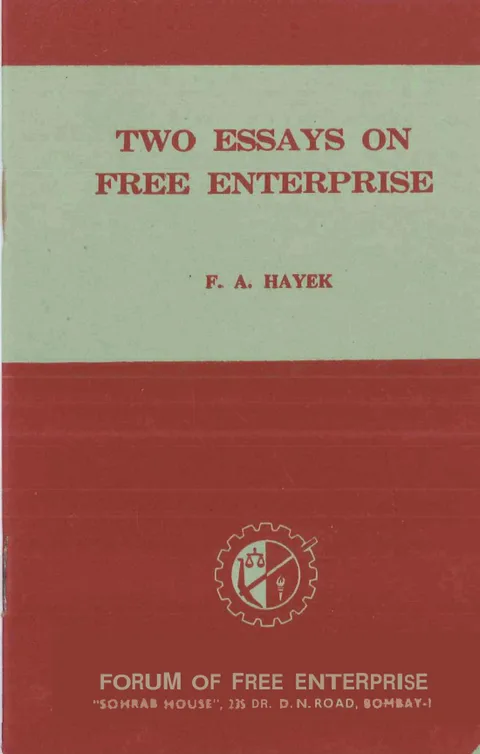
Two Essays on Free Enterprise
Published by M. R. Pai for the Forum of Free Enterprise, 235, Dr. Dadabhai Naoroji Road, Bombay 1, and Printed by Michael Andrades at the Bombay Chronicle Press, Horniman Circle, Bombay-1. · Bombay · 1962
15 pages
Two Essays on Free Enterprise
By Friedrich Hayek
Summary
This Forum of Free Enterprise booklet reproduces two articles by F. A. Hayek, prefaced by an introduction from A. D. Shroff that presents Hayek as a prophet of individual freedom against the encroachments of the state. The two essays argue, respectively, the economic and the moral case for free enterprise.
In the first essay, ‘The Free Market Economy is the Most Efficient Way of Solving Economic Problems,’ Hayek develops his classic knowledge argument: an unhindered market provides the most efficient steering of production because it secures the fullest use of knowledge that is necessarily dispersed among millions of people and can never be assembled at a single central point. Prices act as an impersonal mechanism of communication, telling each individual the relative importance of resources and goods without requiring anyone to know the totality of facts; central planning, by contrast, must discard most of this information. Hayek then turns to the proper role of government, arguing that legitimate state action takes the form of general, predictable rules under the rule of law that frame and assist the market, while discretionary, arbitrary intervention that interferes with prices and the entry of individuals into trades is incompatible with a functioning free system. He concedes a wide range of genuine government service functions (roads, health, defence, monetary stability, education) but insists these be conducted, wherever possible, on the same terms as private enterprise and without claiming a coercive monopoly.
In the second essay, ‘The Moral Element in Free Enterprise,’ Hayek contends that economic freedom is an indispensable condition of all other freedoms and a necessary consequence of personal freedom. Drawing on the Anglo-Saxon tradition of liberty under the law, he argues that moral values can grow only in an environment of freedom, since morality requires genuine choice rather than coerced obedience; a society that suppresses individual responsibility erodes the very capacity for moral judgement. He warns that a free society lacking a moral foundation is unstable, but maintains (citing John Stuart Mill) that morals must be cultivated through conviction and persuasion, not compulsion. He closes by insisting that the free enterprise system is only a means whose ‘infinite possibilities must be used in the service of ends which exist apart.‘
Key points
-
An FFE booklet reproducing two Hayek articles, with an introduction by A. D. Shroff (President, FFE).
-
Essay 1 advances Hayek’s knowledge argument: markets efficiently use dispersed knowledge no central planner can assemble.
-
Prices function as an impersonal communication mechanism coordinating decentralised decisions.
-
Legitimate government acts through general, predictable rules under the rule of law, not arbitrary discretionary intervention.
-
Hayek accepts genuine state service functions but resists coercive monopoly, urging they operate on the same terms as private enterprise.
-
Essay 2 argues economic freedom is an indispensable condition of all other freedoms.
-
Moral values require freedom and genuine choice; coerced virtue is not virtue, and suppressing responsibility erodes morality.
-
A free society needs a moral foundation, but morals must spread by conviction and persuasion (citing J. S. Mill), not compulsion.
-
The free enterprise system is a means; its possibilities must serve ends that exist apart from it.
Generated by the v1.5 extraction pipeline. Awaiting editorial review.
Metadata and summary are AI-extracted from the source PDF and reviewed for editorial accuracy. The original work is available via the Read PDF tab above (where present); paragraph-level citation inside the PDF is deferred to a future engagement.