speech
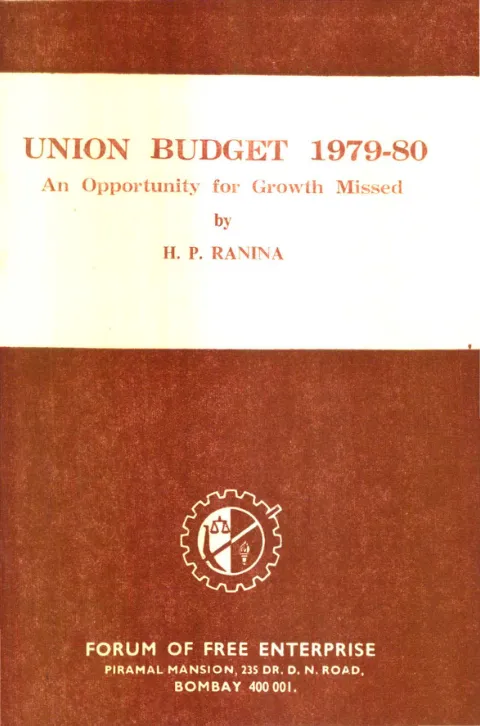
Union Budget 1979-80
An Opportunity for Growth Missed
By HP Ranina
FORUM OF FREE ENTERPRISE, PIRAMAL MANSION, 235 DR. D. N. ROAD, BOMBAY 400 001. · Bombay · 1979
19 pages
Part of The Union Budget
Union Budget 1979-80
By HP Ranina
Summary
H. P. Ranina’s lecture, delivered at the Forum of Free Enterprise in Bombay on 1st March 1979 and published as a Forum booklet, dissects the Union Budget for 1979-80 presented by Finance Minister Charan Singh. Ranina opens by arguing that the moment was singularly propitious: foreign exchange reserves stood at Rs. 5,082 crores, the wholesale price index had risen by only 0.9%, industrial growth had reached 8%, and foodstocks held the impressive figure of 20 million tonnes. The economy had “reached the take-off stage,” yet the Finance Minister, in Ranina’s view, squandered the chance to engineer “an economic miracle which has so far eluded India.”
The core polemic is that the Budget transfers resources from the urban poor and middle class to what Ranina calls the “rural rich” — large benami landholders, black-marketeers, and politicians who have parked ill-gotten gains in agricultural land and who, for thirty years, have paid no income tax. The cut in excise duty on fertilisers (worth Rs. 105 crores in foregone revenue) benefits these landlords, not the cultivator with bullocks and wooden ploughs. Meanwhile, excise hikes on petrol, diesel, motor cars, refrigerators, pressure cookers, soap, toothpaste, radios, televisions, and even biscuits and butter — in the International Year of the Child — make the urban citizen the chief tax-payer for a Plan outlay (Rs. 12,551 crores out of total expenditure Rs. 18,526 crores) tilted to agriculture, rural industries, and irrigation.
The second half of the lecture is a clause-by-clause critique of the Finance Bill, 1979, which adopts most pro-revenue recommendations of the Chokshi Committee on Direct Taxes. Ranina welcomes the revival of the export market development allowance and the new Section 80GGA for donations to rural-development institutions, but attacks the deletion of Section 54E (the capital-gains exemption used to convert black money), the punitive retrospective effect of the Section 64 clubbing amendments aimed at the Supreme Court’s J. G. Shah ruling, the reduction of the Section 80C savings rebate, the withdrawal of Section 80J relief for new “non-priority” industries, and the increase of corporate surcharge from 5% to 7.5% — which pushes the aggregate tax burden past 100% once dividend tax is counted. He singles out the new Section 80JJA mushroom-growing relief as the one streak of humour in a bleak document and as proof of the Budget’s “anti-industry bias.”
Ranina closes by warning that ceilings on managerial remuneration, higher excise duties, a 5% surcharge on income tax, and a reduced savings rebate together squeeze the executive class and will accelerate the brain drain. The hopes and aspirations of the people, he writes, are reduced to those of the rural rich; taxes have become not the lifeblood of the economy but blood drawn from the arteries of the urban sector — “it can only be justified on grounds of political expediency.”
Key points
-
Ranina argues the 1979 macro environment — Rs. 5,082 cr forex reserves, 0.9% WPI growth, 8% industrial growth, 20 mt foodstocks — handed the Finance Minister an exceptional opportunity which the Budget then squandered.
-
Total expenditure of Rs. 18,526 cr against receipts of Rs. 16,551 cr leaves a deficit near Rs. 2,000 cr; revenue measures cover only Rs. 665 cr, leaving an unfilled gap of Rs. 1,355 cr that risks reigniting inflation.
-
The cut in fertiliser excise (worth Rs. 105 cr) and the broader rural-tilted Plan outlay (Rs. 1,811 cr agriculture, Rs. 1,754 cr rural industries, Rs. 1,488 cr irrigation) chiefly benefit benami landlords and political-mercantile speculators, not the bullock-and-plough cultivator.
-
Hikes on petrol, diesel, motor cars, refrigerators, pressure cookers, soap, toothpaste, radios, televisions, biscuits and butter constitute a transfer from urban poor and middle class to the rural rich, dressed up as growth policy.
-
The Finance Bill, 1979 adopts only the revenue-favouring recommendations of the Chokshi Committee on Direct Taxes; Ranina walks through Sections 10, 35CCA/80GGA, 54E, 64, 80A, 80C, 80J, 80JJA, 80P and the appeals/wealth-tax amendments to show their cumulative anti-industry bias.
-
The deletion of Section 54E — which had induced 80–90% disclosure of capital-gains transactions — is read as a step backward in the fight against black money, while the retrospective clubbing amendments to undo the J. G. Shah ruling are flagged as unjust.
-
Withdrawal of Section 80J relief for new industries in the Eleventh Schedule, paired with the absurd Section 80JJA exemption for mushroom growing, dramatises an investment regime that punishes industry and rewards rent.
-
Ceilings on managerial remuneration, a 5% income-tax surcharge, a reduced 80C rebate, and corporate surcharge raised from 5% to 7.5% push aggregate tax past 100% and will accelerate the brain drain; foreign companies will not come, and Indian executives will leave.
Generated by the v1.5 extraction pipeline. Awaiting editorial review.
Metadata and summary are AI-extracted from the source PDF and reviewed for editorial accuracy. The original work is available via the Read PDF tab above (where present); paragraph-level citation inside the PDF is deferred to a future engagement.