pamphlet
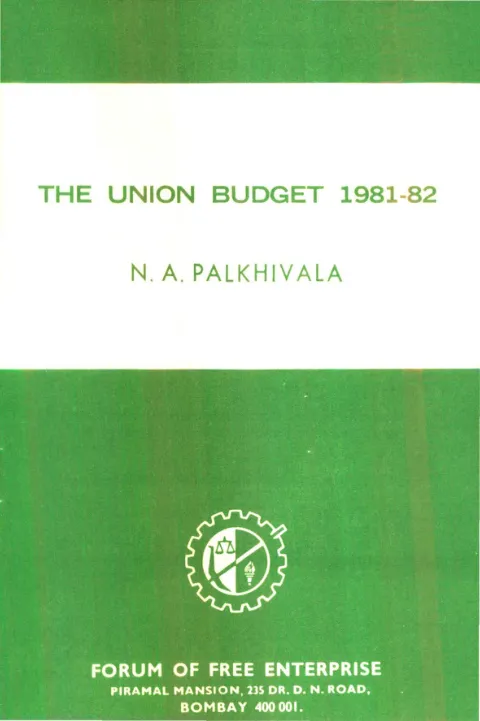
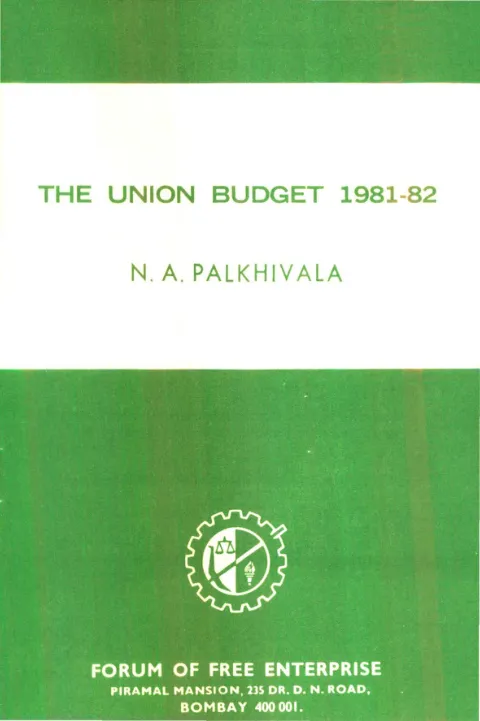
The Union Budget 1981-82
Published by M. R. PAI for the Forum of Free Enterprise 235, Dr. Dadabhai Naoroji Road, Bombay-400 001, and printed at TATA PRESS Ltd., 414, Veer Savarkar Marg, Prabhadevi, Bombay 400 025. · Bombay · 1981
18 pages
Part of The Union Budget
The Union Budget 1981-82
By N. A. Palkhivala
Summary
N. A. Palkhivala’s booklet is a sustained, unsparing critique of the Union Budget of 1981-82, drawn together from a public talk in Bombay, the M. Ct. M. Chidambaram Chettyar Memorial Lecture in Madras, an address in Bangalore, and articles in the Times of India and the Hindustan Times. Palkhivala frames the budget against the backdrop of an anaemic economy: agricultural output up only 0.5 per cent and industrial output only 2.5 per cent over the two-year horizon, real GNP up 1.7 per cent, per capita GNP down 2.2 per cent, foreign exchange reserves just sufficient for five months of imports, and inflation understated by the Finance Minister’s switch from average-index to point-to-point comparisons.
His central thesis is the quadruple verdict that gives the booklet its rhetorical spine: the budget is psychologically perfect, politically clever, economically unsound, and strategically a costly failure. The income-tax reliefs, he argues, are merely an inadequate adjustment for fiscal drag once inflation is taken into account; the corporate surcharge introduced in 1971 for the Bangladesh war remains unending; the 15 per cent customs duty on newsprint is an unconstitutional restriction on a free press; and the budget does nothing to spur industrial growth or to bring the economy near the Sixth Plan’s 5.2 per cent growth target.
Under the heading “Six basic flaws” Palkhivala enumerates: infrastructural inadequacy treated without urgency, the incompatibility of fast-growing government with a fast-growing economy (“so long as India continues to be over-governed, it will continue to be under-developed”), the proliferation of complex tax laws and 88 export-policy changes since April 1980, the absence of stability in fiscal law, a small-hearted approach to exports and human development (only Rs 155 crores for family planning, only 97,000 of 5,76,000 villages with safe drinking water), and the corrosion of values exemplified by the Special Bearer Bonds Scheme, which he calls an institutionalisation of the black market. He closes by urging Mrs. Gandhi to take a U-turn in fiscal and economic policy while she enjoys massive public support and a docile Congress-I majority, lamenting instead “one more year of the locusts”.
Key points
-
Palkhivala judges the 1981-82 Budget against a stagnating economy: only 1.7 per cent real GNP growth over two years, a 2.2 per cent fall in per capita GNP, and foreign exchange reserves sufficient for just five months of imports.
-
He accuses the Finance Minister of “window-dressing” inflation figures by switching from the average-index basis to point-to-point comparisons, hiding that inflation averaged 18.4 per cent in the ten months to January 1981.
-
The headline income-tax relief is dismissed as nothing more than an inadequate adjustment for fiscal drag; India lacks the automatic indexation of exemption limits found in Denmark, the Netherlands, Canada and Australia.
-
He attacks the 15 per cent customs duty on newsprint as an unconstitutional restriction on freedom of speech and expression, since newspapers are the only medium not functioning as a public relations department of the government.
-
Six basic flaws are catalogued: neglect of infrastructure, the incompatibility of big government with a growing economy, ever more complex tax laws, instability in fiscal rules (88 Export-Policy changes since April 1980), a small-hearted approach to exports and human development, and the moral erosion symbolised by the Special Bearer Bonds Scheme.
-
Public-sector capital of Rs 16,354 crores yields a pre-tax profit of just Rs 227 crores (under 1.5 per cent), illustrating the productivity failure of state enterprise.
-
He invokes Nicholas Kaldor’s 1956 Report on Indian Tax Reforms — “too much of false and misguided economy in India” — to argue the diagnosis remains valid a quarter-century later.
-
Palkhivala ends with a direct appeal to Mrs. Gandhi to use her parliamentary majority for a U-turn in fiscal policy, warning that India is otherwise destined to have “one more year of the locusts”.
Generated by the v1.5 extraction pipeline. Awaiting editorial review.
Metadata and summary are AI-extracted from the source PDF and reviewed for editorial accuracy. The original work is available via the Read PDF tab above (where present); paragraph-level citation inside the PDF is deferred to a future engagement.