speech
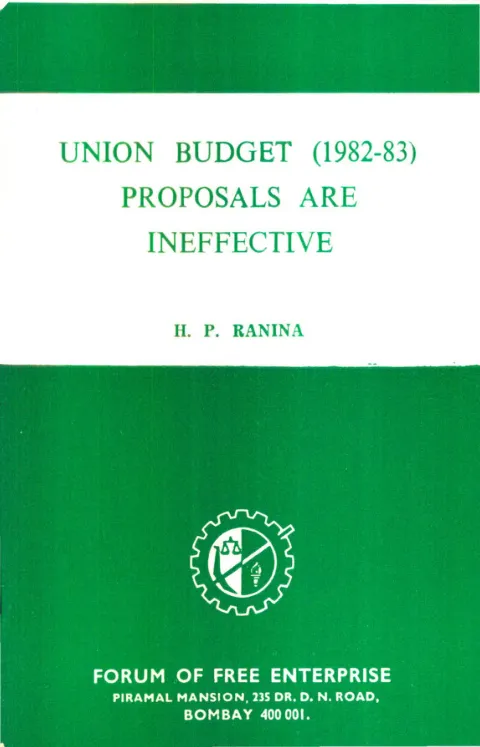
Union Budget (1982-83) Proposals Are Ineffective
By HP Ranina
FORUM OF FREE ENTERPRISE, PIRAMAL MANSION, 235 DR. D. N. ROAD, BOMBAY 400 001. · Bombay · 1982
32 pages
Part of The Union Budget
Union Budget (1982-83) Proposals Are Ineffective
By HP Ranina
Summary
H. P. Ranina’s pamphlet, drawn from a public lecture delivered under the auspices of the Forum of Free Enterprise on 1 March 1982, dissects the Union Budget for 1982-83 presented by Finance Minister Pranab Mukherjee in the so-called ‘Year of Productivity’. Ranina, a taxation specialist, argues that despite great expectations the budget contains nothing that would push industrial growth above the 8% rate recorded the previous year, nor any meaningful incentive to replace the obsolete plant and machinery the Economic Survey had identified as a cause of industrial sickness. He works methodically through the budget’s industrial concessions — the narrow Excise Duty rebate covering only 38 tariff items, the 35% investment allowance under section 32-A(2-B) hedged by restrictive laboratory-origin and assessee-undertaking conditions, the 30% depreciation on a yet-to-be-notified list of energy-saving devices, and the section 80M dividend exemption confined to manufacturers of basic drugs, synthetic rubber and rubber chemicals — and finds them too narrow or too contingent to move the needle.
The pamphlet then turns to the foreign-exchange front, which Ranina calls as ‘depressing’ as the agricultural front is ‘cheerful’. He picks apart the new section 89-A export-profits relief (capped at 10% of tax payable, and likely to have no effect because exporters already struggle to make profits against Japanese, Korean, Taiwanese and Hong Kong competition) and the section 80-HHB concession for building contractors abroad, whose six-month repatriation requirement he says will lock projects out of working capital. He repeatedly holds up Sri Lanka as a comparator that grants 100% exemption on export profits and tax-free salaries to its government employees, asking why India cannot do likewise.
A substantial middle section reviews the elaborate package of incentives aimed at non-resident Indians — Capital Investment Bonds free of income-tax and wealth-tax, equity investment up to 40% with repatriation, 12% six-year National Savings Certificates exempt without any limit, the 2% extra interest on fresh NRE deposits, gift-tax exemptions, and extended facilities for NRI-owned companies, partnerships and trusts. Ranina concludes the package will have only a marginal effect because European destinations already offer NRIs 20-24% repatriable, tax-free returns; he urges the Finance Minister to make NRI dividends totally tax-free, arguing that if the Government can pay tax-free interest to the IMF it can do the same for investors bringing in risk capital.
In the rendered pages Ranina closes by criticising the budget’s treatment of personal savings — the rise in the section 80-L deduction from Rs. 3,000 to Rs. 4,000 and the Unit Trust limit from Rs. 2,000 to Rs. 3,000 he treats as a mockery of ‘relief’ that fails even to compensate for inflation; the 2½% surcharge on incomes between Rs. 60,000 and Rs. 1 lakh he says hits precisely the industrial managers the Year of Productivity is meant to motivate; and the standard-deduction and section 80-C tweaks he calls negligible. His positive verdict is reserved for the Capital Investment Bond, which he calls the ‘most novel and revolutionary idea’ of the budget.
Key points
-
Frames the 1982-83 budget as a failure to live up to the ‘Year of Productivity’ billing and the expectations attached to Pranab Mukherjee’s appointment as Finance Minister.
-
Argues that industrial growth cannot exceed the 8% recorded in 1981-82 because the budget offers no broad incentive to replace obsolete plant and machinery — the very cause of industrial sickness flagged in the Economic Survey.
-
Walks through each industrial concession (Excise Duty rebate on 38 items, 35% investment allowance under section 32-A(2-B), 30% energy-saving depreciation, section 80M dividend exemption for basic drugs and rubber chemicals) and finds them too narrow or too contingent.
-
Treats the section 89-A export-profits relief as cosmetic given competition from Japan, South Korea, Taiwan and Hong Kong, and holds up Sri Lanka’s 100% export-profits exemption as the standard India should match.
-
Criticises the six-month foreign-exchange repatriation rule for section 80-HHB contracts as cash-flow-hostile and proposes 100% exemption on foreign-project profits, parallel to section 80-O for export of technology.
-
Surveys the full NRI incentive package — Capital Investment Bonds, equity up to 40%, 12% NSCs exempt without limit, 2% extra NRE interest, gift-tax relaxations — and concludes it will at best have a marginal effect because Europe already offers 20-24% repatriable tax-free returns.
-
Quotes an independent estimate of Rs. 90,000 crores held by persons of Indian origin abroad to argue that only a total tax exemption on NRI dividends would open the ‘flood gates’ of inward investment.
-
Reads the section 80-L, Unit Trust, standard-deduction and section 80-C revisions as inflation-eroded gestures that fail to lift either the capacity or the desire to save, and the 2½% surcharge on incomes between Rs. 60,000 and Rs. 1 lakh as a tax on the industrial managers needed for productivity.
-
Singles out the Capital Investment Bond — tax-free 7% interest, wealth-tax-free, giftable up to Rs. 10 lakhs, estate-duty-free after two years — as the budget’s one ‘novel and revolutionary’ idea.
Generated by the v1.5 extraction pipeline. Awaiting editorial review.
Metadata and summary are AI-extracted from the source PDF and reviewed for editorial accuracy. The original work is available via the Read PDF tab above (where present); paragraph-level citation inside the PDF is deferred to a future engagement.