occasional paper · statement of principles
Union Budget 2002-2003: The Liberal Point of View
Statement of the Indian Liberal Group
Indian Liberal Group, National Headquarters: Sassoon Building, 1st Floor, 143 Mahatma Gandhi Road, Mumbai 400 001 · Mumbai · 2002
7 pages
Part of The Liberal Budget
Union Budget 2002-2003: The Liberal Point of View
Summary
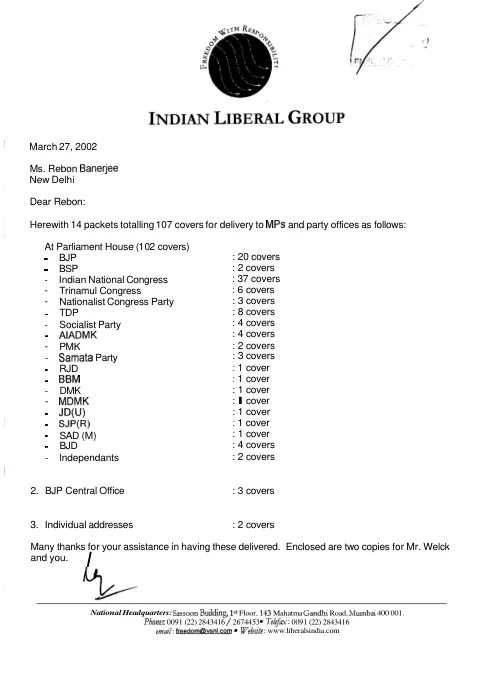
This document is a policy statement issued by the Indian Liberal Group (ILG) setting out a liberal assessment of India’s Union Budget for 2002–2003, dated Mumbai, 21 March 2002. According to the accompanying ILG covering letters (signed by S.V. Raju, President), it was prepared from the inputs of more than fifteen members of the group and circulated to Members of Parliament, party offices, politicians and decision-makers as the first in a planned series of liberal-viewpoint statements on current issues.
The statement opens by diagnosing a slowed economy — GDP growth of 5.4 per cent in 2000–01, weak industrial growth, low inflation and large foreign-exchange reserves — and weighs the Budget’s Keynesian, public-investment-led demand push against the risks of deficit financing given a fiscal deficit of 5.7 per cent of GDP that it judges unsustainable. It criticises measures that increase the tax burden on the middle classes (changes to exemptions and perquisites, the surcharge replacement, dividend taxation), warning these depress disposable income and demand, while urging ruthless cuts to non-productive expenditure such as interest payments, subsidies and the government’s own salary and pension bills. It welcomes the Budget’s encouragement of private investment, especially in infrastructure, the proposed reduction of central staff strength, customs-duty cuts toward ASEAN levels, and the move toward an independent SEBI.
On agriculture and food, the statement attacks the swollen food-subsidy bill and the foodgrain procurement system, arguing the sector accounts for a third of GDP yet is hobbled by high carrying costs, a high minimum support price, and shortages; it calls for reforming the public-distribution system, encouraging private investment, easing controls on movement and procurement, and permitting contract farming. It backs structural reforms in power (the Accelerated Power Development and Reforms Programme), the Urban Land Ceiling Act repeal, disinvestment, and the loosening of labour laws via amendments to the Industrial Disputes Act and the Contract Labour Act, contending these protect rather than harm workers’ interests. It closes by insisting that the passage of pending economic Bills — Electricity, Banking Companies, and the labour-law amendments — is far more urgent to the national interest than questions such as building a temple at Ayodhya, and that political expediency must not override the long-term interests of the people.
Key points
-
A collective policy statement of the Indian Liberal Group on the Union Budget 2002–2003, dated Mumbai, 21 March 2002.
-
Prepared from inputs of over fifteen ILG members and circulated to MPs, party offices and decision-makers (per S.V. Raju’s covering letters).
-
Judges the economy slowed (GDP growth 5.4% in 2000–01) and the 5.7%-of-GDP fiscal deficit unsustainable, cautioning against further deficit financing.
-
Criticises measures raising the tax burden on the middle classes and urges ruthless cuts to non-productive expenditure (interest, subsidies, salary and pension bills).
-
Welcomes encouragement of private investment in infrastructure, cuts to central staff strength, customs-duty reduction toward ASEAN levels, and an independent SEBI.
-
Attacks the food-subsidy bill and procurement system; calls for PDS reform, private investment, decontrol, and contract farming.
-
Backs power-sector reform, repeal of the Urban Land Ceiling Act, disinvestment, and labour-law amendments (Industrial Disputes Act, Contract Labour Act).
-
Concludes that passing pending economic Bills matters more to the national interest than the Ayodhya temple question.
Generated by the v1.5 extraction pipeline. Awaiting editorial review.
Metadata and summary are AI-extracted from the source PDF and reviewed for editorial accuracy. The original work is available via the Read PDF tab above (where present); paragraph-level citation inside the PDF is deferred to a future engagement.