speech
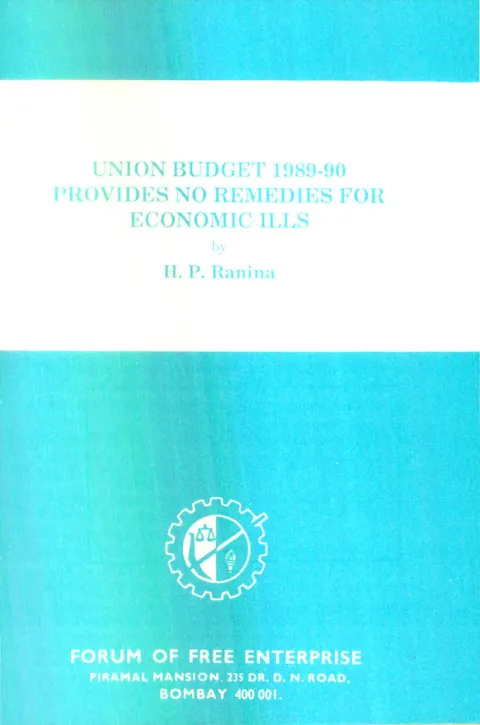
Union Budget 1989-90 Provides No Remedies for Economic Ills
By HP Ranina
Forum of Free Enterprise, Piramal Mansion, 235 Dr. D. N. Road, Bombay 400 001. · Bombay · 1989
18 pages
Part of The Union Budget
Union Budget 1989-90 Provides No Remedies for Economic Ills
By HP Ranina
Summary
H. P. Ranina’s Forum of Free Enterprise booklet is a sober post-mortem of the Union Budget for 1989-90, presented by Finance Minister S. B. Chavan on 28 February 1989. The text is drawn from a talk delivered in Bombay on 1 March 1989 and reads as an industry-friendly critique that conceding what the budget did not do wrong while listing, point by point, what it failed to do. Ranina’s framing line is that the budget contains no provisions that will actively hamper economic growth, but that an election-year temptation to distribute bouquets to the poor and brickbats to the rich has caused the Finance Minister to ignore the industrial sector — which, he reminds the reader, generates almost 80% of central revenues.
The core of the booklet is a structural critique of India’s macro-fiscal position. Ranina argues that the two real problems — the fiscal imbalance and the worsening balance of payments — have been left untouched. He marshals figures from the Economic Survey of 1988-89: a budgetary deficit of around Rs. 7,337 crores, a Central Plan outlay of Rs. 34,446 crores against Rs. 17,000 crores of non-plan defence spending and Rs. 7,472 crores in subsidies, an external debt of roughly Rs. 55,000 crores whose service consumes 24% of foreign-exchange receipts, and a savings rate that has slid to about 20%. He links these to growth in money supply, inflation hovering near 9% despite record foodgrain output projected at 170 million tonnes, and an export target of 30% growth that he calls elusive without fiscal support for industry to upgrade technology and compete in world markets.
The booklet then runs through specific budget measures and finds them wanting or counter-productive. The 8% surcharge on middle-class and affluent incomes is dismissed as creating only a marginal number of mandays of employment, while the two new savings schemes (an equity-linked scheme and a National Housing Bank scheme tied to sections 80-C, 54-E and 5(1-A) of the relevant Acts) are judged unlikely to lift the savings rate. The decontrol of cement and aluminium and a customs-duty cut from 90% to 80% are described as ‘sops’ that will not offset the 5% rise in specific duty rates, the excise hike on iron and steel forgings, an almost 13% freight increase, and the perverse rise in excise on fuel-efficient cars and computers. Ranina reserves particular criticism for a pre-budget amendment to the Capital Issues Order requiring a paid-up capital of Rs. 3 crores and a Rs. 1.8 crore public offer for listing — a rule he says will shelve medium-sized projects of Rs. 7.5–8 crores and damage food processing and light consumer-goods industries.
Ranina closes with a defence of the legislative-intent amendments to sections 32-AB and 115-J of the Income-tax Act, which he reads as sensible clarifications to curb tax avoidance through Investment Deposit withdrawal and ‘book profit’ manipulation in companies whose accounting year differs from 31 March. His conclusion is a classical-liberal coda: poverty-alleviation schemes are ‘laudable’ only if every rupee earmarked percolates down, and ‘social justice can only be obtained not by bringing down the rich but by bringing up the standard of living of the poorest of the poor.‘
Key points
-
Ranina’s overall verdict: the budget does no active harm to growth but fails to address industry, which supplies ~80% of central revenue.
-
Two untreated macro problems — fiscal imbalance and a worsening balance of payments — are foregrounded, with an external debt of ~Rs. 55,000 crores whose servicing absorbs 24% of foreign-exchange receipts.
-
The 8% income surcharge and two new savings schemes (an equity-linked scheme and a National Housing Bank scheme) are judged ineffective against a savings rate that has fallen to about 20%.
-
Customs-duty cut from 90% to 80% and decontrol of cement/aluminium are described as cosmetic ‘sops’ offset by a 5% rise in specific excise rates, hikes on iron and steel forgings, ~13% freight increases, and higher excise on computers and fuel-efficient cars.
-
A pre-budget amendment to the Capital Issues Order (Rs. 3 crore paid-up capital, Rs. 1.8 crore public offer for listing) is singled out as detrimental — projects of Rs. 7.5–8 crores will be shelved, hurting food processing and light consumer-goods industries.
-
Amendments to sections 32-AB and 115-J of the Income-tax Act are endorsed as legitimate clarifications against tax-avoidance interpretations of Investment Deposit withdrawals and ‘book profit’ calculations.
-
Industrial growth of 8% in 1988-89 and record foodgrain output of ~170 million tonnes are acknowledged, but Ranina insists growth must come from a more productive industrial sector, not import-clamping.
-
The closing principle is classically liberal: social justice is achieved by raising the poorest, not by levelling down the rich, and ignoring this ‘inexorable principle of economics’ is done at the nation’s peril.
Generated by the v1.5 extraction pipeline. Awaiting editorial review.
Metadata and summary are AI-extracted from the source PDF and reviewed for editorial accuracy. The original work is available via the Read PDF tab above (where present); paragraph-level citation inside the PDF is deferred to a future engagement.