speech · memorial lecture
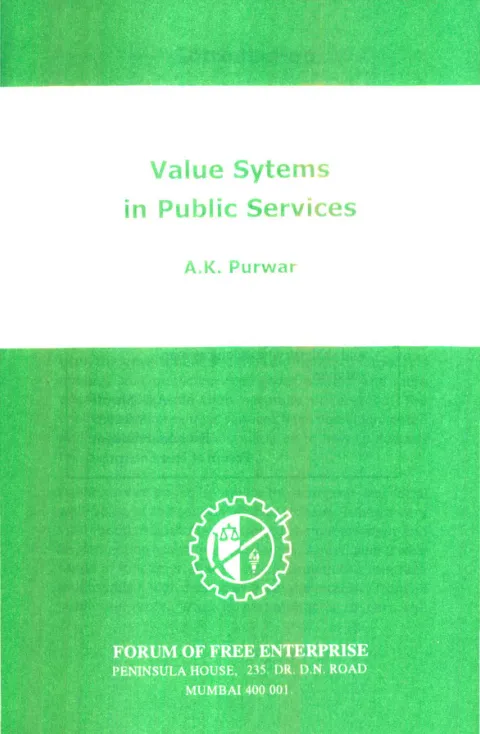
Value Sytems in Public Services
By AK Purwar
Published by S.S. Bhandare for Forum of Free Enterprise, Peninsula House, 235, Dr. D.N. Road, Mumbai 400 001, and printed at Vijay Printing Press, 9-10, 3rd Floor, Mahalaxmi Industrial Estate, Gandhi Nagar, Lower Parel, Mumbai 400 013. · Mumbai · 2005
16 pages
No. 16 in Bhogilal Leherchand Memorial Lecture
Value Sytems in Public Services
By A.K. Purwar
Summary
A. K. Purwar, then Chairman of the State Bank of India, uses the 16th Bhogilal Leherchand Memorial Lecture — delivered under the auspices of the Forum of Free Enterprise on 10 December 2004 and printed here as a Forum booklet — to argue that the renewal of Indian public services is fundamentally a problem of values rather than of structure. He reframes the live “public versus private enterprise” debate as one that turns less on ownership than on the value system a workforce internalises: integrity, commitment to excellence, passion for the work, and teamwork. Honesty, he insists with a David S. Border epigraph, is not a bonus in a public servant — it is the fundamental requirement of the role.
The lecture leans on illustrative case material to make its point that sector is incidental and culture decisive. Lee Kuan Yew’s personal transformation of Singapore from densely populated swamp to garden city, Azim Premji’s “bedrock of integrity” formula at WIPRO, Narayana Murthy and the Tatas as embodiments of integrity, Dhirubhai Ambani’s 24-month Jamnagar refinery as a teamwork miracle, and Sachin Tendulkar’s targeted preparation against Shane Warne are all marshalled to show that determined people with shared values produce world-class outcomes. Purwar offers his own institution as evidence — the State Bank Group’s 13,649-branch computerisation, achieved at the pace of roughly a thousand branches a month, is presented as proof that a public-sector enterprise can keep market leadership against private and foreign competition when commitment, determination and teamwork are in place.
The closing movement re-centres the argument on Mahatma Gandhi. Citing Gandhi’s “two deadly sins” — “knowledge without character” and “commerce without morality” — Purwar argues that India’s crucial challenge can be stated in one line: establishing value systems in public services. He calls for transparency, accountability, professionalism, and a metamorphosis from “a rule-bound, precedence-focused, slothful work culture” to one oriented to society’s satisfaction, with “Integrity … the watchword and common good the ultimate goal.” The booklet is bracketed at front and back by Forum house-quotes from A. D. Shroff (“Free Enterprise was born with man”) and Eugene Black (private enterprise as “affirmative good”), situating Purwar’s ethics-of-service argument inside the Forum’s longer free-enterprise tradition.
Key points
-
Delivered as the 16th Bhogilal Leherchand Memorial Lecture under Forum of Free Enterprise auspices on 10 December 2004; printed as a Forum booklet with an introduction by FFE President Minoo R. Shroff dated 31 March 2005.
-
Reframes the public-versus-private debate: outcomes turn on the value system a workforce internalises, not on ownership category.
-
Identifies four cardinal values for public service — integrity, commitment to excellence, passion for the work, and teamwork — and insists motivation must come from within.
-
Uses the State Bank Group’s 13,649-branch computerisation (roughly 1,000 branches a month) as evidence that a public-sector enterprise can deliver private-sector-grade results.
-
Marshals Lee Kuan Yew’s Singapore makeover and Dhirubhai Ambani’s Jamnagar refinery as case studies of vision plus determined teamwork.
-
Quotes David S. Border that honesty is not a bonus but the fundamental requirement of a public servant’s role.
-
Closes by calling India back to Mahatma Gandhi, invoking the deadly sins of “knowledge without character” and “commerce without morality”.
-
Names “Integrity … the watchword and common good the ultimate goal” as the lecture’s operating maxim and calls for a culture shift from rule-bound proceduralism to result-orientation.
Generated by the v1.5 extraction pipeline. Awaiting editorial review.
Metadata and summary are AI-extracted from the source PDF and reviewed for editorial accuracy. The original work is available via the Read PDF tab above (where present); paragraph-level citation inside the PDF is deferred to a future engagement.