speech · memorial lecture
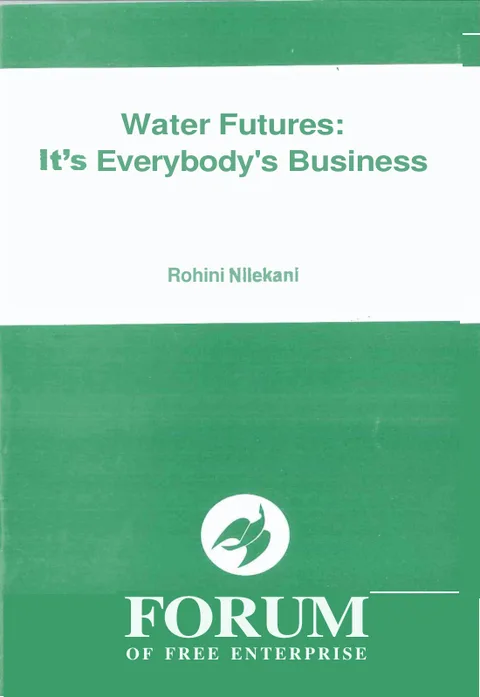
Water Futures: It's Everybody's Business
Published by S. S. Bhandare for the Forum of Free Enterprise, Peninsula House, 2nd Floor, 235, Dr. D. N. Road, Mumbai 400001, and Printed by S. V. Limaye at India Printing Works, India Printing House, 42 G. D. Ambekar Marg, Wadala, Mumbai 400 031. · Mumbai · 2012
12 pages
No. 24 in Bhogilal Leherchand Memorial Lecture
Water Futures: It’s Everybody’s Business
By Rohini Nilekani
Summary
Water Futures: It’s Everybody’s Business is the text of the 24th Bhogilal Leherchand Memorial Lecture, delivered by Rohini Nilekani in Mumbai on 7th December 2012 under the auspices of the Forum of Free Enterprise. Drawing on nearly a decade of work through Arghyam, the public-charitable organisation she founded and funded, Nilekani argues that water has become a civilisational issue. Per-capita availability in India has fallen from roughly 6,008 cubic metres per person in 1947 to about 1,700 in 2001, and is projected to dip below 1,000 by 2030–2050, even as urbanisation, industrialisation and rising aspirations push consumption upward and surface and groundwater alike are polluted and overdrawn.
The lecture is organised around three sectoral sites of the crisis — agriculture (more than 80% of freshwater use, much of it irresponsibly applied to rice in Punjab and Haryana or sugarcane in Rajasthan), industry (8–13% and rising with GDP, with the Mithi, Yamuna and even the Ganga as ‘mute testimony to our indifference’), and cities (with grotesque inequalities, where rich Mumbai neighbourhoods get 400 lpcd while northern slums survive on 36). She introduces the concept of ‘virtual’ or embedded water — popularised by John Anthony Allan of King’s College — to show that food choices, cotton jeans and milk all carry hidden water costs, and that India is in effect exporting scarce water through textiles while saving 1,300 cubic metres per imported tonne of wheat.
The core prescription is a shift from supply-side management to restraint: a ‘low water economy, indeed a low water society’ built on flexible sharing systems, water efficiency, decentralised treatment and reuse, the subsidiarity principle, and a ‘Save Water’ campaign starting in schools. Nilekani repeatedly invokes Gandhi, the 19th-century aphorism ‘Water is a very good servant but it is a cruel master’, and her own coinage ‘Dil Maange More seems to be a more celebrated mantra than Dimaag Maange Less’ to argue for cultural change. The booklet closes with a civic exhortation to citizens, cities and industry to ‘Engage, engage, and engage!’ — to value water, revive lakes and rivers, and accept that securing the country’s water future is everybody’s business. A foreword by Minoo Shroff (President, Forum of Free Enterprise) frames the talk as a realistic, eye-opening assessment of a problem ‘not adequately realized and appreciated’.
Key points
-
Per-capita water availability in India has fallen from ~6,008 m3 (1947) to ~1,700 m3 (2001) and is projected to dip below 1,000 m3 by 2030–2050, with parts of Rajasthan already at 150 mm of rain a year and parts of Assam at 3,000 mm — temporal and spatial maldistribution as much as scarcity.
-
Agriculture absorbs more than 80% of India’s freshwater; domestic use takes 5–7% and industry 10–13%, and state policy effectively subsidises irresponsible withdrawal — flood-irrigated rice in Punjab/Haryana, sugarcane in Rajasthan, and a near-free regime around 23 million bore wells.
-
Nilekani frames water as a ‘civilizational issue’ and calls for a ‘low water economy, indeed a low water society’ — restraint, efficiency, subsidiarity and decentralised treatment in place of supply-side expansion.
-
She introduces virtual or embedded water (crediting John Anthony Allan of King’s College): a kilogram of milk needs 3,000 litres, a pair of denim jeans demands the most water of any garment, and importing one tonne of wheat saves India 1,300 cubic metres of real, local water.
-
Health-food inversion: subsidised pricing and procurement have pushed Indian farmers towards wheat, rice and sugarcane — water-intensive ‘white rice and white sugar’ crops — while the elite migrates to millets, vegetables and fruits the farmers themselves can no longer afford to grow.
-
Urban inequality is stark: in Mumbai rich connected areas can receive ~400 lpcd while northern slums get ~36 lpcd; cities must adopt Singapore-style rationalisation, reuse, decentralised wastewater treatment and ‘cost the cost’ of water to consumers.
-
Industrial responsibility: industry must accept the polluter-pays principle for the contamination of the Mithi, Yamuna and Ganga; Mumbai, as the ‘heart of the world of finance’, can lead in incentivising water efficiency.
-
Arghyam has spent Rs 35 crore over eight years and now spends Rs 10–13 crore annually supporting over 90 projects across 21 Indian states — rainwater harvesting in Bihar, fluoride-safe groundwater in Karnataka, restoring kuins, tankas and other traditional waterbodies in Uttarakhand, Rajasthan, Tamil Nadu and Kerala.
-
Closing civic call: ‘Engage, engage, and engage!’ — citizens must reduce their water footprint, cities must value rivers, and industry must accept polluter-pays; securing India’s water future is ‘everybody’s business’.
Generated by the v1.5 extraction pipeline. Awaiting editorial review.
Metadata and summary are AI-extracted from the source PDF and reviewed for editorial accuracy. The original work is available via the Read PDF tab above (where present); paragraph-level citation inside the PDF is deferred to a future engagement.