pamphlet
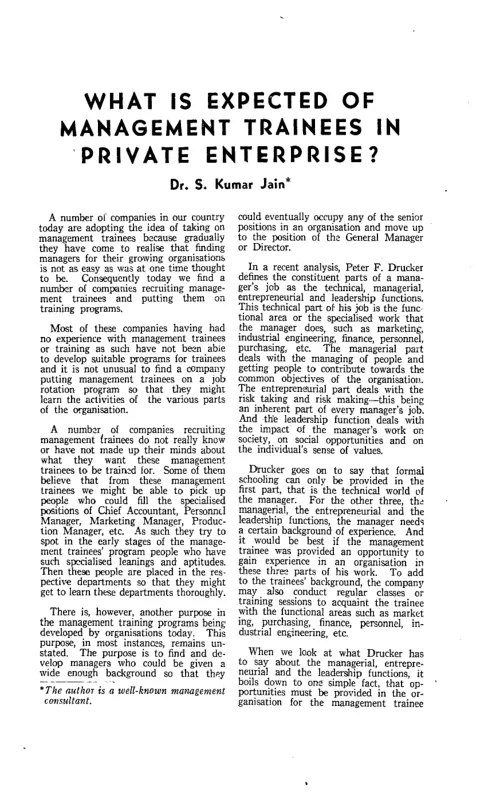
What is Expected of Management Trainees in Private Enterprise?
Forum of Free Enterprise · Bombay · 1962
2 pages
What is Expected of Management Trainees in Private Enterprise?
By Dr. S. Kumar Jain
Summary
Dr. S. Kumar Jain — described in a footnote as a well-known management consultant — uses this short Forum of Free Enterprise pamphlet to argue that Indian private-enterprise firms must take a more deliberate approach to grooming management trainees. He opens by noting that a growing number of companies have come to realise that finding managers for expanding organisations is harder than once supposed, and that as a result they have begun building structured training programmes — apprenticeships, job-rotation schemes, departmental postings — to acquaint recruits with the workings of the firm. Yet many of these companies, Jain observes, have not actually decided what they want management trainees to become; they place such recruits in specialised departments without a coherent end-purpose.
To give the programme a backbone, Jain leans on Peter F. Drucker’s framework: a manager’s job has four constituent parts — the technical, the managerial, the entrepreneurial, and the leadership function. Most formal schooling, he argues, only equips a trainee for the first; the other three must be built deliberately inside the firm. The company’s task is to give trainees varied responsibilities, exposure to errors made under supervision, and the chance to acquaint themselves with marketing, purchasing, finance, personnel and industrial engineering, so that they grow in capacity, self-confidence and self-reliance.
The pamphlet’s central claim, repeated as a refrain, is that management training is fundamentally a self-development venture. The firm can supply the opportunities, but the trainee must supply the analysis, integrity, ambition and perseverance. Jain lays out a wide menu of development tracks — social, intellectual, emotional, avocational, vocational, spiritual — and argues that an unqualified opportunity to develop oneself, including the freedom to make mistakes, is what private enterprise must offer if it wants leaders rather than merely competent specialists. He closes by suggesting that the trainee who devotes himself to making his superior’s position sound creates his own path upward, because the company will only reach the top if its trainees do.
Key points
-
Indian companies are increasingly adopting structured management-trainee programmes, but many lack a clear conception of what those trainees should ultimately become.
-
Jain adopts Peter F. Drucker’s four-part schema — technical, managerial, entrepreneurial and leadership functions — to argue that formal schooling only covers the first, while the firm must build the rest.
-
Existing training methods (apprenticeships, job rotation, departmental postings) are useful but insufficient without a defined end-purpose.
-
Management training is recast as a self-development venture: the firm provides opportunities, but the trainee supplies analysis, ambition, integrity and perseverance.
-
Self-development is broken into multiple registers — social, intellectual, emotional, avocational, vocational and spiritual — and an unqualified opportunity to develop oneself is treated as essential.
-
The freedom to make mistakes under supervision is described as a necessary condition for building greater self-confidence, self-reliance and judgement.
-
Jain ends with a strikingly inverted maxim: the trainee who devotes himself to making his superior’s position sound thereby creates the conditions for his own advancement.
-
The pamphlet is issued as a Forum of Free Enterprise leaflet (Bombay, 8.5/September 1962), printed at the Karnatak Printing Press.
Generated by the v1.5 extraction pipeline. Awaiting editorial review.
Metadata and summary are AI-extracted from the source PDF and reviewed for editorial accuracy. The original work is available via the Read PDF tab above (where present); paragraph-level citation inside the PDF is deferred to a future engagement.